Introduction
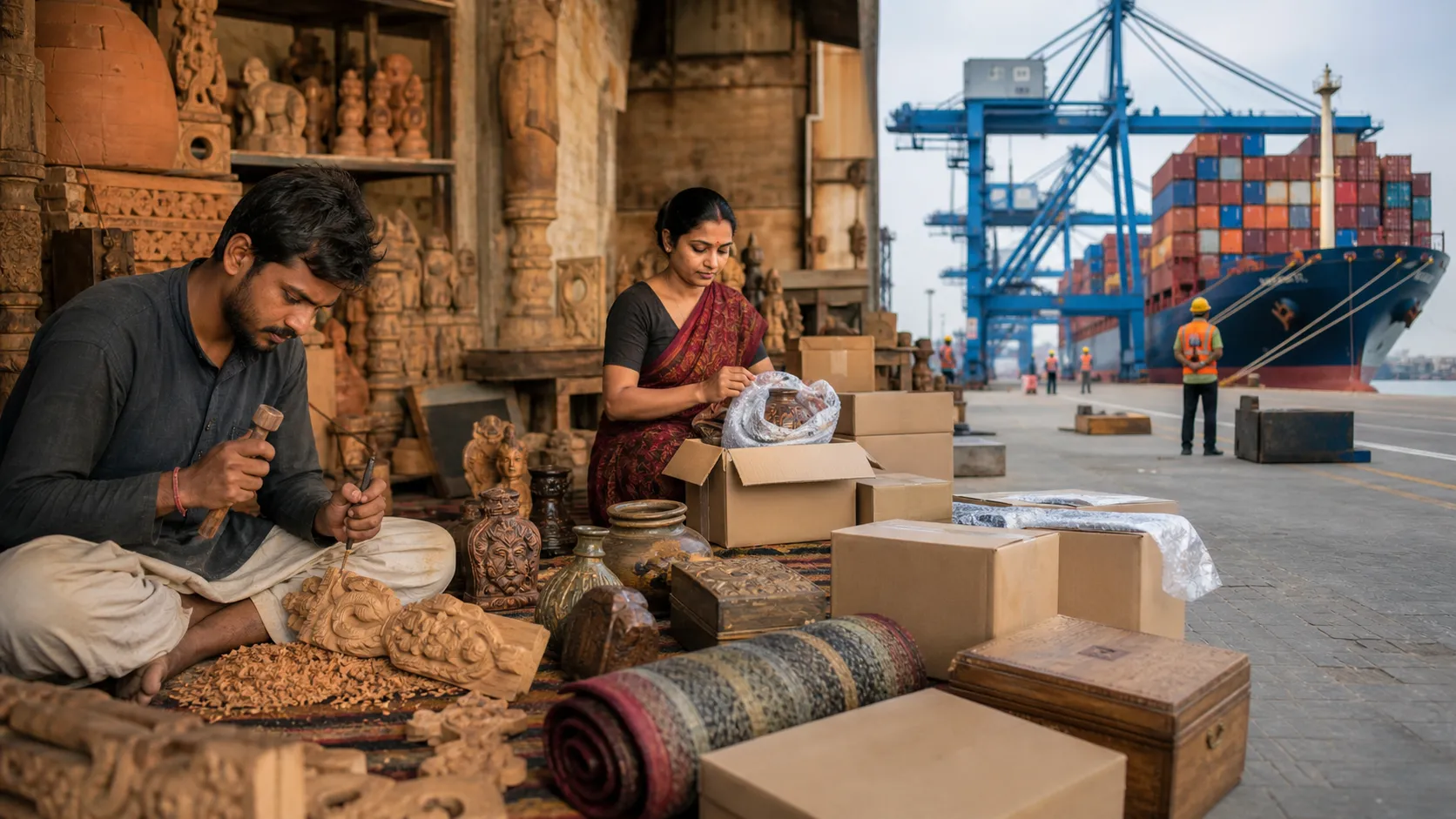
India's handicraft sector is one of the most extraordinary convergences of cultural heritage and commercial opportunity in the global export landscape. Over 7 million artisans work across India's craft clusters — from the brass workers of Moradabad to the marble inlay craftsmen of Agra, from the block printers of Jaipur to the handloom weavers of Varanasi and the cane furniture makers of Assam. The diversity is staggering, the skills accumulated over generations are irreplaceable, and the global market for authentic, artisan-made goods from India is growing every year as consumers in wealthy markets increasingly seek out the story, the provenance, and the human touch that mass-produced goods cannot offer.
India's handicraft exports stand at approximately USD 4–4.5 billion annually — a number that significantly underrepresents the sector's true potential. For context, China's comparable artisan and home décor export category is 5–6x larger by value. The gap is not a capability gap — India's crafts are world-class. It is a market access gap: too few artisans and craft enterprises have the business capability, the export compliance infrastructure, and the international marketing skills to convert their extraordinary craft skill into international commercial success.
This guide gives you the framework to bridge that gap — covering the compliance foundation, the market access strategy, the pricing approach, and the digital channels that are reshaping how Indian handicrafts reach global buyers.
India's Handicraft Export Landscape in 2026
Major Product Categories and Clusters
- Brass and metal artware: Moradabad (UP) — the "Brass City," exports brassware, metal figurines, and decorative items globally. USD 1B+ in annual exports from this single cluster.
- Carpets and rugs: Mirzapur-Bhadohi (UP), Jaipur (Rajasthan) — hand-knotted and hand-tufted carpets. India is the world's largest hand-knotted carpet exporter.
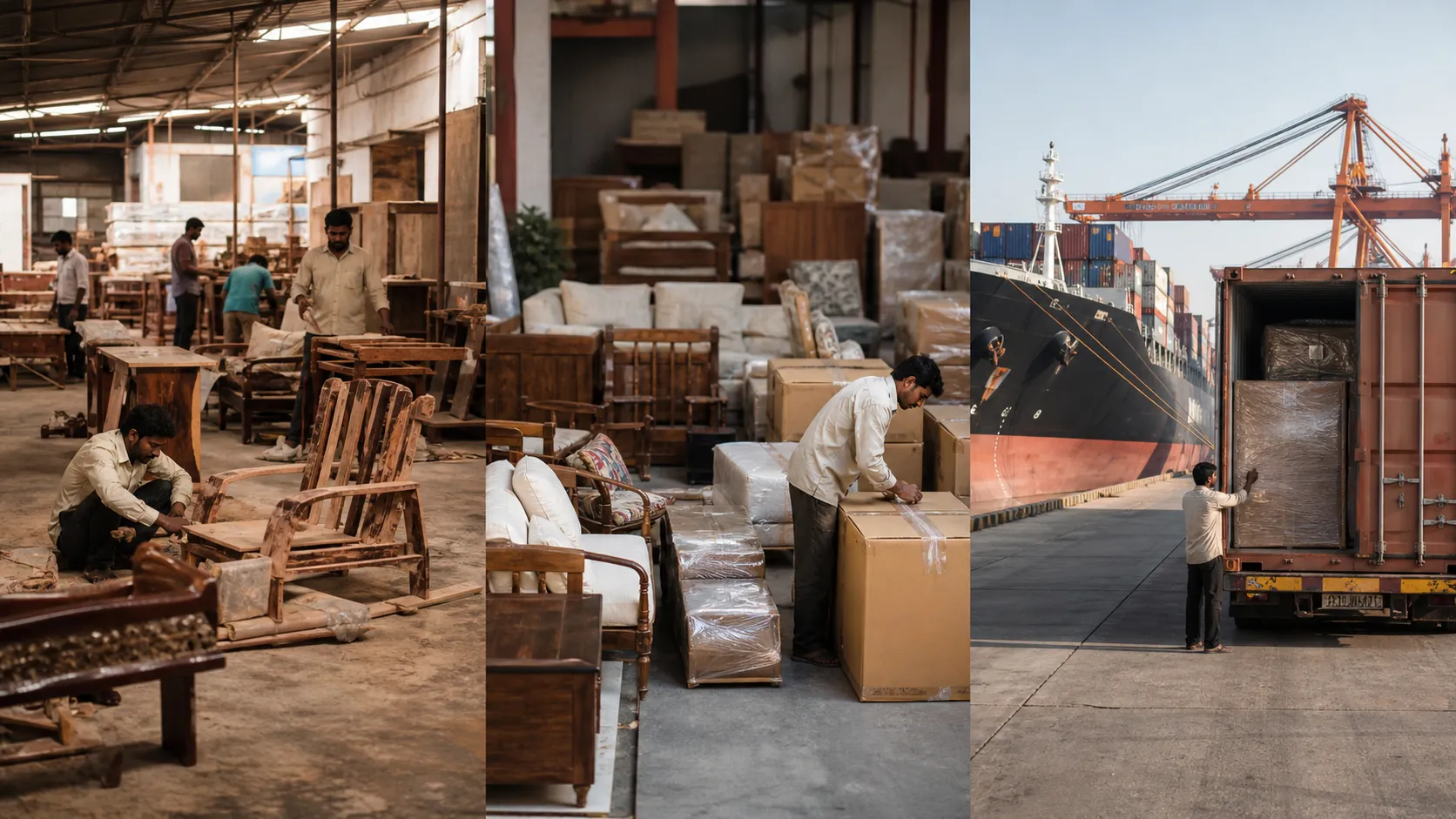
- Woodcraft and furniture: Jodhpur (Rajasthan), Saharanpur (UP), Bangalore (Karnataka). Sheesham, mango wood, and teak furniture for export.
- Textiles and embroidery: Lucknow (chikankari), Bhopal (zardozi), Kutch (mirror work), Phulkari (Punjab). Embroidered home textiles and fashion accessories.
- Pottery and ceramics: Khurja (UP), Jaipur (blue pottery), Kutch (rogan art). Decorative and functional ceramics.
- Stone and marble artware: Agra (marble inlay), Rajasthan (sandstone sculptures). Premium decorative items.
- Bamboo and cane: Northeast India — furniture, baskets, decorative items.
- Leather goods: Kolkata, Kanpur, Chennai — leather bags, wallets, footwear.
- Jewellery (fashion and ethnic): Jaipur, Delhi. Meenakari, kundankari, tribal jewellery.
- Paper machie and lacquerware: Kashmir — papier maché boxes, bowls, trays with traditional motifs.
Key Export Markets
India's primary handicraft export destinations:
- USA: Largest market — home décor, carpets, fashion accessories, ethnic jewellery
- Germany, UK, France, Netherlands: European markets with strong demand for fair-trade, sustainable, artisan goods
- UAE and Gulf: Strong demand for Indian metalware, home décor, and ethnic furnishings among the Gulf's large South Asian diaspora
- Australia and Canada: Growing markets with Indian diaspora and sustainability-conscious mainstream consumers
- Japan: Premium market for high-quality Indian crafts — block prints, handloom textiles, fine metalwork
EPCH: Your EPC for Handicraft Exports
The EPCH (Export Promotion Council for Handicrafts) is the EPC for all handicraft and home furnishings exporters. EPCH membership and RCMC are mandatory for FTP scheme claims and provide access to India's largest handicraft buyer promotion infrastructure.
EPCH Services That Matter
- IHGF (India International Home + Textile Show) and IHGF Delhi Fair: IHGF — the India International Home + Textile Show — is Asia's largest home, lifestyle, fashion, and textiles trade fair, organised biannually by EPCH in Greater Noida (Delhi NCR). Over 4,500 Indian handicraft exhibitors, 40,000+ trade visitors from 100+ countries. This is the single most important handicraft buyer meeting opportunity in the world. As an EPCH member, you can exhibit at IHGF at subsidised rates.
- Ambiente and other international fairs: EPCH organises India Pavilions at Ambiente (Frankfurt), Maison & Objet (Paris), NY NOW (New York), and Tendence (Frankfurt). MAI-funded participation subsidises costs for MSME handicraft exporters.
- Buyer databases and lead circulation: EPCH receives buyer inquiries from international buyers specifically seeking Indian handicraft suppliers and circulates them to members.
- Craft cluster development: EPCH funds common facility centres, training, and design development in major craft clusters — helping artisans upgrade skills and product designs to meet international market requirements.
How to join: epch.in → Membership → Apply Online. Required: IEC, GSTIN, details of handicraft products. RCMC fee: ₹5,000–25,000 depending on turnover category.
Geographical Indication (GI) Tags: Your Authenticity Credential
India has registered over 400 Geographical Indication (GI) tags for products — and the handicraft sector has the highest concentration of any category. GI tags are legally protected product designations confirming that a product originates from a specific geographic region and possesses qualities, reputation, or characteristics attributable to that origin.
Major Handicraft GI Tags Relevant for Exporters
- Darjeeling Tea (West Bengal)
- Kanjivaram/Kanchipuram Silk (Tamil Nadu)
- Banarasi Silk and Brocades (Uttar Pradesh)
- Pochampally Ikat (Telangana)
- Sambalpuri Saree (Odisha)
- Madhubani Painting (Bihar)
- Jaipur Blue Pottery (Rajasthan)
- Channapatna Toys (Karnataka)
- Agra Marble Inlay (Uttar Pradesh)
- Moradabad Metal Craft (Uttar Pradesh)
- Mirzapur Hand-Made Carpet (Uttar Pradesh)
- Phulkari (Punjab)
How GI Tags Create Export Value
For exporters, a GI tag does two things commercially:
1. Legal protection: A buyer in Germany cannot label a machine-made synthetic rug as "Mirzapur Hand-Made Carpet" — the GI designation is legally protected in countries that recognise India's GI registrations (EU, UK, Australia, and most WTO members through TRIPS provisions). This prevents cheaper imitations from flooding the market under your authentic product's name.
2. Price premium: GI-tagged products consistently command 15–50% price premiums in premium markets — because the GI credential signals authenticity, provenance, and the quality associated with that specific origin. A Kanjivaram silk saree with proper GI authentication commands a significantly higher price than "Indian silk saree" in EU boutiques. A Darjeeling first flush tea with GI mark commands premium pricing in Japanese specialty tea shops. Invest in GI compliance and make the GI tag visible in all your marketing materials.
How to Access GI Certification
Contact the relevant state GI registry or the Geographical Indications Registry of India (ipindia.gov.in). Your craft association (the producer society or artisan cooperative registered for the GI tag) can certify that your specific products are authentic GI-compliant products. Individual artisans and craft enterprises typically need to be members of the authorised producer association to use the GI mark commercially.
Pricing Handicraft Exports: The Value Story Approach
Handicraft export pricing differs from standard manufactured goods pricing in one fundamental way: you are not primarily competing on cost-per-unit — you are competing on story, authenticity, and aesthetic differentiation. This changes your pricing approach significantly.
The Cost-Up Floor
Like any export, start with your full landed cost calculation:
- Material cost (raw materials: brass, cotton thread, marble dust, etc.)
- Artisan labour cost — and this is where handicraft pricing differs from manufactured goods. Fair artisan wages are a selling point in premium markets, not a cost to minimise. European and US buyers of artisan goods increasingly pay for fair trade credentials that require documented minimum wage compliance.
- Workshop/production overhead
- Export packaging (presentation packaging matters enormously for handicrafts — a beautifully packaged product commands a higher price)
- Inland freight, CHA, port charges
- Bank charges and finance cost
- RoDTEP and Drawback income (deduct)
The Value Story Ceiling
What differentiates handicraft pricing from commodity pricing is that your ceiling is determined by the buyer's perceived value of the story, not just by competing supplier prices. A brass flower vase from Moradabad, sold with the story of the master craftsman who made it, the 400-year tradition of Moradabad's brass-making heritage, and a fair trade certification, can command USD 45 in a US home décor boutique. The same vase, sold as "brass decorative item, 15cm height" with no story, might achieve USD 18 from a mass importer.
Your job is to build the story into your product offering:
- Artisan profiles — name, location, craft tradition, years of experience
- Process documentation — photos or videos of the making process
- GI tag and certification documentation
- Fair trade certification or equivalent
- Heritage and provenance narrative
Buyers who are willing to pay for the story are self-selecting premium buyers. Buyers who only want the lowest price for a generic "decorative item" are not your market — trying to win price-only buyers with handicraft products is a strategy that leads to margin destruction and artisan exploitation.
Key Compliance Requirements for Handicraft Exports
REACH Regulation for Metal and Chemical Finishes (EU)
Any handicraft product exported to the EU that contains metals, dyes, or surface treatments must comply with REACH regulations. Specific concerns:
- Nickel: Severely restricted in EU for jewellery and items in prolonged skin contact. Many Indian fashion jewellery items use nickel alloys — test against EN 1811 before exporting to EU.
- Lead and cadmium: Restricted in EU — some traditional Indian ceramic glazes and metal alloys contain levels above EU limits. Test all ceramics and metal products destined for EU.
- Azo dyes: Certain azo dyes used in fabric dyeing are restricted in EU. Textiles and leather goods destined for EU must be tested against the restricted azo dye list.
CPSC Regulations for US (Children's Products)
If any of your handicraft products might be used by or near children — toys, soft furnishings, decorative items in nurseries — CPSC regulations apply in the US. Lead content in children's products is strictly limited (100 ppm). Test any product that could be used by children before exporting to the US.
CITES for Wildlife-Derived Products
Some traditional Indian craft materials fall under CITES (Convention on International Trade in Endangered Species) regulations — ivory (banned for commercial trade), certain woods (rosewood/dalberger), tortoiseshell, certain feathers. Before exporting any product that uses these or similar materials, verify CITES compliance. Many Indian craft exporters have faced customs seizures for products that inadvertently used restricted materials. When in doubt, switch to permitted alternative materials — synthetic ivory, alternative woods — before exporting.
Fumigation for Wooden Products
All wooden furniture and wooden handicraft items exported to the US, EU, Australia, and most other countries must have ISPM-15 treatment (heat treatment or methyl bromide fumigation) for the wooden packaging. The product itself (a wooden furniture piece or wooden decorative item) also needs treatment in many cases — particularly for Australia, which has extremely strict wood biosecurity. Confirm with your freight forwarder the specific treatment requirements for your destination market.
Digital Export Channels: Where Handicraft Buyers Shop Online
The handicraft sector is one of the best-positioned Indian export categories for digital and e-commerce channels — authenticity, craft narrative, and aesthetic differentiation translate powerfully into digital product presentations that justify premium pricing.
Etsy — The Artisan's Global Marketplace
Etsy hosts over 90 million active buyers globally specifically looking for handmade, vintage, and artisan goods. Indian artisans and craft exporters have found Etsy to be one of the most effective channels for reaching premium buyers in the US, UK, EU, Canada, and Australia.
How it works for Indian exporters: You open an Etsy seller account, list your products with detailed descriptions and high-quality photographs, and Etsy handles buyer discovery, payments (in USD/EUR/GBP), and reviews. Payments are received through Etsy Payments and transferred to your Indian bank account through Payoneer — FEMA-compliant when receipts are brought into India.
What makes Etsy work for Indian handicrafts: Detailed product stories (the craft tradition, the artisan, the process), excellent product photography, customer reviews that build credibility over time. Etsy's algorithm rewards engaged, high-review sellers — the first 30–50 sales are the hardest; after that, organic discovery accelerates.
Amazon Handmade — Scale Without Sourcing Dependency
Amazon Handmade is Amazon's artisan-specific marketplace — products must be genuinely handmade and sellers must apply and be accepted. Once approved, your products are listed on Amazon's platform with Amazon's fulfillment infrastructure available.
For Indian handicraft exporters, Amazon Handmade provides access to Amazon's enormous global buyer base — particularly US buyers — with the trust signals of the Amazon platform. The trade-off: Amazon takes a 15% commission and controls the buyer relationship. But for exporters who want scale rather than boutique positioning, Amazon Handmade is a viable path.
Own Website and Direct DTC
Building your own e-commerce website (on Shopify or WooCommerce) and acquiring buyers directly gives you full margin and full buyer relationship ownership. The trade-off: you must invest in your own buyer acquisition — through Instagram, Pinterest, content marketing, and paid advertising — rather than leveraging Etsy's or Amazon's existing traffic.
The typical progression for successful handicraft exporters: start on Etsy or Amazon to build reviews, revenue, and market knowledge. Build a direct website once you have an established product range and customer base. Use social media (Instagram, Pinterest — the visual platforms) to drive discovery for both channels.
B2B Digital Platforms for Larger Orders
For wholesale orders (minimum 50–200 pieces per design), B2B platforms relevant for Indian handicrafts:
- Faire.com: A US-based wholesale marketplace for independent retailers. Indian handicraft suppliers are successfully connecting with US boutiques and home décor stores through Faire.
- Handshake by Shopify: Shopify's wholesale marketplace for independent brands.
- IndiaMART Global and Alibaba: For larger wholesale quantities to importers.
Fair Trade Certification: The EU and US Premium Market Key
Fair Trade certification is increasingly the entry credential for premium EU and US retail channels for artisan goods. The two major certifications:
- Fairtrade International (FLO): The most internationally recognised fair trade certification. Covers price minimums for farmers and artisans, fair trade premium funds for community development, and social and environmental standards.
- WFTO (World Fair Trade Organisation): Organisation-level certification confirming the entire supply chain operates on fair trade principles — not just individual product certification.
Fair trade certification is particularly relevant for craft cooperatives and social enterprises working with marginalised artisan communities. Major US and EU retailers (Ten Thousand Villages, Traidcraft, SERRV, Oxfam shops, and hundreds of independent fair trade retailers) specifically source from WFTO or Fairtrade-certified suppliers and will not consider non-certified suppliers regardless of quality.
Frequently Asked Questions
How do I handle the minimum order quantity problem? International buyers want large quantities but I am a small artisan.
This is the central commercial challenge for small artisan exporters. Three practical approaches: (a) Cluster pooling: Work with other artisans in your craft cluster to fulfill larger orders collectively — one artisan takes the order, others contribute production. Your craft cooperative or NGO partner can facilitate this. (b) Target smaller buyers: Independent boutiques, online stores, and direct-to-consumer buyers through Etsy/Amazon accept smaller order quantities (5–50 pieces) that individual artisans can fulfill. These are better-fit buyers than mass importers. (c) Sample + commercial model: Sell small quantities initially (5–10 pieces for USD 30–80 each) to multiple smaller buyers; build the order size over time as the buyer builds confidence in your reliability and quality.
I make products with rosewood (Dalbergia). Can I still export them?
Rosewood (most Dalbergia species) is listed under CITES Appendix II, which means commercial international trade requires CITES permits from both India and the destination country. Obtaining CITES permits for commercial rosewood trade is administratively complex and some countries (EU) have effectively restricted rosewood imports to near-zero. The practical recommendation: transition to alternative woods (sheesham which has no CITES restriction, mango wood, reclaimed wood) for new product designs. For existing rosewood inventory, consult TRAFFIC India or a CITES compliance specialist before attempting to export.
What is the customs duty on Indian handicrafts in the US and EU?
US duties on Indian handicrafts vary by HS code — most decorative items face 0–7.5% MFN duty. Carpets face 0.9–4.4% for hand-knotted (lower than machine-made). Furniture faces 0–9.4%. No India-US FTA exists, so India pays the same MFN rate as most competitors (except CAFTA countries). EU duties similarly vary — most handicraft items face 1.7–6.5% under EU CET. India benefits from EU GSP for most handicraft categories, which reduces rates to approximately 0–4.4%. These duty levels are generally manageable — they are not a significant barrier relative to product differentiation opportunities in premium market positioning.
Conclusion
Indian handicrafts represent one of the most compelling propositions in global trade — irreplaceable craft heritage, living artisan traditions, extraordinary aesthetic diversity, and growing global demand for the authenticity and human story that mass-produced goods cannot provide. The gap between India's current USD 4.5 billion in handicraft exports and the sector's USD 15–20 billion potential is not a capability gap. It is a market access gap, a storytelling gap, and a compliance gap — all of which are bridgeable.
Join EPCH. Exhibit at IHGF. Invest in GI certification where applicable. Build your product story. Test your products for EU REACH and US CPSC compliance. Open an Etsy store for direct-to-consumer access. The global market for authentic Indian craftsmanship is real, growing, and genuinely waiting for more Indian artisans and craft enterprises who can present their extraordinary work with the marketing sophistication and compliance confidence that premium global buyers require.