Introduction
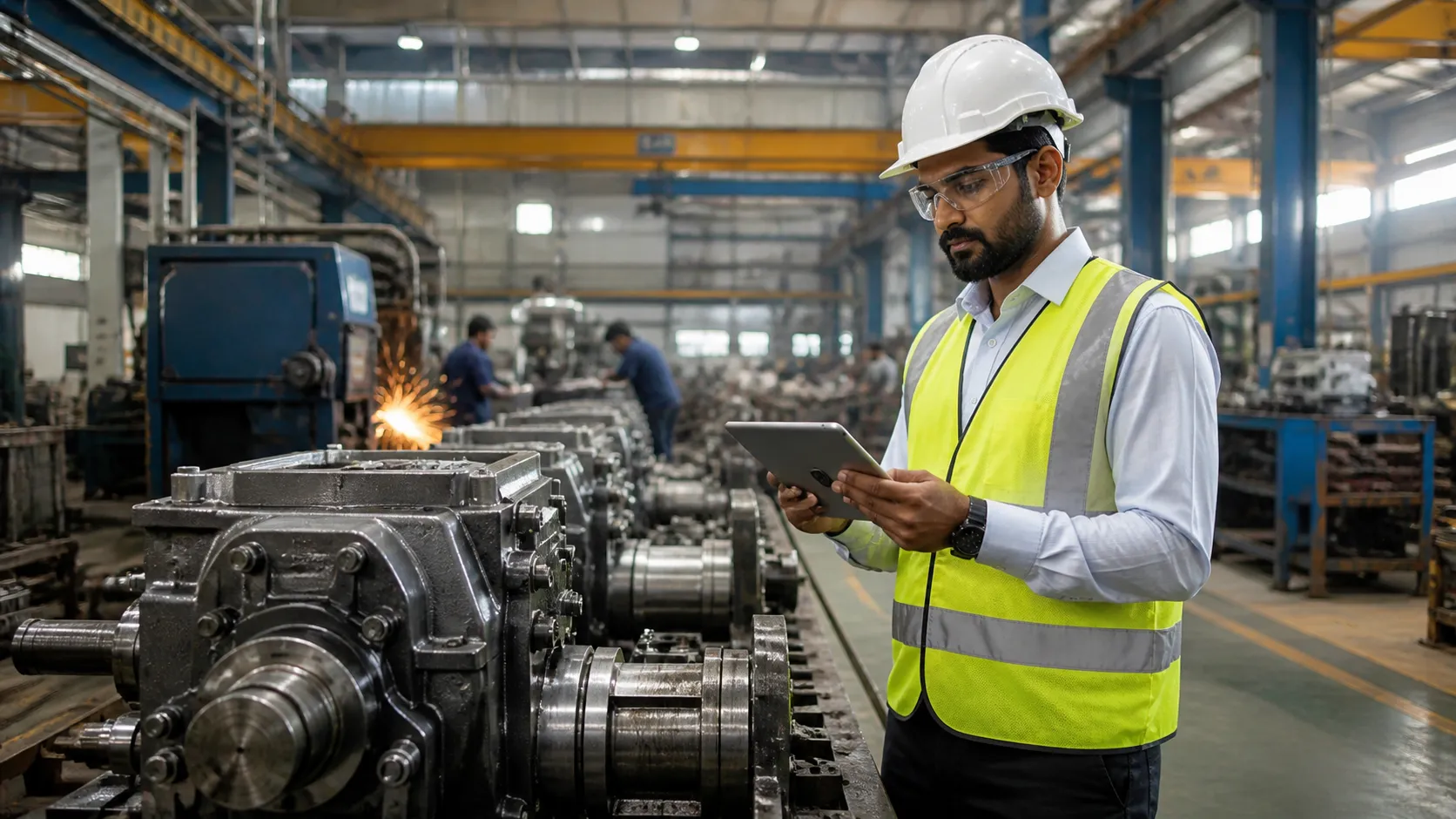
Engineering goods — the broad category covering machinery, equipment, auto components, castings and forgings, fasteners, pipes and fittings, electrical equipment, and related industrial products — is India's largest merchandise export category. At USD 100+ billion annually, it represents approximately 25–28% of India's total merchandise exports and directly employs tens of millions in manufacturing jobs across clusters in Pune, Chennai, Coimbatore, Rajkot, Ludhiana, Faridabad, and dozens of other industrial cities.
What distinguishes engineering goods export from other categories is the buyer relationship structure. Unlike consumer goods where you might sell to thousands of end consumers through distributors, engineering goods are typically sold to a smaller number of professional buyers — OEMs (Original Equipment Manufacturers), Tier 1 and Tier 2 component suppliers, industrial distributors, and EPC (Engineering, Procurement and Construction) companies. These buyers are sophisticated, require rigorous quality systems, and once qualified, tend to be long-term, repeat customers. One qualified auto component supply relationship with a European Tier 1 supplier can mean decades of recurring orders.
The China+1 strategy — where global manufacturers are actively reducing supply chain dependence on China — has created the best conditions for Indian engineering exporters in decades. This guide tells you how to position for it.
India's Engineering Export Landscape in 2026
Sub-Sector Breakdown
Engineering goods is not a monolithic category. The major sub-sectors by export value:
- Transport equipment: Auto components, two-wheeler parts, commercial vehicle components — USD 20–22 billion
- Machinery and instruments: Industrial machinery, pumps, compressors, process equipment — USD 15–18 billion
- Iron and steel products: Structural steel, pipes, tubes, wire rods — USD 12–15 billion
- Electrical machinery: Transformers, motors, switchgear, cables — USD 10–12 billion
- Castings and forgings: Grey iron, ductile iron, steel forgings for automotive and industrial — USD 5–7 billion
- Non-ferrous metals: Copper products, aluminium products — USD 4–6 billion
- Electronic components: PCBs, connectors, semiconductor components — USD 3–5 billion (growing rapidly under PLI)
- Hand tools and fasteners: Cutting tools, hand tools, industrial fasteners — USD 3–4 billion
Where India Is Genuinely Competitive
India's engineering competitiveness is concentrated in:
- Castings and forgings: India has the world's second-largest foundry industry. Indian castings command quality-competitive pricing in global markets. Coimbatore (pumps and auto castings), Rajkot (ferrous and non-ferrous castings), Pune (auto forgings), and Ludhiana (cycle and auto components) are globally recognised clusters.
- Auto components: India's auto component industry has invested heavily in quality — 1,000+ IATF 16949-certified plants supply global OEMs. Indian auto components supply Maruti-Suzuki, Hyundai, Renault-Nissan, and their global supply chains. The India-made part credibility has been built over decades.
- Precision machined components: Cost-competitive precision machining for aerospace, defence, and industrial applications is a growing Indian strength — particularly as US and European OEMs seek to qualify Indian suppliers to reduce China dependence.
- Pumps: Coimbatore is the "Pump City" — Indian pumps export to 150+ countries and hold significant global market share in agricultural and industrial pump categories.
- Hand tools: Jalandhar district (Punjab) is one of the world's largest hand tool manufacturing clusters — spanners, pliers, files, wrenches at highly competitive prices.
The China+1 Opportunity: Why 2026 Is Different
The US-China trade war that began in 2018 and has escalated through 2024–26 has created structural demand for India-sourced engineering goods in two ways:
Direct tariff arbitrage: Chinese engineering goods face 25–35% additional Section 301 tariffs in the USA on top of standard MFN rates. Indian engineering goods face only standard MFN rates (typically 0–7.5% for most categories). For auto components, castings, and industrial machinery where Chinese competitors previously had a price advantage, the tariff differential now puts Indian goods at price parity or better in the US market.
Supply chain diversification strategy: Beyond price, US and European OEMs have explicitly adopted China+1 strategies — qualifying second and third suppliers in non-Chinese locations for every critical component category. This means active, funded supplier qualification programmes at major automotive companies (GM, Ford, Stellantis, Volkswagen, Toyota), industrial companies (Caterpillar, Deere, Parker Hannifin), and defence contractors. Indian engineering companies with the right certifications are being actively sought out as these programmes progress.
The window is real, the demand is active, and the Indian engineering industry has the capability to serve it. What is required is proactive positioning — reaching out to US and European procurement teams, demonstrating certification credentials, and going through the qualification process rather than waiting for buyers to find you.
Quality Certifications: The Entry Tickets to Global Engineering Supply Chains
In engineering goods exports, certifications are not marketing assets — they are functional entry requirements. Without specific certifications, you are literally not eligible to supply to major buyers in regulated markets. Here is the certification landscape by sector:
ISO 9001 — The Universal Foundation
ISO 9001 certification (Quality Management System) is the baseline quality certification for virtually all industrial and engineering exports. It confirms that your organisation has documented, consistent quality processes. Without ISO 9001, you are not in consideration for any serious industrial buyer relationship globally.
How to get it: Choose an accredited certification body (Bureau Veritas, TÜV SÜD, SGS, DNV, Intertek). The certification process involves a documentation review, a Stage 1 audit, a Stage 2 certification audit, and annual surveillance audits. Initial certification takes 3–6 months and costs ₹1–3 lakh depending on your facility size. Renewal every 3 years.
IATF 16949 — Mandatory for Automotive Supply Chains
IATF 16949 is the automotive-specific quality management standard — the mandatory certification for any supplier to global automotive OEMs (Tier 1 suppliers) or their Tier 2 suppliers. It is based on ISO 9001 with additional automotive-specific requirements for production part approval (PPAP), failure mode and effects analysis (FMEA), and advanced product quality planning (APQP).
Without IATF 16949, you cannot supply to automotive Tier 1 suppliers such as Bosch, Denso, Magna, Lear, Continental, or any of the major global auto component companies. Full stop — not as a preference, as a contractual requirement.
How to get it: Requires ISO 9001 as a prerequisite. Additional time and cost above ISO 9001 — typically 6–12 months for IATF 16949 implementation if ISO 9001 is already in place. Cost: ₹2–6 lakh for certification. Annual surveillance required; full recertification every 3 years.
AS9100 — For Aerospace and Defence
AS9100 is the quality management standard for the aerospace and defence industry — the equivalent of IATF 16949 for the aerospace supply chain. Required for any supplier to aerospace OEMs (Boeing, Airbus, Safran, GE Aviation, Honeywell Aerospace) and their Tier 1/2 suppliers.
India's aerospace manufacturing is growing under the Make in India and Aatmanirbhar Bharat defence programmes. Indian companies like Tata Advanced Systems, Mahindra Defence, Bharat Forge, and dozens of SME aerospace component suppliers hold AS9100 certifications and supply global aerospace programmes.
CE Marking — For Products Sold in the EU
CE marking is required for most machinery and electrical/electronic equipment sold in the European Union and EEA. It indicates that the product meets EU safety, health, and environmental requirements. CE marking is not a voluntary quality mark — it is a legal requirement for covered products to enter the EU market.
Self-declaration vs Notified Body: For many machinery categories, CE marking can be self-declared by the manufacturer based on conformity with relevant EU harmonised standards. For higher-risk categories (lifts, pressure vessels, medical devices), a Notified Body (third-party EU-approved assessment body) must assess the product. Work with a CE marking consultant to determine which pathway applies to your specific product.
UL Listing — For the US Market
UL (Underwriters Laboratories) listing is not a legal requirement for all products in the USA — but it is a practical requirement for electrical and electronic products because US distributors and retailers typically will not stock products without UL or equivalent (ETL, CSA) safety certification. For industrial machinery and equipment, UL listing gives US buyers confidence in safety compliance.
BIS Certification — For Certain Categories in India
While primarily a domestic India requirement, BIS (Bureau of Indian Standards) certification for specific product categories may be referenced by some buyers as evidence of quality compliance. Not typically a requirement for exports but worth understanding for categories where BIS certification is mandatory for domestic sale.
EEPC India Quality Mark
The EEPC India Quality Mark is an Indian engineering export quality brand — recognising exporters who meet EEPC's quality criteria. It functions as a quality credential specifically for engineering goods exports, recognised by buyers in developing markets particularly. While not equivalent to ISO 9001 or IATF, it adds credibility in markets where international certification is not yet a standard requirement.
Key Export Markets for Indian Engineering Goods
USA — China+1 Opportunity Market
The USA is India's largest or second-largest engineering goods export destination. Auto components, castings, forgings, industrial machinery, and electronic components all export significantly to the US.
The Section 301 tariff environment has significantly improved India's competitiveness in the US market relative to Chinese suppliers. Indian engineering exporters should actively target US manufacturers that have published China diversification strategies — Caterpillar, John Deere, Parker Hannifin, Parker Lord, Eaton, Emerson Electric, and auto OEMs' tier 1 supplier bases.
EU — Large Market, Strong Quality Requirements
EU countries collectively represent the world's largest industrial economy. German, French, Italian, and Spanish manufacturers source auto components, precision machinery, castings, and industrial equipment from India at scale. CE marking and IATF 16949/ISO 9001 are entry requirements for most EU industrial supply chains.
Germany is the highest-priority EU market for most Indian engineering exporters — Hannover Messe (the world's largest industrial trade fair, held annually in April) is the single best opportunity to meet German and European industrial buyers at scale.
Middle East — Infrastructure and Construction
Gulf countries — UAE, Saudi Arabia, Qatar, Kuwait — have enormous infrastructure, construction, and industrial development programmes. Demand for pipes and fittings, valves, pumps, structural steel, construction equipment, and electrical equipment is sustained and growing. India-UAE CEPA provides zero duty access for most Indian engineering goods entering UAE. Saudi Arabia, Kuwait, and Qatar have MFN rates typically 5% — no FTA, but manageable duty levels.
Africa — Industrial Development
African countries — Nigeria, Ethiopia, Kenya, South Africa, Egypt — are investing in industrialisation. Demand for industrial machinery, power generation equipment, construction equipment, and basic engineering components is growing. India has natural advantages: competitive pricing, technical familiarity (many African engineers trained at Indian institutions), and the Exim Bank's national lines of credit that facilitate Indian exports to African infrastructure projects.
Southeast Asia — Supply Chain Integration
Vietnam, Indonesia, Thailand, and Malaysia are rapidly industrialising and serve as manufacturing hubs for global OEMs. Indian engineering components — auto parts, electrical components, industrial consumables — increasingly supply these manufacturing clusters. India-ASEAN FTA provides preferential rates for Indian engineering goods in ASEAN markets.
EEPC India: Your EPC for Engineering Exports
The EEPC India (Engineering Export Promotion Council) is the EPC for all engineering goods exports. Registration with EEPC and obtaining RCMC is required for claiming FTP scheme benefits on engineering exports.
EEPC services of particular value:
- Participation in Hannover Messe, ADIPEC, BAUMA, EMO, and other major industrial trade fairs — India Pavilion
- Buyer-seller meets in USA, EU, Africa, and Middle East
- Export performance data and market intelligence specific to engineering sub-sectors
- EEPC India Quality Mark certification
- Government representation for engineering export policy — tariff, anti-dumping, market access barriers
How to Find Engineering Goods Buyers
Hannover Messe — The Premier Industrial Fair
Hannover Messe (April, Hannover, Germany) is the world's largest industrial trade fair — 6,000+ exhibitors, 200,000+ visitors including procurement managers from every major industrial company globally. India has one of the largest national pavilions at Hannover. For any Indian engineering exporter targeting European and US industrial buyers, Hannover Messe is the most concentrated opportunity available. EEPC India organises India Pavilion participation with MAI scheme subsidy.
Import Data Tools — Finding Active Buyers
Use ImportYeti.com (free) to identify US manufacturers currently importing your specific engineering component from China. Search by HS code and filter for Chinese origin importers. These companies are your primary targets for outreach — they are active buyers, they know what the product is, and they are in markets where China+1 sourcing diversification creates a specific need you can address. This is the most targeted buyer identification method for US-focused engineering export development.
LinkedIn Outreach to Procurement Managers
Procurement managers, supply chain directors, and sourcing managers at manufacturing companies are active on LinkedIn. Search LinkedIn with: "Procurement Manager" + "automotive components" + "USA" or "Supply Chain Director" + "industrial machinery" + "Germany." Your outreach message should be specific: reference their company's supply chain (you can see their public announcements about China diversification), state your IATF 16949 / ISO 9001 certification, and ask for a 15-minute call to share your specifications and pricing.
Direct OEM and Tier 1 Supplier Portals
Major automotive OEMs (General Motors, Ford, Volkswagen, Toyota) and Tier 1 suppliers (Bosch, Denso, Continental, Magna) have online supplier registration portals. These require IATF 16949 certification, financial stability documentation, and technical capability evidence. The registration process is demanding — but qualifying as a registered supplier makes you visible in their active sourcing databases when they open new programmes.
Frequently Asked Questions
I manufacture general industrial components — not specifically automotive or aerospace. Which certification should I get first?
ISO 9001 is your foundation and should be your first certification. It takes 3–6 months, costs ₹1–3 lakh, and qualifies you for a broad range of industrial buyer relationships globally. Once ISO 9001 is in place, assess your primary target market: if automotive, invest in IATF 16949 next. If EU-bound machinery or electrical products, work on CE marking. If US electrical products, work toward UL listing. Prioritise based on your buyer pipeline, not abstract certification value.
How do I demonstrate PPAP (Production Part Approval Process) compliance for automotive buyers?
PPAP is a process — not a separate certification — by which you formally document and prove that your production process is capable of consistently producing parts to the buyer's specification. A PPAP submission includes dimensional reports, material certifications, process capability studies (Cpk values), process flow diagrams, control plans, and sample parts. PPAP is part of the IATF 16949 framework and cannot be done without solid quality systems in place. If you are new to PPAP, work with your IATF 16949 certification consultant to build the PPAP capability alongside the certification process.
My foundry produces castings for both domestic and export. Does my domestic quality system support export quality requirements?
It depends on your domestic buyer's requirements. If you supply to Maruti-Suzuki, Tata Motors, or other Indian OEMs through their supplier qualification process, you may already have QMS requirements close to IATF 16949 standards. If your domestic sales are through traders or for less demanding industrial applications, there is likely a gap between your current quality system and what international buyers require. The most efficient path: get your system independently assessed by an IATF 16949 consultant before starting the formal certification process. The consultant will identify the gaps and help you close them systematically.
Section 301 tariffs on Chinese goods benefit India — but what if the US lifts those tariffs?
This is a legitimate risk to monitor. US-China trade policy has oscillated — tariffs could be reduced in a future trade deal scenario. However, two factors suggest the structural opportunity for Indian engineering exports is durable even if tariffs reduce: (1) supply chain diversification away from China is driven by geopolitical risk (not just tariff costs) — US manufacturers want to reduce concentration risk regardless of tariff levels, and (2) once Indian suppliers are qualified in US manufacturers' supply chains, the switching cost creates a degree of supply relationship stickiness. Build your US market position on genuine quality and reliability, not exclusively on tariff arbitrage.
Conclusion
Engineering goods export is a relationship business more than a price business. The entry barrier — quality certifications, qualification processes, technical documentation — is genuine and takes time and investment to clear. But once cleared, the buyer relationships that result are durable, high-volume, and financially rewarding in a way that price-driven commodity exports are not.
The China+1 opportunity is real and present in 2026. US and European manufacturers are actively qualifying Indian engineering suppliers in every category. The window to establish these relationships — before the supply chains are set and the qualifying slots are filled — is available now.
Invest in ISO 9001 as your foundation. Add IATF 16949 if automotive is your target. Use import data tools to find active US buyers currently sourcing from China. Attend Hannover Messe under the India Pavilion. Register with EEPC India. And approach every buyer conversation with the confidence that India's engineering manufacturing capability — proven by decades of supply to domestic OEMs — is genuinely world-class.