Introduction
India's furniture and home furnishings export sector sits at an interesting junction in 2026. On one side, the global home furnishings market — estimated at USD 700+ billion — is experiencing a sustained shift toward artisan-made, sustainably sourced, and design-distinctive products as consumers in affluent markets push back against the homogenous aesthetic of flat-pack mass-market furniture. On the other side, India's furniture export industry — at USD 2.5–3 billion annually — is growing but capturing only a fraction of the opportunity that its manufacturing base, design heritage, and material advantages should enable.
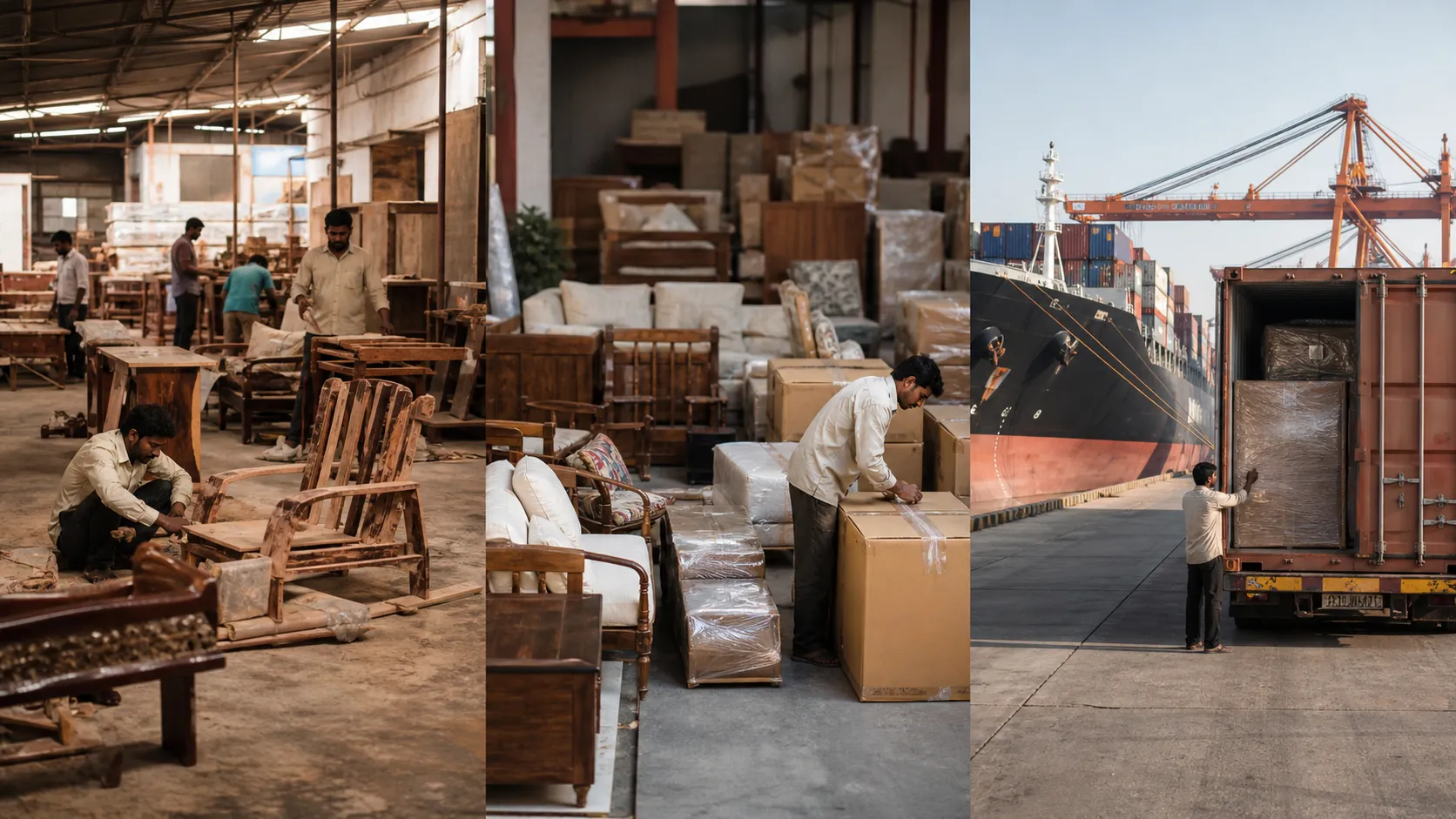
The gap is not a quality gap. Jodhpur's sheesham and mango wood furniture is genuinely beautiful and well-crafted. Saharanpur's carved woodwork is world-class. The furniture clusters of Bangalore, Chennai, and Pune produce export-quality contemporary pieces. The gap is in market access, compliance preparedness, and the ability to present Indian furniture to international buyers through the channels and with the certifications they require.
This guide covers the complete framework for furniture and home furnishings exports — from the compliance requirements that are non-negotiable in major markets to the buyer channels that are actively sourcing from India.
India's Furniture Export Landscape in 2026
Major Clusters and Product Categories
- Jodhpur (Rajasthan): India's largest furniture export cluster. Known for sheesham (Indian rosewood alternative), mango wood, and recycled/reclaimed wood furniture. Produces colonial, rustic, distressed, and contemporary styles. Exports primarily to USA, UK, Australia, Germany. Approximately USD 800M–1B in annual export value.
- Saharanpur (Uttar Pradesh): Carved wooden furniture and decorative woodwork. Intricate hand-carved designs in sheesham, teak, and mango. Primarily USA and Middle East markets.
- Bangalore and Chennai: Contemporary and modern furniture for export. Office furniture, upholstered seating, modular furniture. Growing export base for European and US corporate buyers.
- Pune and Mumbai region: Upholstered furniture, contemporary home furnishings, contract furniture for hospitality projects.
- Northeast India (Assam, Manipur, Meghalaya): Bamboo and cane furniture — growing export category with strong sustainability credentials.
- Kerala: Teak furniture (from certified plantations), coir products, natural fibre furnishings.
Home Furnishings (Soft Furnishings)
Beyond wooden furniture, India's home furnishings export category includes:
- Carpets and rugs: Covered in the handicraft guide — hand-knotted (Mirzapur/Bhadohi), hand-tufted, flatweave dhurries
- Bed linen and bath: Karur (Tamil Nadu) — world-leading cluster for cotton bed linen, towels, and kitchen textiles
- Cushion covers, throws, and decorative textiles: Jaipur block-printed textiles, Rajasthani patchwork, embroidered home décor
- Curtains and window furnishings: From multiple textile clusters
- Tableware and home accessories: Brass and metalware from Moradabad, ceramics from Khurja
Non-Negotiable Compliance Requirements
ISPM-15: The Foundation for Wooden Furniture Exports
Every wooden furniture or wooden packaging item exported internationally must comply with ISPM-15 (International Standards for Phytosanitary Measures No. 15) — the global standard for treating and marking wood to prevent the international spread of insects, parasites, and plant diseases through wooden packaging and wood products.
ISPM-15 compliance requires:
- Treatment: Either Heat Treatment (HT) — heating wood to 56°C core temperature for 30 minutes — or Methyl Bromide (MB) fumigation (being phased out in many countries). Heat treatment is the preferred and increasingly mandated method.
- Marking: The IPPC (International Plant Protection Convention) mark must appear on every treated wooden item — showing the treatment type (HT or MB), the country code (IN for India), and the producer/treatment provider code.
- Certification: The treatment facility must be registered with India's NPPO (National Plant Protection Organisation) under the Ministry of Agriculture.
Who performs ISPM-15 treatment in India: Registered ISPM-15 treatment providers, including fumigation companies and heat treatment facilities. Your freight forwarder can advise on approved providers near your manufacturing cluster. Allow 1–3 days for treatment in your production/packing timeline.
Markets where ISPM-15 is most strictly enforced: Australia (most strict — will confiscate and destroy non-compliant wooden items), USA, EU, Japan, New Zealand. Do not export wooden furniture to these markets without ISPM-15 treatment — customs seizure and destruction at your cost is the consequence.
REACH Compliance for Finishes and Coatings
Furniture exported to the EU is subject to REACH regulations for any chemical substances in the product — primarily surface finishes, coatings, varnishes, stains, adhesives, and upholstery treatments.
Key REACH concerns for furniture:
- Formaldehyde: Used in adhesives and some wood finishes. EU has strict formaldehyde emission limits for wood-based panels (E1 standard). Furniture made with plywood, MDF, or particleboard must use E1 or E0 grade panels.
- VOCs (Volatile Organic Compounds): EU Paints Directive limits VOC content in coatings. Furniture finished with high-VOC paints may not comply.
- SVHC substances: Check ECHA's SVHC Candidate List against the chemicals in your finishes. If any SVHC is present above 0.1% by weight of the article, notification requirements apply.
- Biocides: Preservative treatments for wood must comply with the EU Biocidal Products Regulation.
Request Safety Data Sheets from all your paint, varnish, adhesive, and coating suppliers and have these reviewed against EU REACH requirements before exporting. For volume EU business, engage a REACH compliance consultant to conduct a systematic product compliance review.
US Formaldehyde Standards (CARB)
For furniture exported to the USA containing composite wood products (plywood, MDF, particleboard), the California Air Resources Board (CARB) ATCM (Airborne Toxic Control Measure for Formaldehyde) is the de facto national standard — major US retailers and buyers require CARB Phase 2 compliance or equivalent, even for products sold outside California.
CARB Phase 2 requires very low formaldehyde emissions from composite wood panels. Your panel supplier must provide CARB certification for their panels, and the final product may need testing. This is increasingly a US retailer requirement — Walmart, Target, Home Depot, and most US furniture retailers include CARB compliance in their vendor requirements.
CITES for Restricted Wood Species
As noted in the handicraft guide: Rosewood (Dalbergia species) is listed under CITES Appendix II — commercial international trade requires CITES export/import permits. This directly affects Jodhpur's traditional sheesham furniture production, since sheesham is a Dalbergia species.
Practical guidance for Jodhpur exporters:
- Dalbergia sissoo (sheesham) was added to CITES Appendix II in 2017 — commercial exports require CITES permits from India's CITES Management Authority (Ministry of Environment)
- EU, USA, Australia, and most major markets enforce CITES controls on rosewood imports
- Many Jodhpur exporters have already transitioned to mango wood, acacia, teak (from certified plantation sources), and reclaimed wood for export products — these face no CITES restrictions
- If you are still using sheesham/Dalbergia, engage with India's CITES Management Authority for current permit procedures
FSC Certification: The Sustainability Credential
The FSC (Forest Stewardship Council) certification is the leading international standard for responsible forest management. FSC-certified wood comes from forests managed to FSC's environmental and social standards. FSC Chain of Custody (CoC) certification tracks certified wood through the supply chain from forest to final product.
FSC certification is increasingly required or preferred by:
- European furniture retailers and brands (IKEA sources only FSC-certified wood; many other EU retailers have FSC commitments)
- US sustainable home goods retailers
- Corporate furniture buyers with sustainability procurement policies
- Government procurement in EU and UK — public sector furniture contracts increasingly specify FSC
How to get FSC CoC certification: Apply to an FSC-accredited certification body (Bureau Veritas, SGS, Rainforest Alliance, and others accredit in India). The certification process involves an audit of your supply chain documenting wood sourcing. Annual surveillance audits are required. Cost: USD 1,500–5,000 per year for most Indian furniture manufacturers.
FSC certification is the single most commercially impactful certification investment for Indian furniture exporters targeting EU and US premium markets. It opens doors to buyers who will not consider non-certified suppliers and typically enables a 10–20% price premium over non-certified equivalents.
Fire Retardancy Standards for Upholstered Furniture
Upholstered furniture (sofas, chairs, mattresses) exported to the UK and USA must meet fire retardancy standards:
- UK: The Furniture and Furnishings (Fire Safety) Regulations 1988 (as amended) require that upholstered furniture sold in the UK meet specific flammability tests. UK regulations are among the strictest in the world. Sofas and chairs must use fire-resistant filling and cover fabrics, or have an interliner barrier system.
- USA: California TB 117-2013 is the most relevant flammability standard for upholstered seating. Federal standard 16 CFR 1634 applies to mattresses. Many US retailers specify California TB 117 compliance even for products sold nationally.
- EU: EU fire standards for furniture are currently being harmonised — individual member state standards apply in some countries. The UK standard is stricter than most EU standards.
If you manufacture or export upholstered furniture to the UK or USA, have your filling materials, cover fabrics, and finished products tested against the applicable standards at an accredited test laboratory. Testing is typically ₹10,000–50,000 per product type depending on complexity.
EPCH Membership for Home Furnishings Exporters
EPCH (Export Promotion Council for Handicrafts) is the relevant EPC for furniture and home furnishings exporters — in addition to artisan handicrafts, EPCH covers the broader home décor and furnishings category.
The IHGF (India International Home + Textile Show) — the biannual trade fair organised by EPCH at India Expo Centre, Greater Noida — is the most important buyer meeting opportunity for Indian furniture and home furnishings exporters. 4,500+ Indian exhibitors, 35,000–40,000 trade visitors from 100+ countries attend IHGF's Spring and Autumn editions. Major US retailers (World Market, Pier 1, HomeGoods, TJX), European importers, and Australian and Middle East distributors walk IHGF specifically looking for Indian furniture and home décor suppliers.
Exhibiting at IHGF — as an EPCH member at subsidised rates — is the single highest-return marketing investment available to Indian furniture exporters. A well-presented IHGF stall can generate more buyer leads in three days than months of cold outreach through other channels.
Finding Furniture and Home Furnishings Buyers
IHGF and International Trade Fairs
Beyond IHGF, relevant international furniture trade fairs:
- Ambiente (Frankfurt, February): World's leading consumer goods and home décor fair. EPCH organises India Pavilion. Essential for European furniture and home décor buyers.
- High Point Market (North Carolina, October and April): The world's largest furniture trade show — twice yearly in High Point, NC. The US furniture industry concentrates here. IHGF + High Point Market are the two essential trade fair investments for US-focused Indian furniture exporters.
- Maison & Objet (Paris, January and September): Premium French/European design and home décor market. Good for high-design, premium-positioned Indian furniture brands.
- Interior Lifestyle Tokyo (June): Japan's leading home furnishings trade show. Good for Indian exporters targeting the Japanese market's premium artisan aesthetic.
- Index Dubai (May): The Middle East's largest furniture and interior design trade show. Key for Indian exporters targeting Gulf markets.
US Furniture Importers and Distributors
The US market structure for imported furniture involves:
- Mass-market retailers: Walmart, Target, Costco, HomeGoods/TJX — high volumes, very price-sensitive, CARB and CPSC compliance mandatory
- Mid-market specialty retailers: World Market/Cost Plus, Pier 1 (restructuring), Crate & Barrel, Pottery Barn — more design-focused, better margins, FSC and sustainability preferences
- Online furniture retailers: Wayfair, Overstock — significant volumes through e-commerce with direct supplier programmes
- Interior designers and commercial contract: Hotel/restaurant furniture projects — typically specified by designers, executed through contract furniture dealers
Use ImportYeti.com to identify which US companies currently import wooden furniture from India — search by HS code 9403 (wooden furniture). This shows you who is already buying, at what frequency, from which Indian suppliers, giving you a verified target list for your outreach.
Faire.com for Independent Retailers
Faire is a US-based wholesale marketplace connecting independent retailers with suppliers. Indian home décor and furniture companies are successfully reaching US boutiques and independent home stores through Faire — order sizes are smaller (USD 500–5,000 per order) but margins are better and buyer quality is high.
Pricing Furniture Exports: Key Considerations
Furniture pricing for export has specific cost components that new exporters frequently underestimate:
- Packaging for sea freight: Furniture requires substantial export packaging — bubble wrap, foam, corrugated cardboard, wooden crating for fragile items. Export packaging cost can be 8–15% of product value for complex pieces. This is significantly higher than domestic packaging — do not use domestic packaging cost estimates for export pricing.
- ISPM-15 treatment: Adds ₹500–2,000 per container or per lot depending on treatment method. Include in your costing.
- Freight: Furniture is voluminous — a 40ft container of wooden furniture weighs only 8,000–12,000 kg but fills the container. You almost always hit the volume limit before the weight limit. CBM-based LCL rates or 40ft FCL rates must be accurately calculated for your specific furniture dimensions.
- Destination assembly instructions: US and EU buyers often require assembly instructions in English (and other languages) — a small but real cost if you outsource document production.
- Testing and certification costs: CARB testing, FSC certification, ISPM-15 treatment facility fees — amortise these across your annual export volume for per-unit cost calculation.
Frequently Asked Questions
I manufacture furniture with both sheesham (Dalbergia) and mango wood. Should I stop using sheesham?
For export to US, EU, Australia, and most major markets: yes, transitioning away from sheesham for export products is the practical recommendation. The CITES permit process for Dalbergia exports is administratively complex, the permit requirement adds time and cost to every shipment, and some buyers will not accept CITES-covered wood regardless of permit compliance due to reputational risk concerns. Mango wood, acacia, teak from certified plantation sources, and reclaimed/recycled wood are all commercially viable alternatives with no CITES restrictions. For domestic sales or for export to markets that do not enforce CITES, sheesham can continue — but segregate your product lines clearly.
What is the HS code for wooden furniture and what duty does it face in the US?
Wooden furniture for domestic use (beds, wardrobes, dining tables, chairs) falls primarily under HS Chapter 94 — HS code 9403 for other furniture and parts. US duties under MFN on wooden furniture range from 0% (for some categories) to 3.2–9.4% depending on the specific sub-heading. India does not have an FTA with the USA, so full MFN rates apply. Use Eximigo's Tariff Checker with your specific 6-digit HS code to check the exact MFN rate applicable to your furniture category.
My furniture has upholstery from China — does this affect my "Made in India" certification of origin?
For Certificate of Origin purposes, products must undergo "substantial transformation" in India to qualify as Indian origin. If the final product is substantially manufactured in India (wood structure made in India, upholstered in India) with imported fabric as one of several inputs, it generally qualifies as Indian origin under the standard substantial transformation test. The Rules of Origin for most markets use either Change in Tariff Classification (CTC) or Value Added Content (VAC) criteria — a sofa whose wooden frame, filling, and manufacturing are Indian-origin, with imported Chinese fabric as an input, would typically pass the CTC test (the fabric HS heading changes to furniture HS heading through the manufacturing process). Confirm your specific product's ROO compliance with your EPC or customs consultant before claiming Indian origin on products with significant imported component content.
Conclusion
India's furniture and home furnishings sector has the manufacturing capability, the design heritage, the material advantages, and the artisan skill base to be a USD 10–15 billion export industry. The current USD 2.5–3 billion represents years of underinvestment in market access infrastructure — trade fair presence, compliance preparedness, and the storytelling capability that premium markets require.
The compliance foundation is achievable and investment-worthy: ISPM-15 for wood treatment, FSC certification for sustainability credibility, CARB compliance for US composite wood, REACH review for EU finishes, fire retardancy testing for UK/US upholstered furniture. These investments, once made, are durable competitive advantages that open doors to premium buyer relationships that less-compliant competitors cannot access.
Exhibit at IHGF. Engage with High Point Market. Invest in FSC. Make your wood treatment visible in your buyer communications. And build the product story — the craftsman, the material, the tradition, the design process — that justifies the premium pricing that Indian furniture's genuine quality deserves.