Introduction
Agriculture is the heartbeat of Indian exports in a way that most people outside the sector do not fully appreciate. India is the world's largest exporter of spices, the largest exporter of buffalo meat, the largest producer of milk, the second-largest producer of fruits and vegetables, and among the top global exporters of rice, cotton, sugar, and dozens of processed food categories. Agricultural and food product exports from India crossed USD 53 billion in FY2024-25 — roughly 15% of India's total merchandise exports.
I have worked with agricultural exporters across multiple product categories, and what consistently separates the successful ones from those who struggle is not production quality — India has excellent agricultural production. It is compliance. Pesticide residue violations at EU borders, missing phytosanitary certificates at US ports, incorrect labelling for Gulf markets, failed microbiological tests at Japanese ports — these are the specific, preventable failures that block otherwise excellent products from reaching their buyers and generate the kind of crisis that damages buyer relationships for years.
This guide is the compliance-first, market-second framework for agricultural exports from India. Understanding the compliance requirements before targeting markets saves you from the painful experience of building a buyer relationship only to have your first shipment held or rejected at the destination port.
India's Agricultural Export Landscape in 2026
Top Export Categories
- Marine products: USD 7–8 billion — shrimp, fish, squid, cuttlefish (India's #1 agri export category)
- Spices: USD 4–5 billion — pepper, cardamom, chilli, turmeric, cumin, coriander
- Non-basmati rice: USD 3–4 billion (subject to periodic export restrictions)
- Basmati rice: USD 5+ billion
- Buffalo (bovine) meat: USD 3–4 billion
- Fresh fruits and vegetables: USD 2–3 billion
- Processed food products: USD 6–8 billion
- Sugar: USD 2–3 billion (subject to export policy changes)
- Coffee and tea: USD 1–1.5 billion combined
The Compliance Challenge Specific to Agriculture
Agricultural products face a compliance burden that manufactured goods largely do not: they are biological organisms (or derived from them) with natural variability, they are consumed directly by humans or animals, and they carry risks — of pests and diseases, of chemical residues, of microbial contamination — that importing countries take extremely seriously. A failed pesticide residue test is not just a lost shipment; it can trigger an import alert that blocks all shipments of that product from India to that market until the issue is systematically resolved.
This is why agricultural exporters must understand compliance as the foundation — not as a bureaucratic checkbox — before thinking about markets and buyers.
APEDA: Your Mandatory Starting Point
For any exporter of scheduled agricultural and processed food products, registration with APEDA (Agricultural and Processed Food Products Export Development Authority) is legally mandatory under the APEDA Act, 1985. APEDA is a statutory body under the Ministry of Commerce — it functions as both the regulator and promoter of India's agricultural exports.
Products Requiring APEDA Registration
- Fruits, vegetables, and their processed products
- Meat and meat products (buffalo, sheep, goat, poultry)
- Dairy products
- Confectionery, biscuits, and bakery products
- Honey, jaggery, and sugar products
- Cocoa and chocolate
- Alcoholic and non-alcoholic beverages
- Floriculture and seeds
- Guar gum
- Basmati rice (for MEP monitoring and registration)
- Groundnuts and peanuts
How to Register with APEDA
- Go to aped.gov.in
- Click "Register as Exporter" — create an account using your IEC Code
- Fill the registration form with your business details, products, bank details
- Upload: IEC Certificate, GSTIN, PAN Card, cancelled cheque, address proof
- Pay registration fee: ₹5,000 (one-time)
- APEDA registration certificate issued within 7–15 working days
Your APEDA registration gives you: RCMC for agricultural export incentive claims, access to APEDA's buyer lead database, eligibility for APEDA financial assistance schemes, and the ability to apply for APEDA quality certifications.
Phytosanitary Requirements: The Non-Negotiable Compliance Layer
A phytosanitary certificate is an official certificate issued by India's National Plant Protection Organisation (NPPO) — under the Ministry of Agriculture — confirming that your plant or plant-based products have been inspected and found free from quarantine pests and diseases listed in the importing country's phytosanitary regulations.
Which Products Need Phytosanitary Certificates
- All fresh fruits and vegetables
- Dried fruits, nuts, seeds
- Grains and cereals (wheat, rice, maize, pulses)
- Spices — whole and minimally processed (black pepper, cardamom, whole chilli)
- Cut flowers and plants
- Tea and coffee (in some markets)
- Raw agricultural commodities generally
Processed foods in sealed packaging (canned, bottled, retorted products) generally do not require phytosanitary certificates — but always verify with your buyer and the specific destination country's phytosanitary requirements.
How to Get a Phytosanitary Certificate in India
- Register on the NPPO's online portal (NIC portal for plant quarantine services)
- Apply for phytosanitary inspection — specify the product, quantity, port of export, and destination country
- Plant Quarantine Inspector visits your premises (processing facility, cold storage, or export packing site) or conducts inspection at the port CFS
- Inspector examines the consignment for pests, diseases, and condition
- If satisfied, phytosanitary certificate is issued — typically within 1–3 working days
- Present the certificate to your CHA for inclusion in the export document set
Validity: Most phytosanitary certificates are valid for only 14–21 days from issue. You must ship within this window. Do not obtain the certificate too early if your loading date is uncertain.
Destination-specific conditions: The phytosanitary certificate for the EU includes specific declarations about treatments applied (e.g., fumigation for insect pests). For the USA, USDA APHIS has specific requirements that may include treatment certificates. Your plant quarantine inspector should be familiar with the destination requirements — provide them the destination country clearly when applying.
Pesticide Residue Compliance: The Most Common Export Barrier
This is the compliance area where Indian agricultural exporters face the most rejections, import alerts, and shipment destructions globally. Pesticide residue violations — finding pesticide levels above the Maximum Residue Limit (MRL) set by the importing country — are the #1 reason Indian food shipments are rejected at EU, US, and Japanese ports.
Why Residue Compliance Is So Difficult
- MRL standards vary by country and are frequently revised — an MRL that is acceptable in India may be far lower in the EU or Japan
- Many pesticides widely used in Indian agriculture are either not approved at all in destination countries or approved at much lower MRLs
- Residue testing requires NABL-accredited laboratory infrastructure that smaller farmers and exporters often lack or underutilise
- The supply chain from farm to export warehouse involves multiple handling points where cross-contamination can occur
EU MRL Standards — The Most Stringent
The EU has the most comprehensive and stringent MRL framework in the world — covering over 500 pesticides on thousands of food commodities. EU MRLs for many pesticides are set at the "limit of detection" (typically 0.01 mg/kg) when no specific MRL is established — effectively a zero-tolerance standard for unauthorised pesticides.
Indian spices, fresh herbs, dried chillies, and sesame seeds have been the most frequently flagged Indian food categories at EU borders. The EU Commission maintains an online MRL database (EU Pesticides MRL database, available at ec.europa.eu) — check the MRL for every pesticide used in your supply chain before exporting to the EU.
Implementing a Pesticide Residue Management Programme
For any agricultural exporter targeting regulated markets, a formal pesticide residue management programme is not optional:
- Approved pesticide list: Identify which pesticides are used by your farmers/suppliers. Compare against destination country MRLs. Create a list of approved vs prohibited pesticides for your supply chain.
- Farmer/supplier training: Train your supplier farmers on which pesticides to use, correct application rates, and pre-harvest intervals (PHI) — the minimum number of days between last pesticide application and harvest.
- Pre-harvest testing: For high-risk products (spices, fresh produce), test samples from the field at an NABL-accredited laboratory before harvest — catch any residue issues before the crop enters your supply chain.
- Pre-shipment testing: Test every export batch at an NABL-accredited laboratory against the destination market's MRL standards before shipping. Do not ship without a clean test report.
- Documentation: Maintain pesticide use records at the farm level — which pesticide, which crop, which field, application date, rate, operator. These records are increasingly required by EU buyers for their supply chain due diligence.
NABL-Accredited Laboratories for Residue Testing
Ensure your laboratory is NABL-accredited (National Accreditation Board for Testing and Calibration Laboratories) and uses the specific testing methods required by your destination market. For EU exports, the laboratory must use EN ISO 17025 accredited methods. Key laboratories: FSSAI-empanelled labs, IARI (Indian Agricultural Research Institute) labs, and private NABL labs (Bureau Veritas, Intertek, SGS India, Eurofins India).
Organic Agricultural Export: The Premium Pathway
India is one of the world's largest organic farming countries by number of farmers — with approximately 4 million organic farmers and 2.5+ million hectares under organic cultivation. Organic certified exports command 20–80% premium over conventional equivalents in EU, US, and Japanese markets.
NPOP — India's Organic Certification
India's National Programme for Organic Production (NPOP) is administered by APEDA. NPOP certification involves inspection and certification by accredited certification bodies. The NPOP standard is recognised as equivalent to EU organic regulations and US NOP (National Organic Programme) — meaning NPOP-certified products can be exported to both EU and USA as organic without additional certification.
Certification Bodies
NPOP-accredited certification bodies in India include: Ecocert India, Control Union, IMO Control, ADITI, ISCOP, OneCert, and others. The certification body inspects your farm or processing facility annually and issues the organic certificate. Annual certification fee: ₹15,000–1,00,000 depending on scale of operations.
FSSAI for Processed Food Exports
The Food Safety and Standards Authority of India (FSSAI) regulates food safety for all foods manufactured, processed, and exported from India. For export purposes, FSSAI issues Export Health Certificates (EHC) confirming that specific food products meet Indian food safety standards and are fit for consumption.
FSSAI Export Health Certificate is required by many importing countries for processed food products — particularly for EU, USA, Japan, and Gulf markets. Apply through the FSSAI portal at foscos.fssai.gov.in. Requires: FSSAI licence, product details, manufacturing facility details, and a declaration that the product meets Indian food safety standards.
Product-Specific Requirements for Major Indian Agricultural Exports
Basmati Rice
- Basmati rice exports require compliance with the APEDA Basmati Rice specification standard — minimum grain length, aroma certification
- EU Basmati exports face specific MRL requirements and require certificates from NABL labs showing compliance with EU pesticide MRLs
- Exporters must register with APEDA's Basmati Rice Export Development Foundation (BREDF) system for MEP (Minimum Export Price) compliance
- DNA testing may be required for premium basmati varieties to verify varietal authenticity
Spices (Pepper, Cardamom, Chilli, Turmeric)
- Spices Board registration is mandatory for all spice exporters — Spices Board certificate required per consignment
- Aflatoxin testing is critical — EU has strict aflatoxin limits (4 ppb total aflatoxin for spices). Test every batch before shipping to EU
- Pesticide residue testing against destination MRLs — EU and Japan have strict MRLs for many spice-used pesticides
- Steam sterilisation for microbiological decontamination may be required for certain markets (Japan, EU)
- Phytosanitary certificate for whole spices
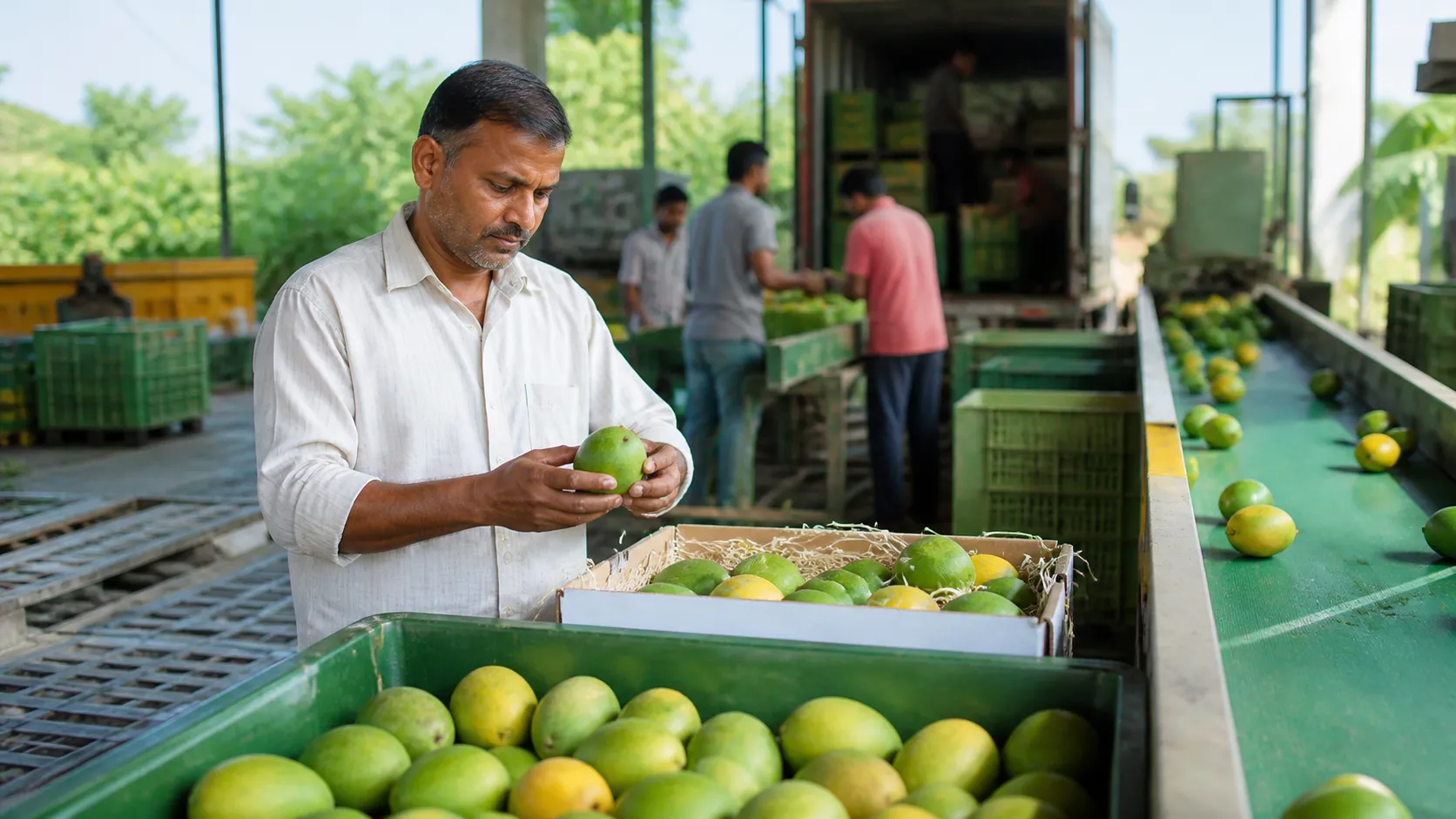
Fresh Fruits and Vegetables (Mangoes, Grapes, Pomegranate)
- Phytosanitary certificate from NPPO is mandatory
- Pre-shipment inspection by APEDA-empanelled inspection agency
- For mangoes to USA: USDA APHIS-approved vapour heat treatment (VHT) facility required — treatment eliminates fruit fly risk. Very few Indian facilities are USDA-approved; exporting fresh Indian mangoes to the US requires using one of these approved VHT facilities.
- For grapes to EU: EU has very low MRLs for specific fungicides widely used in Indian grape farming — pre-harvest and pre-shipment residue testing is mandatory for any serious grape exporter targeting EU
- Cold chain integrity documentation for temperature-sensitive fresh produce
Marine Products (Shrimp, Fish)
- MPEDA registration is mandatory
- EIC (Export Inspection Council) certificate — mandatory for seafood exports; EIC-approved processing facilities only
- Health certificate (country-specific) — EU requires an official health certificate from MPEDA; US FDA requires prior notice and maintains an import alert system for antibiotic residues
- HACCP certification for the processing facility — required for EU and US markets
- Antibiotic residue testing — chloramphenicol, nitrofurans, and other banned antibiotics are frequently tested at destination markets; any positive is catastrophic for market access
Finding Buyers for Agricultural Exports
APEDA Buyer Connect
APEDA's digital buyer-seller platform connects Indian agricultural exporters with foreign buyers. Register on APEDA's platform (aped.gov.in) and complete your product profile — commodity, certification status, production capacity, and target markets. APEDA circulates buyer leads to registered exporters and organises virtual and in-person buyer meets.
Anuga, SIAL, and Gulfood
The world's three largest food trade shows are essential channels for agricultural and food exporters:
- Anuga (Cologne, October, biennial): World's largest food trade show — over 7,000 exhibitors, 165,000 buyers from 200 countries. APEDA organises India Pavilion.
- SIAL (Paris, October, biennial, alternate years to Anuga): 150,000+ visitors. Strong European buyer attendance.
- Gulfood (Dubai, February, annual): The world's largest annual food trade show. Essential for Gulf, Middle East, Africa, and Asian food buyers.
Apply to APEDA for MAI-funded participation — the government subsidy covers 75–100% of eligible costs for MSME food exporters at these approved fairs.
Indian Diaspora Food Distribution Networks
In the USA, UK, Canada, UAE, and Australia, large Indian diaspora communities are served by established Indian grocery distribution networks — distributors who import Indian food products and supply to Indian grocery stores, supermarkets, and online platforms. These networks are accessible without the compliance burden of EU supermarket private label supply. For initial market entry, targeting diaspora distribution channels provides cash flow and market learning before investing in the more demanding mainstream retail channel.
Export Policy Risks Specific to Agriculture
Agricultural exports face an export policy risk that manufactured goods largely do not: the government can impose or lift export restrictions, minimum export prices (MEP), or outright bans based on domestic supply and price conditions. This has affected rice, wheat, sugar, onion, and other politically sensitive commodities.
For exporters in these categories:
- Monitor DGFT export notifications frequently — policy can change within 24–48 hours
- Build force majeure clauses into all export contracts that specifically cover government export restrictions
- Diversify to products with less export restriction risk where possible
- Maintain DGFT notification subscription — DGFT sends email alerts for policy changes
Frequently Asked Questions
My product failed a pesticide residue test at an EU border. What are the consequences and what should I do?
An EU border rejection for pesticide residues creates a formal notification in the EU's RASFF (Rapid Alert System for Food and Feed) database — which is public and can be accessed by all EU food safety authorities and buyers. Serious violations result in an "increased controls" measure on future shipments of the same product from India — meaning every subsequent shipment of that product from India is subjected to mandatory testing at the EU border, which adds cost and delay. If violations continue, a temporary import ban can be imposed. Immediate actions: identify the specific pesticide involved and its source in your supply chain, implement corrective action (ban the pesticide, increase PHI, pre-shipment testing), and document the corrective action for your EU buyer and for APEDA.
Is GI (Geographical Indication) tagging useful for agricultural exporters?
Yes — significantly for premium products. Indian agricultural products with GI tags include Darjeeling Tea, Basmati Rice, Alphonso Mango, Nagpur Orange, Coorg Coffee, Malabar Pepper, Kashmir Saffron, and dozens of others. GI status: (a) legally protects the product's name and origin in international markets — competitors cannot sell non-genuine products under the GI name, (b) commands a premium — GI-tagged products typically sell at 15–50% higher prices than non-GI equivalents in premium markets, and (c) provides a compelling authenticity narrative for marketing. If your product has a GI tag available, register and use it actively.
Can I export food products directly to Amazon or Flipkart Global for e-commerce?
Yes — India has specific courier export regulations that simplify small consignment food exports through platforms like Amazon Global and Etsy. Key requirements: FSSAI licence, APEDA registration (for applicable products), correct labelling per destination country requirements, and compliance with the destination platform's food safety policies. The volume of Indian food products exported through e-commerce channels is growing rapidly — particularly for specialty and artisan food products (organic spices, artisan teas, specialty pickles, niche rice varieties) that command premium pricing from diaspora and food-enthusiast buyers globally.
Conclusion
Agricultural exporting from India combines some of the world's greatest natural advantages — diverse agro-climatic zones, skilled farming communities, enormous production scale — with some of the most demanding compliance requirements in global trade. The exporters who build sustainable agricultural export businesses are those who treat compliance not as a cost but as a capability that differentiates them from competitors who cut corners.
Start with APEDA registration and correct phytosanitary compliance. Build a pesticide residue management programme before targeting regulated markets. Test every batch before shipping. Maintain meticulous documentation through your supply chain. And use APEDA's buyer connect platform, trade fair participation, and diaspora distribution networks to build the buyer relationships that turn compliance capability into commercial success.