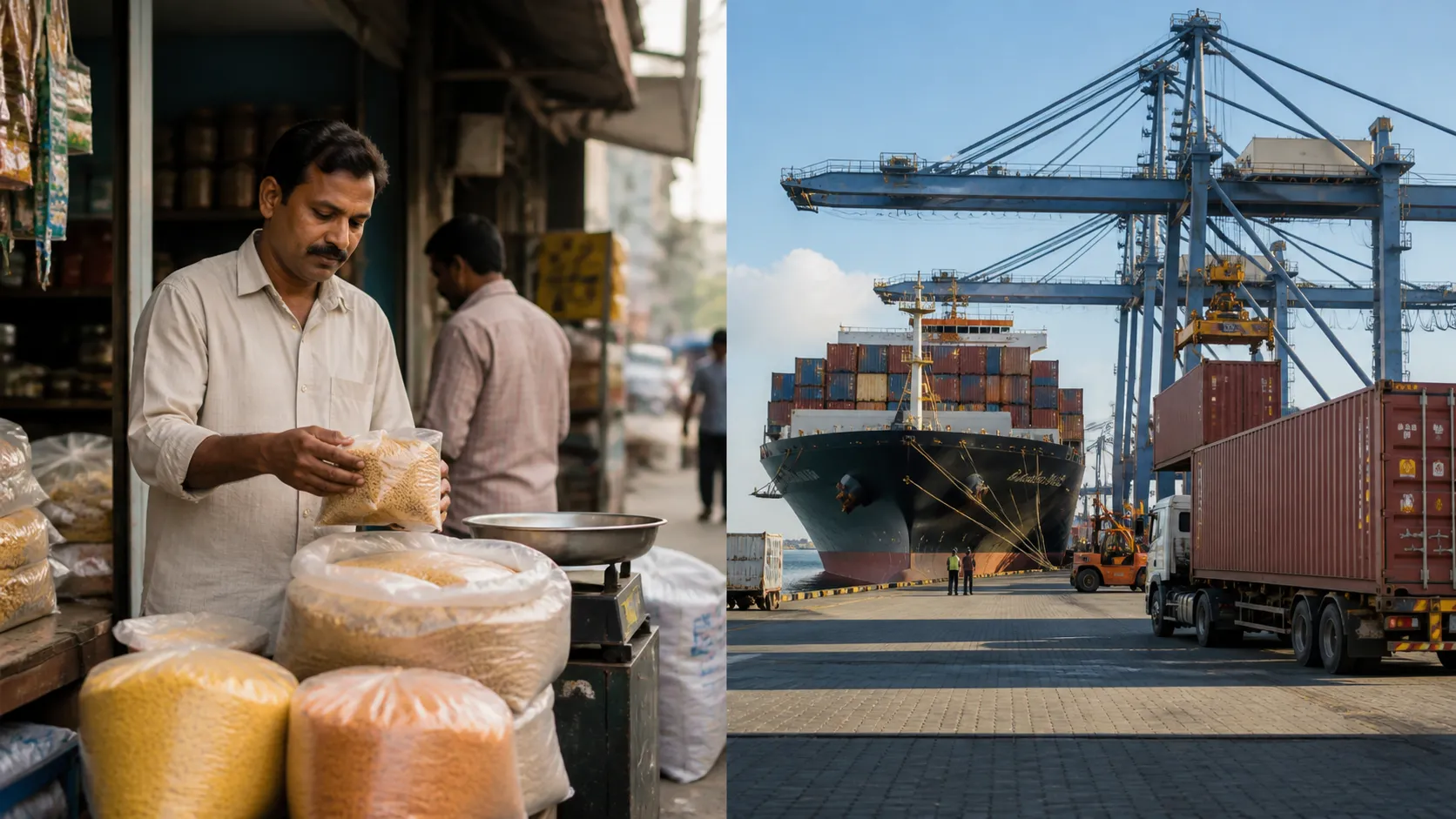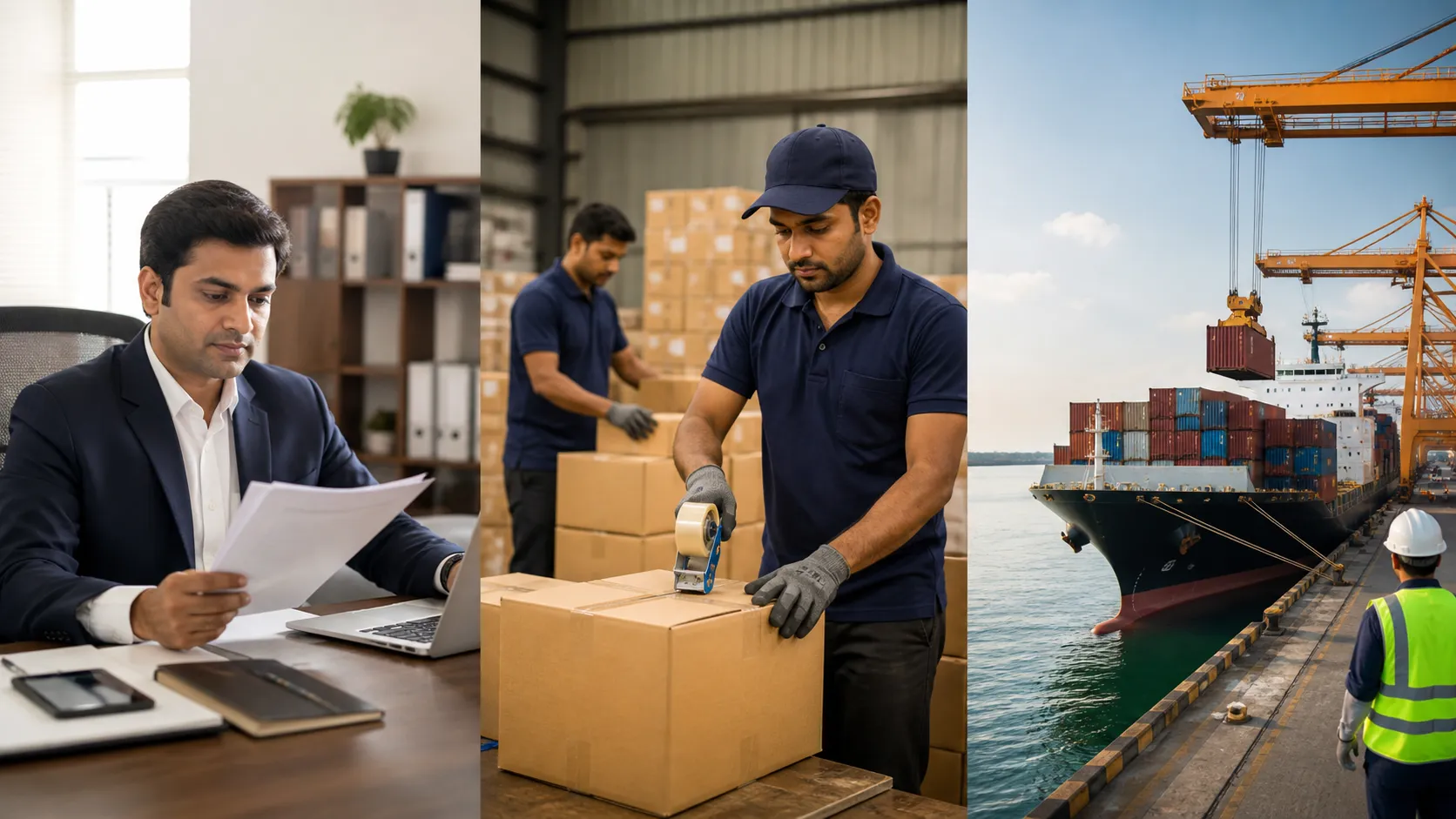
Imagine you make handloom sarees in Varanasi and a boutique in Paris wants to sell them. Road 1: you deal directly with the Paris boutique — negotiate, ship, document, receive payment. Road 2: an export trading company in Mumbai buys your sarees, exports them to Paris, and you simply sell to the Mumbai company in rupees without touching a single customs form. Both roads get your sarees to Paris. But the journey, risks, rewards, and effort are completely different. This is the fundamental choice every Indian exporter faces — direct export vs indirect export.
What Is Direct Export?
Direct export means you — the manufacturer or producer — export your goods directly to a foreign buyer. No middleman between you and the overseas customer. You handle everything: finding the foreign buyer, negotiating price and terms, managing export documentation, arranging shipping, receiving foreign currency payment, and claiming export incentives like RoDTEP and Duty Drawback.
The foreign buyer could be a retailer or wholesaler abroad, a distributor in the target country, an end consumer (for B2C exports via Amazon Global or Etsy), or a company buying for their own use.
How Direct Export Works — A Simple Example
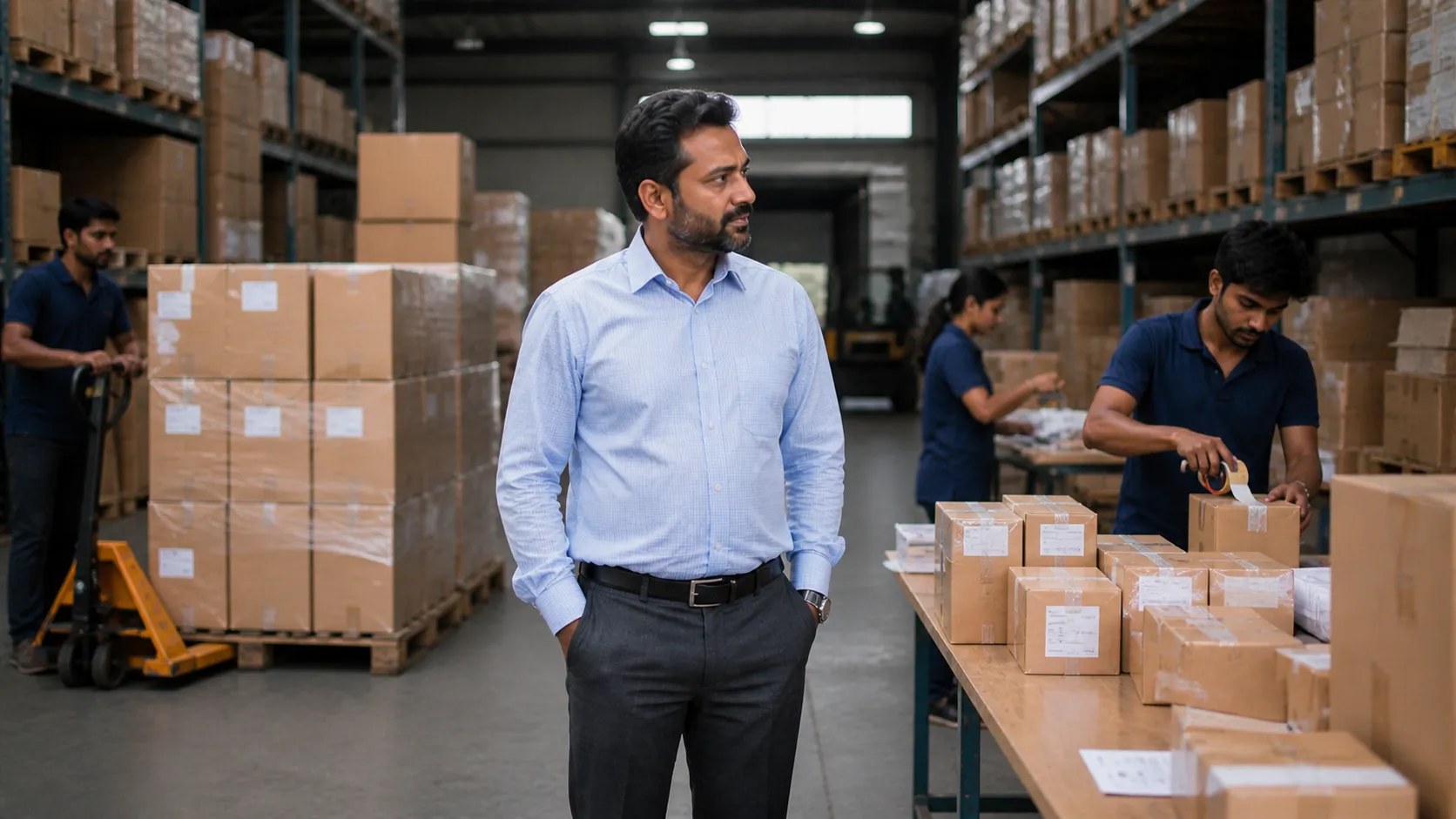
Rajesh manufactures stainless steel kitchenware in Rajkot. He lists his products on Alibaba. A restaurant equipment supplier in the UK finds his listing and sends an inquiry. Rajesh responds, sends a Proforma Invoice, negotiates terms, receives 30% advance, produces the order, hires a CHA, ships via sea freight from Mundra port, sends documents to the UK buyer, receives the balance 70% payment, and files for RoDTEP benefits. He is a direct exporter — he dealt with the UK buyer from first inquiry to final payment.
What Is Indirect Export?
Indirect export means you sell your goods to an intermediary in India — who then exports them on your behalf. You don't deal with the foreign buyer directly. You don't handle export documentation. You don't receive foreign currency. You sell domestically — in rupees — and someone else handles the export.
The intermediary could be:
- Export Trading Company (ETC) — buys goods from multiple Indian manufacturers and exports under their own name. They aggregate products, find buyers, and manage the entire export process. You're their supplier.
- Export Management Company (EMC) — represents your products in foreign markets, finds buyers, and manages export on your behalf for a fee or commission. Often works on agency basis rather than buying outright.
- Merchant Exporter — a trader who buys from manufacturers and exports them. They hold an IEC, handle all export documentation, and take the risk. You supply goods against a domestic purchase order.
- Buying Agent / Indenting Agent — a representative of a foreign buyer in India. They identify suppliers, negotiate on behalf of their foreign principal, and coordinate the export. They earn a commission from the foreign buyer.
- Canalising Agency — for certain controlled products, the government designates specific agencies (MMTC, STC, NAFED) as the only permitted exporters. Manufacturers must route exports through these agencies.
- E-commerce platforms — when you sell on Amazon's Global Selling programme or similar cross-border platforms, Amazon handles customs, shipping, and international payments. This is a form of indirect export.
How Indirect Export Works — A Simple Example
Meena makes organic herbal teas in Dehradun. She doesn't know export documentation, foreign buyers, or shipping. An Export Trading Company in Delhi contacts her, buys 500 kg of assorted herbal teas at ₹800/kg, pays ₹4,00,000 in rupees, and Meena forgets about it. The ETC exports those teas to a health food chain in Germany, handles all documentation, receives Euros, and makes their margin. Meena never dealt with Germany. She never touched a Shipping Bill. She just sold domestically.
Direct Export vs Indirect Export: Head-to-Head Comparison
| Parameter | Direct Export | Indirect Export |
|---|---|---|
| Who deals with foreign buyer | You | Intermediary |
| Control over pricing | Full control | Limited — intermediary sets export price |
| Profit per unit | Higher | Lower (intermediary takes margin) |
| Risk | Higher | Lower |
| Documentation responsibility | Your responsibility | Intermediary's responsibility |
| IEC required | Yes | Not necessarily (supplying to merchant exporter) |
| Payment currency | Foreign currency (USD/EUR etc.) | Indian Rupees |
| Payment risk | You bear it | Intermediary bears it |
| Market knowledge | You build it directly | Limited — intermediary holds market knowledge |
| Brand building | You build your brand internationally | Your brand may not be known abroad |
| Government incentives (RoDTEP, Duty Drawback) | You claim them | Intermediary claims them |
| Learning curve | Steep initially | Very gentle |
| Capital requirement | Higher | Lower |
| Long-term potential | Very high | Moderate |
The Pros and Cons: Honest Assessment
Direct Export — Advantages
Higher profit margins. When you export directly, you capture the full export margin. No middleman eating into your profits. Example: you make leather bags for ₹1,500. A merchant exporter buys at ₹2,000 (₹500 margin for you). He exports them for $60 each (approximately ₹5,000). His margin is ₹3,000 per bag. That ₹3,000 could have been yours.
Direct market intelligence. You understand what foreign buyers actually want — quality expectations, packaging preferences, price sensitivity, seasonal demand, and product trends. This intelligence makes you a more competitive exporter over time.
Brand building. Your brand name appears on the export invoice, on packaging, and in the buyer's records. International buyers know YOUR company. Your brand grows globally.
Government incentives go to you. RoDTEP benefits, Duty Drawback refunds, GST refunds — all go directly to you, the exporter of record. In indirect export, the merchant exporter claims these, not you.
Long-term buyer relationships. You build direct relationships with foreign buyers — relationships that become valuable business assets. A loyal international buyer who returns year after year is worth crores. You can't build that through an intermediary.
Full pricing control. You decide your export price, your margins, and your payment terms. Nobody else controls your destiny.
Direct Export — Disadvantages
Steep learning curve. Documentation, customs procedures, Incoterms, letters of credit, freight booking — there's a lot to learn. Your first few shipments will involve mistakes and confusion.
Higher capital requirement. You need working capital to fund production before receiving full payment. You pay CHA, freight forwarder, and other service providers upfront.
Payment risk falls on you. If the foreign buyer doesn't pay, you suffer the loss. You need ECGC cover, careful buyer verification, and sound payment terms to protect yourself.
Time and bandwidth. Export administration — responding to inquiries, preparing documents, coordinating with CHA and freight forwarders, tracking shipments, following up on payments — takes significant time. As a small manufacturer, this can be overwhelming initially.
Finding buyers is hard. International buyer discovery — listing on B2B platforms, attending trade fairs, outbound marketing — takes effort and often money.
Indirect Export — Advantages
Zero export complexity. You sell in rupees. You deal with an Indian buyer. The entire export process — documentation, customs, freight, forex — is someone else's problem. You focus entirely on production.
Immediate payment. Merchant exporters and trading companies typically pay quickly — in rupees — with short credit periods. No waiting 60–90 days for foreign currency to arrive.
No payment risk from foreign buyer. The intermediary bears the risk of non-payment from the foreign buyer. Your risk ends when the merchant exporter pays you.
Low capital requirement. No working capital beyond your normal production cycle. No upfront CHA fees, freight costs, or bank charges.
No IEC needed in some cases. Manufacturers supplying to merchant exporters don't always need their own IEC — the merchant exporter uses theirs for the shipment. (Having your own IEC is always recommended regardless.)
Good starting point. If you're a manufacturer with no export experience, indirect export lets you participate in the export ecosystem without diving into the deep end immediately.
Indirect Export — Disadvantages
Significantly lower margins. The intermediary takes 20%–50% of the final export value. Over years and high volumes, this adds up to crores of rupees that could have been yours.
No market knowledge. You don't know which countries buy your product, what foreign buyers want, or international pricing. This knowledge gap keeps you permanently dependent on intermediaries.
No brand building. The merchant exporter exports under their brand or the foreign buyer's private label. Your company name may never appear on an international document.
No government incentives. RoDTEP and Duty Drawback go to the merchant exporter — not you. Some merchants pass on a portion to suppliers, but many don't. You leave money on the table.
Dependent on intermediary's health. If your merchant exporter loses their major buyer, faces financial trouble, or shuts down — your export revenue disappears overnight with no direct market access to fall back on.
Constant price pressure. Merchant exporters continuously push your selling price down to protect their own margins — and you have no visibility into what the final export price actually is.
The Third Model: Semi-Direct Export
There's a middle path that many smart Indian exporters use — semi-direct export.
In this model, you export directly — you have your own IEC, you handle your own documents, you receive foreign currency — but you sell to an intermediary in the foreign country rather than directly to the end retailer or consumer. For example: you export directly to a distributor in the UAE who supplies to retail stores, or to a wholesale importer in the UK who resells to restaurants.
You are the exporter of record. You claim all incentives. You receive foreign currency. But your foreign buyer is an intermediary — not the final consumer — which simplifies buyer management considerably. Semi-direct export gives you most of the benefits of direct export with slightly less complexity.
Which Model Is Right for You? A Decision Framework
Do you have an IEC and basic export knowledge?
No → Start with indirect export through a merchant exporter. Learn the product-market dynamics. Get your IEC. Then migrate to direct export within 1–2 years.
Yes → You're ready to attempt direct export for small orders.
What is your production capacity?
Small (below ₹5,00,000 per month) → Indirect export may be more practical. Merchant exporters aggregate volume from multiple small suppliers — this works in your favour.
Medium to large → Direct export makes more economic sense. The margin savings at higher volumes are significant.
Can you handle documentation complexity?
Not comfortable → Start indirect. Hire a CHA. Learn over time. Or partner with an Export Management Company that handles documentation while you remain the technical exporter.
Comfortable or willing to learn → Go direct. Documentation is learnable and outsourceable to a good CHA.
What is your working capital situation?
Tight working capital → Indirect export — you get paid in rupees quickly by the merchant exporter, not after 60–90 day international payment cycles.
Adequate working capital or access to bank export credit → Direct export — the higher margins justify the working capital wait.
What is your long-term goal?
I just want extra revenue without changing my business model → Indirect export is fine.
I want to build an international brand, develop global market relationships, and maximise export earnings long-term → Direct export is the only path. Indirect export is a ceiling. Direct export is a sky.
The Evolution Path: Start Indirect, Go Direct
Here's the smartest approach for most Indian manufacturers and small exporters:
Year 1 — Indirect Export. Supply to a merchant exporter or trading company. Earn export-linked revenue. Learn which markets buy your product. Understand what quality and packaging standards foreign buyers demand. Get your IEC. Open your export current account.
Year 2 — Semi-Direct. Start listing on one B2B platform (IndiaMART Global, Alibaba free listing). Attend one domestic trade fair. Start receiving your first direct inquiries. Handle 2–3 direct export shipments with the help of a good CHA.
Year 3 onwards — Full Direct Export. You now have international buyer relationships, export process knowledge, and confidence to operate fully independently. Scale your direct exports. Build your brand. Claim all government incentives yourself. Maximise margins.
This evolutionary path is the most common among India's most successful MSME exporters. They didn't start as confident direct exporters — they started somewhere accessible and grew into it.
Real-World Examples of Each Model
Direct Export — Spice Exporter from Kerala
A small spice processor in Idukki started listing on the Spices Board's buyer-seller platform and Alibaba. Within 6 months, he had his first direct order from a German organic food company. Today he exports 40 MT of certified organic spices annually — directly, under his own brand, at premium prices. His margins are 3x what they were when he sold to a trading company.
Indirect Export Working Well — Handicraft Cluster in Moradabad
Brass handicraft makers in Moradabad's famous cluster supply to large export trading companies that attend international trade fairs and maintain buyer relationships in Europe and the US. The craftsmen focus on intricate brasswork while the trading companies handle everything else. Both sides benefit — craftsmen earn well without export complexity, trading companies build international businesses on the craftsmanship of the cluster.
Smart Transition — Textile Manufacturer in Tiruppur
A garment manufacturer in Tiruppur started by supplying to buying agents representing European fast-fashion brands. Over 5 years, she learned exactly what European buyers want — size grading, fabric certifications, packaging standards, labelling requirements. She then started attending Texworld Paris. Today she has 4 direct European clients and has eliminated the buying agent from 60% of her business, dramatically improving her margins.
E-Commerce Exports: A New Form of Direct Export
The rise of cross-border e-commerce has created a powerful new export model that didn't exist a decade ago:
- Amazon Global Selling — list your products on Amazon.com, Amazon.co.uk, Amazon.de, and other marketplaces. When a foreign consumer buys, Amazon handles payment and shipping (via FBA). You receive INR payment from Amazon India.
- Etsy — ideal for handmade, vintage, and craft products. Huge global audience with strong brand-building potential.
- Shopify + International Shipping — build your own branded website, drive global traffic, ship via DHL or FedEx internationally.
This is technically a hybrid — you're the exporter of record (direct) but the platform mediates the buyer relationship (semi-indirect). For small artisans, handicraft makers, fashion designers, and unique product creators — e-commerce exports are a revolutionary low-barrier entry into global markets.
Final Thoughts
There is no universally correct answer between direct and indirect export. The right model depends on where you are today — your knowledge, your capital, your capacity, and your ambition.
But here's the truth every experienced exporter will tell you — indirect export is where you start, not where you stay. The real money, the real brand, the real relationships, and the real long-term export business are built through direct export. Indirect export is a launching pad — useful and necessary for many — but ultimately a stepping stone.
Use it as one. Learn from it. And when you're ready — take that step directly into the global market.
To understand what's involved in a direct export shipment, read how the full export process works. To understand the costs of going direct, see how much capital you actually need to start exporting.