Introduction
Every exporter eventually faces the same moment: a buyer wants a delivery date that your standard sea freight schedule cannot meet, or a product is too fragile, too urgent, or too valuable to risk weeks at sea — and you have to decide whether to absorb the air freight cost or negotiate a later delivery. It is a decision that affects your margin, your buyer relationship, and in some cases your ability to win the order at all.
I have shipped everything from industrial machinery components to agricultural spices across both modes over the years. The rule I have arrived at is simple in principle but requires genuine understanding to apply correctly: sea freight is almost always the right choice for standard commercial exports, and air freight earns its premium only in specific, well-defined situations. The mistake most exporters make is either defaulting to sea freight when air would have saved a buyer relationship, or defaulting to air freight when the premium is entirely unjustified by the value of the goods.
This guide gives you everything you need to make this decision correctly — a complete cost comparison, transit time data for major India trade lanes, the specific scenarios where each mode makes sense, how to calculate the weight-based cost breakeven, and the less obvious factors like insurance, packaging, and customs implications that affect the total cost picture.
The Core Difference: What You Are Really Trading Off
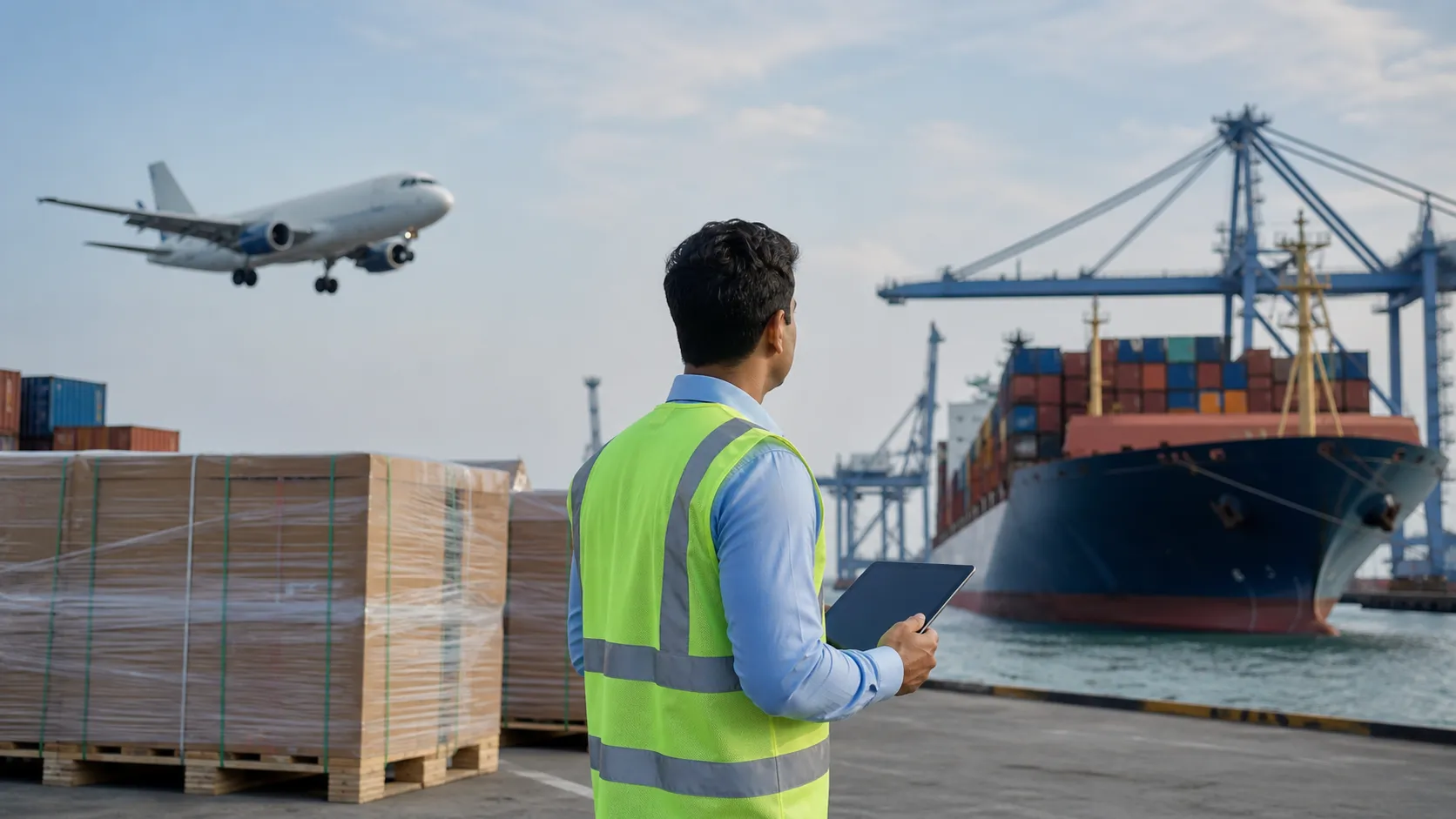
The sea freight vs air freight decision is fundamentally a trade-off between three variables:
- Cost: Air freight typically costs 4–8 times more per kilogram than sea freight for equivalent routes
- Speed: Air freight delivers in 1–5 days door-to-door versus 15–45 days for sea freight depending on the destination
- Risk: Longer transit time = more exposure to damage, delay, theft, and market changes; faster transit = less exposure but significantly higher cost
The correct mode is the one that minimises total cost for the specific shipment — where total cost includes not just the freight rate but also the value of time (working capital tied up in transit goods, interest cost), risk cost (damage probability, insurance), and relationship cost (what does a late delivery to this buyer cost you in future orders?).
For most standard manufactured goods at standard commercial quantities, sea freight wins the total cost calculation by a wide margin. For high-value, time-sensitive, or perishable goods, air freight's total cost advantage becomes real.
Sea Freight: The Default Mode for Most Indian Exports
How Sea Freight Works
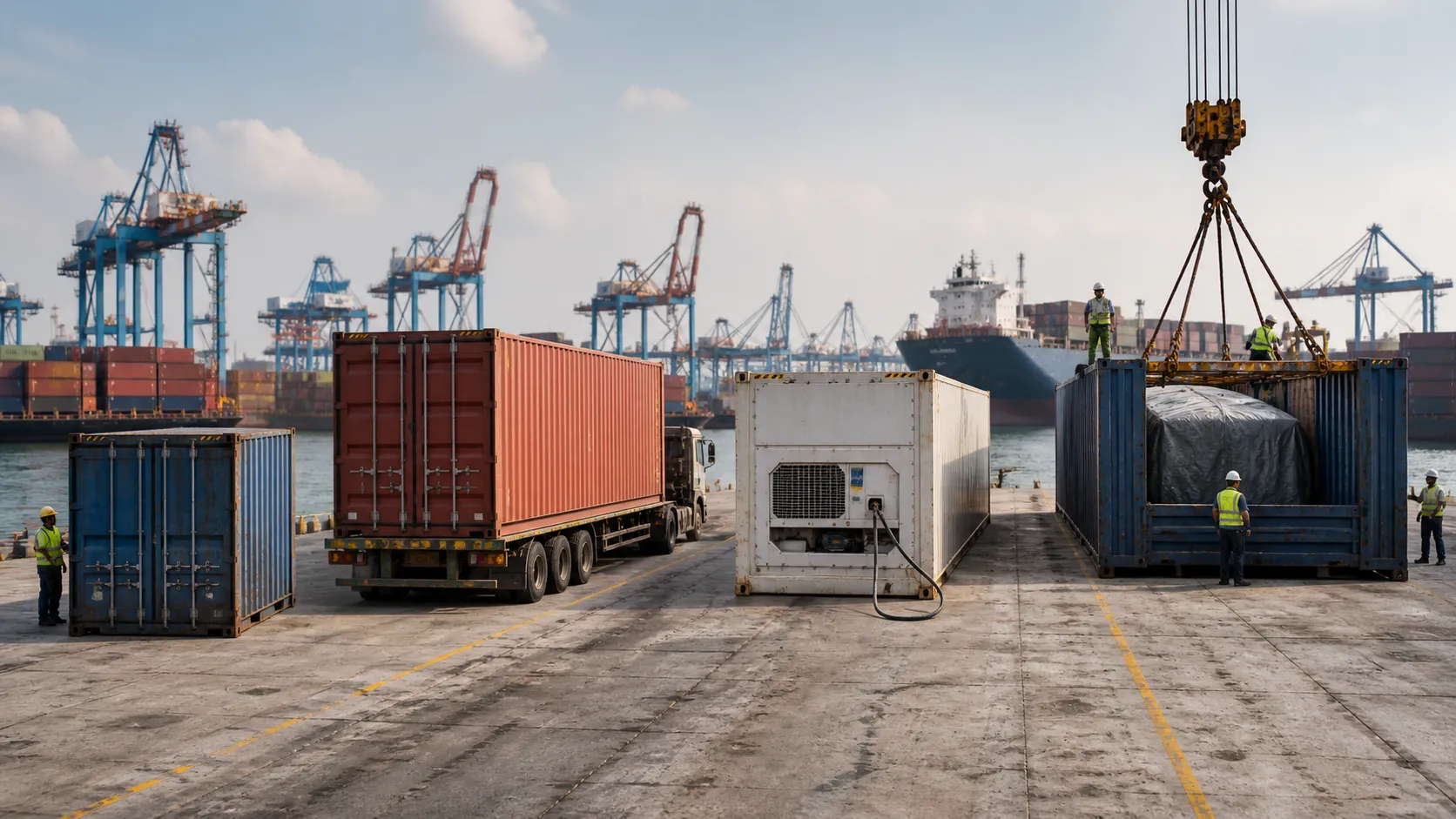
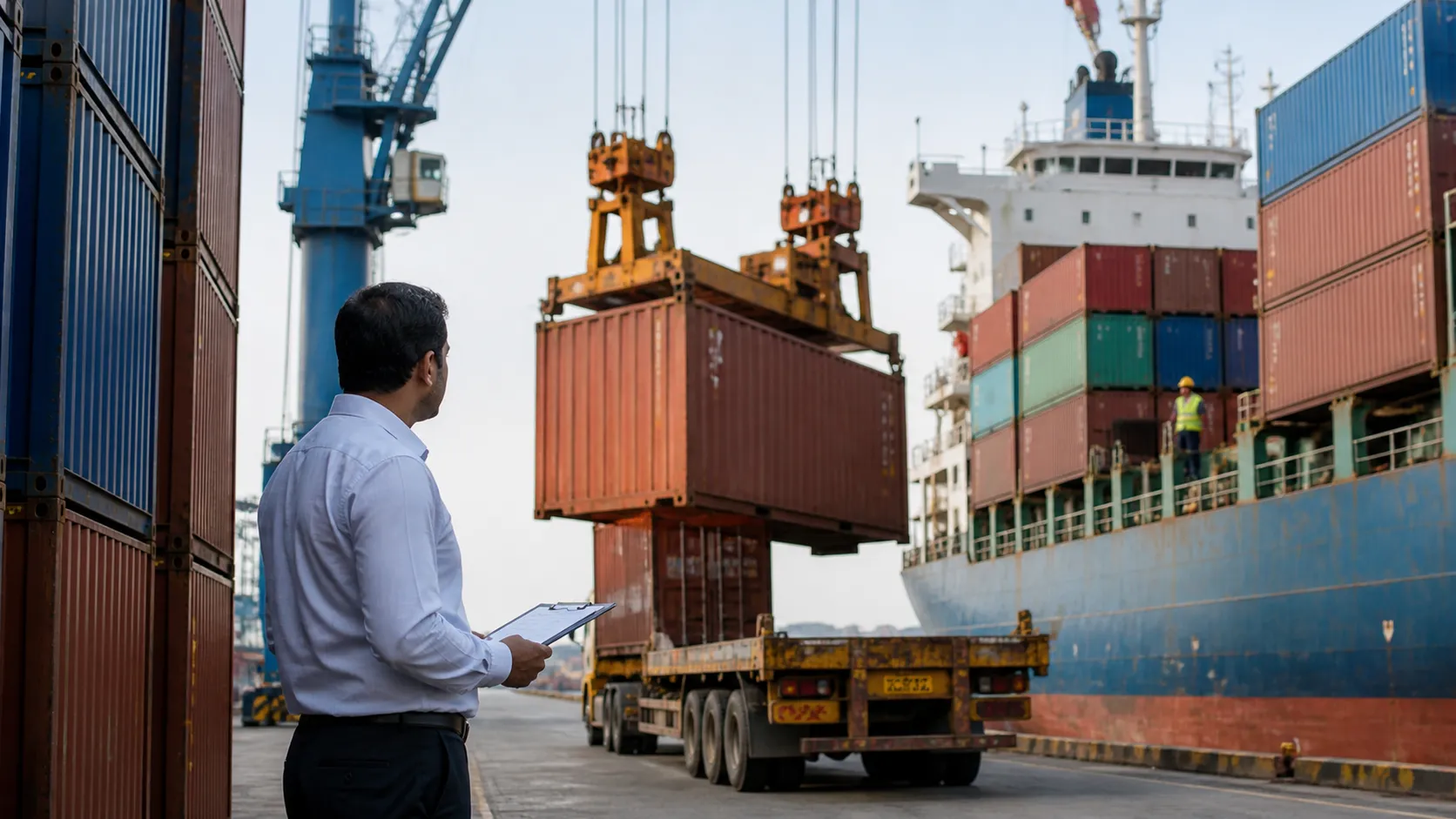
Sea freight moves goods inside standardised containers — typically 20-foot containers (TEU) or 40-foot containers (FEU) — on containerships between ports. The container is the unit of capacity, and the industry is organised around container movements.
For Indian exporters, two booking arrangements are relevant:
FCL (Full Container Load): You book an entire container for your goods. You stuff the container at your factory or at an ICD (Inland Container Depot), seal it, and it moves as a single unit. FCL is cost-effective for loads above approximately 14–15 CBM (cubic metres) or 7,000–8,000 kg. You get price certainty, direct container control, and no risk of delays from other shippers' cargo.
LCL (Less than Container Load): Your cargo is grouped with other shippers' goods in a shared container. You pay per CBM or per kilogram (whichever is higher), and the freight forwarder consolidates multiple small shipments into a single container. LCL is cost-effective for small shipments (under 10–12 CBM). The trade-off: longer handling time at origin and destination consolidation warehouses, higher per-unit cost than FCL for equivalent cargo, and slightly higher damage risk from the additional handling involved in grouping and de-stuffing.
Sea Freight Transit Times from India (2026)
Transit times below are port-to-port for FCL shipments, reflecting the current routing situation including the Red Sea diversion for Europe-bound cargo:
- India → Middle East (Dubai, Jebel Ali): 5–10 days. The closest major market — short, reliable sea connections from JNPT, Mundra, and Chennai.
- India → East Africa (Mombasa, Dar es Salaam): 12–18 days. Growing market for Indian goods — reliable services from major Indian west coast ports.
- India → Southeast Asia (Singapore, Bangkok, Jakarta): 10–18 days. Important for Indian manufacturers targeting ASEAN buyers.
- India → East Asia (Shanghai, Qingdao, Busan): 15–22 days. Competitive market but significant volumes move this route.
- India → UK and Northern Europe (Rotterdam, Hamburg, Felixstowe): 32–42 days currently via Cape of Good Hope routing (Red Sea avoidance). This is a significant increase from the 18–24 days that was standard via Suez Canal before 2024. Budget an extra two weeks in all India-Europe delivery commitments.
- India → Mediterranean (Genoa, Barcelona, Piraeus): 28–38 days via Cape.
- India → USA East Coast (New York, Baltimore, Savannah): 22–30 days. Trans-Pacific routing (eastbound via Singapore, Taiwan) or direct Suez routing depending on carrier.
- India → USA West Coast (Los Angeles, Long Beach): 18–25 days.
- India → West Africa (Lagos, Tema, Dakar): 18–28 days.
- India → Australia (Sydney, Melbourne): 18–25 days.
Add 3–7 days for inland transport from your factory to the port, and 3–10 days for destination customs clearance and inland delivery. Total door-to-door sea freight time is typically 25–55 days for most routes.
Sea Freight Costs from India (2026)
Container freight rates are volatile and change weekly based on supply-demand dynamics. Current approximate ranges for 20ft container (FCL) from major Indian ports:
- India → Middle East: USD 400–900 per 20ft container
- India → Southeast Asia: USD 400–700
- India → Europe: USD 2,500–4,500 (elevated due to Cape routing)
- India → USA: USD 2,000–4,000
- India → Australia: USD 800–1,500
For LCL, current rates are approximately USD 30–80 per CBM for most major trade lanes, with minimum charges typically applying to small shipments.
Beyond the base freight rate, account for:
- BAF (Bunker Adjustment Factor): Fuel surcharge, fluctuates with oil prices
- CAF (Currency Adjustment Factor): Exchange rate surcharge on some routes
- THC (Terminal Handling Charges): Origin and destination port handling — typically USD 100–200 per container at Indian ports
- Documentation fees: B/L issuance, EGM charges — typically USD 50–150
- Inland haulage: Trucking from your factory to the port/ICD
Air Freight: When Speed Justifies the Premium
How Air Freight Works
Air freight moves goods on commercial passenger aircraft (belly cargo) and dedicated cargo aircraft (freighters). For Indian exports, the major air cargo hubs are Indira Gandhi International Airport (Delhi), Chhatrapati Shivaji Maharaj International Airport (Mumbai), Kempegowda International Airport (Bengaluru), and Chennai International Airport.
Air freight is priced by two competing measures and the higher of the two applies:
- Actual weight: Physical weight in kilograms
- Volumetric (dimensional) weight: Length (cm) × Width (cm) × Height (cm) ÷ 6,000 = Volumetric weight in kg
This means bulky, light cargo (like cushions, packaged food with large boxes, hollow metal components) is charged at its volumetric weight even though it physically weighs less. Compact, heavy cargo (like metal parts, stone samples, electronic components) is charged at actual weight. Understanding this distinction is important for calculating your true air freight cost — especially for goods with high packaging volume relative to product weight.
Air Freight Transit Times from India (2026)
- India → Middle East: 1–2 days (door-to-door)
- India → Europe: 2–4 days
- India → USA: 3–5 days
- India → Southeast Asia: 2–3 days
- India → East Africa: 2–4 days
- India → Australia: 3–5 days
These are air cargo transit times — from airport to airport. Add 1–2 days for origin pickup and customs clearance at the Indian airport, and 1–2 days for destination customs clearance and local delivery. Total door-to-door is typically 3–7 days for most routes.
Air Freight Rates from India (2026)
Air freight rates are highly variable depending on route, season, space availability, and carrier. General ranges:
- India → Middle East: USD 1.80–3.50 per kg
- India → Europe: USD 3.00–6.00 per kg
- India → USA: USD 4.50–8.00 per kg
- India → Southeast Asia: USD 2.00–4.00 per kg
- India → Australia: USD 3.50–6.00 per kg
Additional charges on air freight:
- Fuel surcharge (FSC): Significant — typically USD 0.50–2.00 per kg additional, quoted as a separate line item
- Security surcharge: USD 0.10–0.30 per kg
- AWB (Airway Bill) fee: USD 20–50 flat
- Airport handling charges: At origin and destination airports
- Customs clearance fees: At both ends
The Cost Per Kilogram Comparison: When Air Gets Competitive
At first glance, air freight looks 4–8 times more expensive per kilogram than sea freight. But this comparison changes significantly when you account for the full landed cost of a sea freight shipment:
Sea freight full cost components per kg (example: 1,000 kg, India to Germany):
- Ocean freight (₹250/kg equivalent on LCL): ₹250
- Origin charges (CHA, THC, doc fees) per kg: ₹40
- Marine insurance (0.3% of ₹10,00,000 cargo value): ₹30
- Destination port charges per kg: ₹30
- Destination customs clearance per kg: ₹20
- Capital cost of 35-day transit (10% p.a. on ₹1,000/kg value): ₹9.60
- Total sea freight landed cost per kg: ≈ ₹380
Air freight full cost components per kg (same 1,000 kg, India to Germany):
- Air freight rate (₹480/kg at USD 5.50/kg): ₹480
- Fuel surcharge (₹150/kg): ₹150
- Air cargo handling and AWB per kg: ₹20
- Marine/air cargo insurance (0.3%): ₹30
- Destination customs clearance per kg: ₹20
- Capital cost of 4-day transit (negligible): ₹1.10
- Total air freight landed cost per kg: ≈ ₹701
In this example, air freight costs approximately 84% more than sea freight on a full landed cost basis — not 4–8x more. The premium narrows when you account for all the ancillary costs of sea freight. For a ₹5,000/kg value product, the 84% freight premium (₹321/kg extra) is a 6.4% increase in total landed cost — possibly justifiable for the right buyer relationship or product.
For a ₹100/kg value product (like bulk spices), the ₹321/kg freight premium is 321% of the product value — obviously not justifiable under any normal commercial scenario.
The break-even rule of thumb: Air freight starts to become economically defensible when your product's value-to-weight ratio exceeds approximately ₹3,000–5,000 per kg. Below that level, the freight premium is too large relative to product value for most normal export situations. Above ₹10,000/kg, air freight is almost always justifiable if there is any time pressure at all.
The Weight Break: When LCL Sea Freight and Air Freight Cost Cross Over
For very small shipments — samples, urgent small orders, replacement parts — the comparison is not FCL sea versus air but LCL sea versus air. LCL has higher per-kg costs than FCL, and this changes the crossover point.
For small shipments below approximately 100–150 kg and 1–2 CBM, the cost difference between LCL sea and air freight can be surprisingly small — particularly to nearby markets like the Middle East or Southeast Asia. Factor in the 3–5 week transit time difference and the advantage of LCL over air becomes questionable for small high-value shipments.
For samples under 25–30 kg, courier (DHL, FedEx, UPS) often beats both LCL and air cargo on a total cost and simplicity basis — no separate customs clearance needed, door-to-door tracking, and typically 2–4 day delivery.
When to Choose Sea Freight: The Decision Criteria
Choose sea freight when:
Your Cargo is Bulk or High Volume
Any shipment that fills a significant portion of a container — more than 8–10 CBM or 3,000+ kg — is naturally suited to sea freight. The per-kg cost advantage of sea is largest for heavy, voluminous cargo.
Your Product Has Low Value-to-Weight Ratio
Commodities, agricultural goods, textiles, basic chemicals, construction materials, furniture — products where the value is ₹100–2,000 per kg. The air freight premium as a percentage of product value is too high to be commercially viable.
Delivery Timelines Are Flexible
If your buyer can accommodate 4–8 week lead times and your contract allows it, sea freight preserves your margin. Build the sea freight transit time into your production planning and your buyer's inventory management expectations from the beginning of the relationship.
The Buyer Has No Urgency Premium to Offer
If a buyer wants fast delivery but is not willing to pay even a modest premium to cover air freight costs, sea freight is the only viable option. The urgency must translate into either a higher selling price or an explicit buyer contribution to the freight upgrade.
Goods Are Too Heavy or Bulky for Economic Air Freight
Large machinery components, steel products, heavy castings, timber — goods where the sheer physical weight makes air freight prohibitively expensive regardless of product value.
When to Choose Air Freight: The Decision Criteria
Choose air freight when:
The Shipment Is Time-Critical
Replacement parts for a production line that has stopped. Fashion garments for a seasonal collection launch. Pharmaceutical products needed for an urgent medical requirement. Event merchandise for an immovable event date. When missing the delivery window means losing the entire order value or triggering a contractual penalty, air freight premium is a business necessity, not a luxury.
Your Product Has High Value-to-Weight Ratio
Pharmaceutical APIs and formulations, electronic components, precision instruments, semiconductor materials, jewellery, luxury goods — products valued above ₹5,000–10,000 per kg. The freight premium as a percentage of product value is small, and the shorter transit time reduces the working capital tied up in in-transit goods.
The Goods Are Perishable
Fresh fruits and vegetables, cut flowers, live seafood, fresh fish, chilled meat products — anything that physically cannot survive 25–40 days in a container. Even with refrigerated containers (reefer), extremely perishable goods require air freight for distant markets. Indian flowers to European florists, fresh Indian mangoes to Japan and Singapore, live ornamental fish — these are genuine air freight categories.
The Buyer Is Paying for Freight
If you are quoting CIF or CPT and the buyer will see a total price, the mode choice affects your cost. But if you are quoting FOB and the buyer is paying freight separately, and the buyer explicitly requests air freight and is paying the air freight bill directly — your job is to coordinate with the airline or air forwarder, not to absorb the cost difference.
Samples and Small High-Value Shipments
Product samples for buyer qualification, initial small trial orders, replacement for defective components, urgent replenishment of high-value SKUs — all cases where the shipment value is high, the quantity is small, and speed matters more than freight efficiency.
Insurance Risk on Sea Is Unacceptable
For extremely fragile, moisture-sensitive, or theft-prone goods — high-end electronics, precision optical instruments, certain chemicals — the additional handling, ocean environment exposure, and longer duration on sea freight may create unacceptable damage risk that the insurance payout does not fully compensate for (considering the disruption to buyer relationships and supply commitments).
The Sea-Air Hybrid: For When You Need Both
There is a third option that many Indian exporters overlook — the sea-air combination. Goods travel by sea to a hub with strong air connections (typically Dubai, Singapore, or Hong Kong), then transfer to air for the final leg.
How it works: Ship goods from India to Dubai by sea (5–8 days). Transfer to air cargo from Dubai to Europe, USA, or further destinations (1–3 days). Total: 8–12 days door-to-door versus 3–5 days for full air and 28–45 days for full sea.
Cost: Approximately 40–60% lower than full air freight. Transit: approximately 60–70% faster than full sea freight. For time-sensitive goods that cannot justify full air freight costs but cannot wait for sea, sea-air is a genuine and practical middle ground.
Dubai and Singapore are the most practical sea-air hubs for Indian exporters given their proximity and the strength of their air cargo connections to major global markets.
How Freight Mode Affects Your Export Documentation
The choice of mode affects two important documents:
Bill of Lading vs Airway Bill: Sea freight generates a Bill of Lading (negotiable document of title). Air freight generates an Airway Bill (non-negotiable, consignee-specific). This distinction matters for LC transactions — most LCs require a marine B/L and must be specifically adapted if air transport is used. If your buyer's LC requires a "shipped on board marine B/L," you cannot use air freight without an LC amendment.
Shipping Bill vs Air Shipping Bill on ICEGATE: For air exports, your CHA files an Air Shipping Bill (also called Airway Shipping Bill) on ICEGATE — the process is the same as sea export but uses the air-specific form. Ensure your CHA has experience with air export Shipping Bills if you are shipping by air for the first time.
Insurance documents: Sea freight typically uses Institute Cargo Clauses (A, B, or C). Air freight uses Institute Air Cargo Clauses. These are different insurance documents. If your LC specifies an insurance certificate, it should specify the appropriate clauses for the transport mode.
How to Get Freight Quotes and Compare
For sea freight:
- Contact 3–4 freight forwarders with your cargo details: origin, destination, commodity, weight, volume, requested delivery date
- Request FCL and LCL quotes if your cargo volume is borderline (8–15 CBM)
- Compare all-inclusive rates — base freight + THC + documentation + BAF — not just the headline rate
- Check the service schedule: how many direct sailings per week, do they require transhipment (which adds time), what is the transit time guarantee
For air freight:
- Contact 2–3 air freight forwarders or check rates directly with airlines (Air India Cargo, IndiGo Cargo, Emirates Sky Cargo, Singapore Airlines Cargo all operate from major Indian airports)
- Provide: commodity (some goods have higher charges or are prohibited on passenger aircraft), actual weight, dimensions of each package (for volumetric weight calculation), airport of origin, airport of destination, requested departure date
- Get all-in rates including fuel surcharge and security surcharge
- Ask specifically whether the goods will move on passenger belly cargo or dedicated freighter — some routes only have limited freighter capacity and slots must be booked well in advance
Frequently Asked Questions
My buyer in the UAE is asking for air freight. They say sea freight takes too long. How do I handle this?
India to UAE by sea is only 5–8 days — shorter than some domestic highway movements in India. This is a factual misunderstanding by your buyer. Clarify the actual sea transit time, propose a specific sailing date and estimated delivery date, and most buyers who assumed sea freight to the Gulf takes "weeks" will be satisfied with sea freight once they understand the reality. The UAE is one of the best-served sea freight lanes from India precisely because of its proximity.
I have a perishable export order — mangoes to Japan. Do I have to use air freight?
For fresh alphonso mangoes to Japan, air freight is the standard mode — the sea freight transit time (15–20 days to Japan) is longer than the shelf life of premium fresh mangoes after harvest. There are sea reefer (refrigerated container) options for more hardy tropical fruits, but for premium fresh mango exports to Japan, air freight is the correct and expected mode. Build the air freight cost into your FOB price calculation — Japanese buyers for premium Indian mangoes expect and accept the price level that air freight economics require.
Can I mix sea freight and air freight in the same shipment?
No — a single consignment travels on one mode. If you want to send part of an order by air (urgent) and part by sea (balance), these become two separate shipments with separate invoices, separate Shipping Bills, and separate B/L / AWB. If your LC covers the full order, splitting may require an LC amendment to allow partial shipments or to allow different transport modes. Discuss with your buyer and bank before splitting a single order across modes.
Does shipping mode affect my RoDTEP and Duty Drawback rates?
No. RoDTEP and Duty Drawback rates are determined by your product's HS code, not by whether you shipped by sea or air. You claim the same rates regardless of mode. The FOB value on your Shipping Bill (sea or air) is the base for incentive calculation — and the FOB value is the same regardless of who pays the freight (which depends on Incoterms, not mode).
My goods are going to multiple countries on the same shipment. Which mode makes sense?
Split shipments to multiple countries from a single production run are common in LCL sea freight — you can send individual LCL bookings to each destination from the same ICD or port. For air freight to multiple destinations, you book separate AWBs to each destination airport. There is no single-mode "multi-country" shipment option — each destination is treated as a separate consignment regardless of mode. Sea LCL is generally more cost-effective for multi-country distribution of moderate-weight shipments; air becomes relevant when multiple destination buyers all have urgent requirements simultaneously.
Conclusion
The sea vs air freight decision is ultimately a product-and-customer-specific calculation, not a blanket rule. Most standard manufactured goods exports from India should go by sea — the cost advantage is overwhelming, the transit times are acceptable for buyers who plan their inventory correctly, and the entire export infrastructure (documentation, incentives, LC mechanisms) is built around sea freight as the default.
Air freight earns its premium in well-defined categories: perishables, high-value electronics and pharmaceuticals, time-critical replacement parts and samples, and seasonal goods with hard delivery windows. In these cases, the premium is genuinely justified — not just by the product value but by the value of the customer relationship and the commercial consequence of late delivery.
Know your product's value-to-weight ratio. Know your buyer's actual delivery tolerance. Build your freight cost accurately into your pricing model. And when a buyer asks for air freight for goods that do not commercially justify it, educate them on the actual sea transit time before automatically agreeing to a premium that will come straight out of your margin.
Use Eximigo's Landed Cost Calculator to model the total freight cost for your shipment across both modes before making your decision.