Introduction
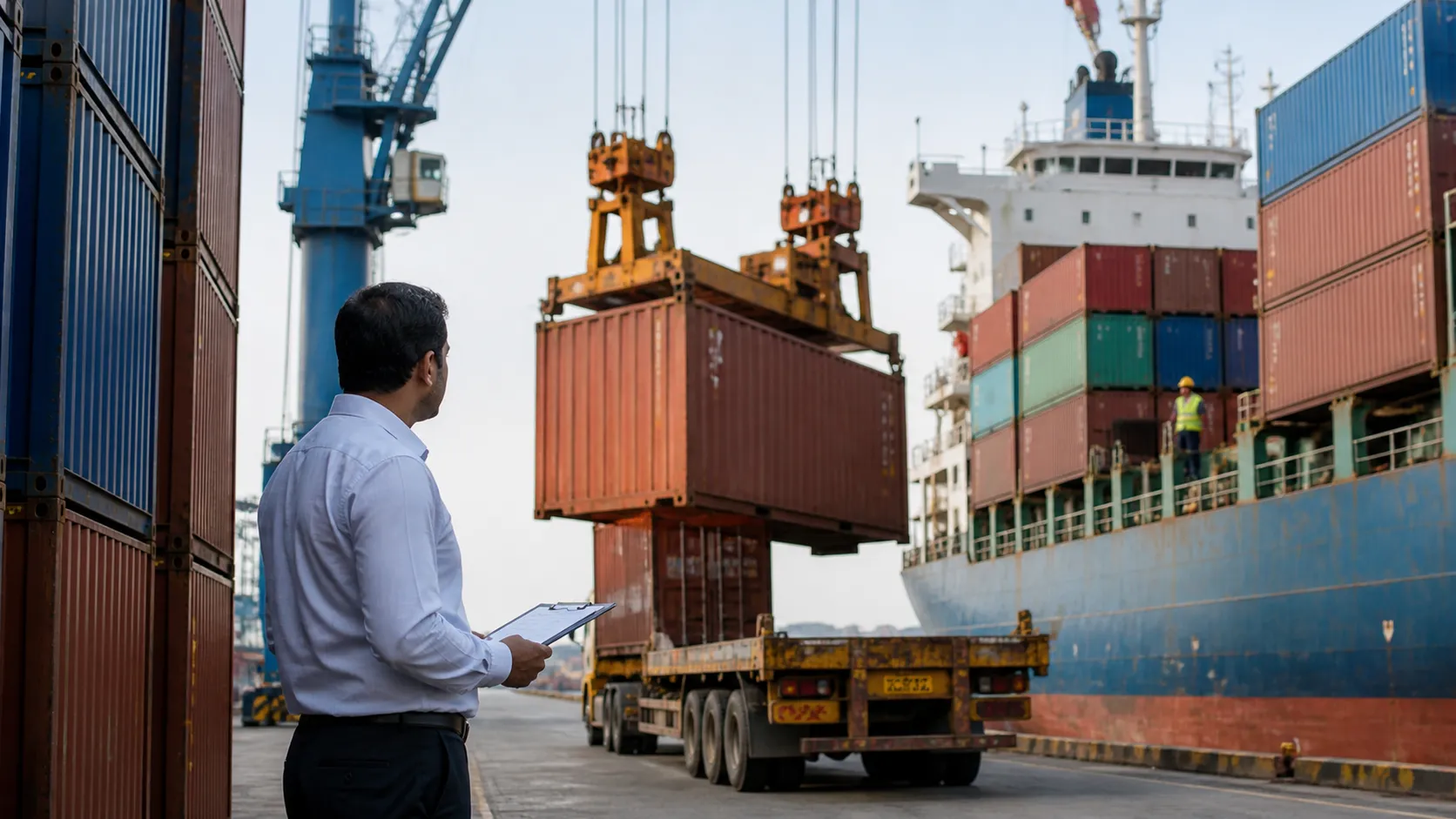
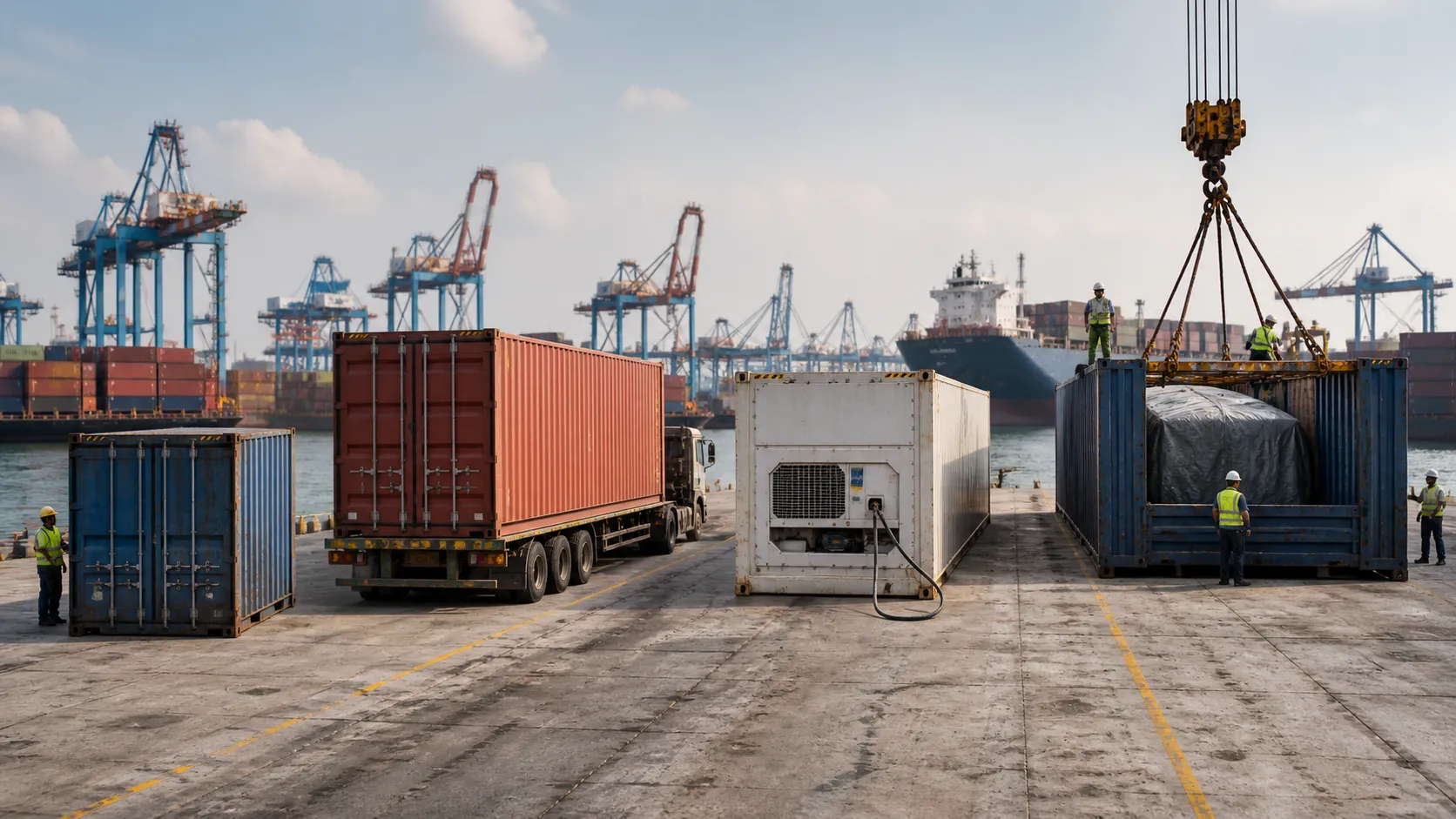
Ask most new exporters what a shipping container looks like and they will describe the standard blue or red metal box they have seen at ports or on trucks. What they often do not realise is that the shipping container world has far more variety than that one image suggests — and choosing the wrong container type for your cargo is not just an inconvenience, it can result in cargo damage, customs complications, or significant cost overruns.
I have personally made the mistake of booking a standard dry container for a shipment of overheight machinery components — discovering at the port that the machinery would not fit. The freight forwarder sorted it out, but it cost me a missed vessel, a one-week delay, and an embarrassing conversation with my buyer about why the goods were late. That experience made me study container specifications carefully, and this guide is the result.
This is a practical, complete guide to every container type relevant to Indian exporters — dimensions, capacities, ideal cargo types, and the specific scenarios where each is the right choice.
Standard Dry Containers: The Workhorse of Global Trade
Standard dry containers — also called "general purpose" or "GP" containers — handle approximately 70–75% of all global containerised trade. If your cargo is manufactured goods, textiles, engineering products, packaged foods, or most other commercial products, a dry container is what you need.
20-Foot Container (TEU — Twenty-Foot Equivalent Unit)
External dimensions: 6.06m (L) × 2.44m (W) × 2.59m (H)
Internal dimensions: 5.90m (L) × 2.35m (W) × 2.39m (H)
Door opening: 2.34m (W) × 2.28m (H)
Capacity: Approximately 33 CBM (cubic metres) usable volume
Maximum payload: Approximately 28,000 kg gross (varies slightly by shipping line and container manufacturer)
Tare weight: Approximately 2,200–2,400 kg (the empty container weight)
When to use a 20ft:
- Heavy, dense cargo — metals, machinery parts, chemicals in drums, stone, ceramics — where you will hit the weight limit before filling the volume
- Shipments between 14–33 CBM where LCL would be more expensive than FCL
- Cargo that loads and unloads from one end — the 20ft is easier to handle with forklifts at both origin and destination
- When the destination port or inland transport has weight restrictions that a loaded 40ft would violate
40-Foot Container (FEU — Forty-Foot Equivalent Unit)
External dimensions: 12.19m (L) × 2.44m (W) × 2.59m (H)
Internal dimensions: 12.03m (L) × 2.35m (W) × 2.39m (H)
Door opening: 2.34m (W) × 2.28m (H)
Capacity: Approximately 67 CBM usable volume
Maximum payload: Approximately 26,500–28,000 kg (slightly less than 20ft due to the heavier container frame)
Tare weight: Approximately 3,800–4,200 kg
When to use a 40ft:
- Voluminous, lightweight cargo — textiles, garments, packaged consumer goods, foam products, plastics — where you will fill the volume before hitting the weight limit
- Shipments above 28–30 CBM where a 40ft is more cost-effective per CBM than two 20ft
- Long cargo that needs the full 12m interior length — timber, steel pipes, rolled materials
20ft vs 40ft cost comparison: A 40ft container typically costs 1.5–1.7x the rate of a 20ft container (not 2x). For the same cargo volume above approximately 25–28 CBM, a 40ft is usually more cost-effective per CBM than a 20ft. Your freight forwarder should compare both options for shipments in the 20–35 CBM range.
High Cube Containers: Extra Height for Voluminous Cargo
40-Foot High Cube (HC)
External dimensions: 12.19m (L) × 2.44m (W) × 2.90m (H) — 31cm taller than standard
Internal dimensions: 12.03m (L) × 2.35m (W) × 2.69m (H)
Capacity: Approximately 76 CBM — about 13% more than standard 40ft
Maximum payload: Similar to standard 40ft
When to use a 40ft High Cube:
- Light, voluminous cargo that needs the extra height — furniture, mattresses, large appliances, oversized packaging, bulk bags
- Cargo stacked higher than 2.39m internal height of standard containers
- When you want the extra 13% volume without changing container length
Note on road transport: High cube containers have greater external height (2.90m) than standard containers. In some countries and on some routes, high cube containers require special permits for road transport due to bridge and overpass height restrictions. Check with your destination country's inland transport regulations before specifying high cube.
20-Foot High Cube
Less common than 40ft HC but available. Same height advantage as the 40ft HC. Used primarily for cargo that is specifically volumetrically challenging but not long enough to justify a 40ft.
Refrigerated Containers (Reefer)
Reefer containers are equipped with integrated refrigeration units that maintain the internal temperature within a specified range throughout transit. They are essential for any cargo that requires temperature control.
Standard Reefer (20ft and 40ft)
Temperature range: -25°C to +25°C (some units go to -30°C for frozen cargo)
Usable volume: Slightly less than equivalent dry containers due to insulation and refrigeration unit (approximately 28 CBM for 20ft reefer, 60–62 CBM for 40ft reefer)
When to use reefer:
- Frozen seafood: Shrimp, fish, squid — maintained at -18°C to -22°C. India's marine product exports rely heavily on reefer containers.
- Chilled meat and dairy: 0°C to +4°C
- Fresh fruits and vegetables: Temperature varies by product — mangoes typically 10–13°C, grapes 0°C, bananas 13–15°C
- Pharmaceutical products: Temperature-sensitive APIs and formulations — typically 2°C to 8°C (cold chain) or 15°C to 25°C (controlled room temperature)
- Chemicals: Some chemicals require temperature control to prevent decomposition or freezing
- Confectionery and chocolate: To prevent melting during tropical transits
Reefer container surcharge: Reefer containers cost significantly more than dry containers — typically USD 800–2,500 more per 20ft equivalent on major trade lanes, plus electricity surcharges at transshipment ports. Include reefer cost in your product costing and buyer pricing.
Reefer pre-trip inspection (PTI): Before loading, the reefer unit is tested (pre-trip inspection) by the shipping line to confirm the refrigeration system is functioning correctly. A failed PTI results in a container swap — allow 24–48 hours for this in your loading schedule.
Open Top Containers
Open top containers have no fixed roof — instead, they have a removable tarpaulin cover. This allows cargo to be loaded from above (by crane) rather than through the end doors only.
External dimensions: Same length and width as standard dry containers (20ft or 40ft)
Internal height: Similar to standard, but effective loaded height can be higher since cargo can protrude above the container frame if necessary (subject to the "over-height" surcharge)
When to use open top:
- Oversized or tall machinery: Equipment that is too tall for standard container doors but not too heavy — construction equipment, industrial machines, transformers
- Stone and marble slabs: Loaded by crane from above — standard in the marble export industry from Rajasthan and Andhra Pradesh
- Steel coils and rolls: Too heavy or too large to slide through end doors
- Bulky raw materials: Scrap metal, large castings, aggregate — loaded by crane or from above
Over-height cargo: If cargo protrudes above the container frame (over-gauge), shipping lines charge an "over-height" surcharge and require special documentation. Your freight forwarder handles this — declare the over-height dimensions clearly when booking.
Flat Rack Containers
Flat rack containers are essentially platforms — they have a floor and two end walls (collapsible or fixed), but no side walls and no roof. They are for cargo that is too wide, too heavy, or too awkwardly shaped for any enclosed container type.
Types: Fixed-end flat rack (permanent end walls) and collapsible flat rack (end walls fold down for easy stacking when empty)
Dimensions (20ft flat rack): 6.06m (L) × 2.44m (W) platform, maximum height depends only on cargo dimensions
When to use flat rack:
- Heavy project cargo: Turbines, generators, large industrial machinery — cargo that is both overweight and oversize for enclosed containers
- Wide cargo: Excavators, bulldozers, agricultural combines — construction equipment that is too wide for container side walls
- Long cargo: Windmill blades, bridge girders, ship sections — cargo that overhangs the container ends
- Boats and vehicles: Yachts, large trucks, commercial vehicles
Out-of-gauge (OOG) surcharges: Flat rack cargo that exceeds standard container dimensions on any side (over-height, over-width, over-length) incurs OOG surcharges from the shipping line, special port handling charges, and may require special deck positions on the vessel. OOG cargo logistics require specialist freight forwarders experienced in project cargo.
Tank Containers
Tank containers are ISO-standard frames containing a cylindrical tank — used for shipping liquids, gases, and powders in bulk quantities.
Capacity: Typically 21,000–26,000 litres
Materials: Stainless steel (for food-grade, chemical, and pharmaceutical liquids), carbon steel (for industrial chemicals and petrochemicals)
When to use tank containers:
- Bulk liquid chemicals: Acids, alkalis, solvents, specialty chemicals in quantities above what drums can handle economically
- Food-grade liquids: Edible oils, molasses, fruit juices, milk concentrates
- Pharmaceutical liquids: Bulk liquid APIs, excipients
- Gases: Compressed or liquefied gases (with appropriate hazmat certification)
Tank containers require specialised handling and cleaning between uses. They are typically leased from tank container operators (Stolt Tank Containers, Hoyer, Bulkhaul, Den Hartogh) rather than owned by the shipping line.
Bulk Containers
Bulk containers (also called "bulk head" containers) are standard dry container frames modified with a hatch in the roof and a discharge port in the end wall — designed for loading dry bulk commodities from above and discharging by gravity or pneumatic pressure.
When to use bulk containers:
- Granular commodities — grain, sugar, fertiliser, mineral powder — in quantities that justify FCL bulk but not enough for a vessel bulk compartment
- Spice seeds and pulses in export quantities where bagging is not practical
Ventilated Containers
Ventilated containers have ventilation openings at the top and bottom of the side walls, allowing air circulation through the container during transit. This prevents condensation buildup — particularly important for hygroscopic (moisture-absorbing) agricultural commodities.
When to use ventilated containers:
- Coffee beans and cocoa in jute bags — need ventilation to prevent mould
- Raw cashew nuts
- Agricultural seeds
- Green vegetables that generate heat and moisture
Ventilated containers are not as widely available as standard dry or reefer containers. Book well in advance and confirm availability on your specific trade lane.
Choosing the Right Container: A Decision Framework
Use this decision framework for every export shipment:
- Does your cargo require temperature control? If yes → Reefer container. If no → proceed to step 2.
- Is your cargo liquid in bulk quantities? If yes → Tank container. If no → proceed to step 3.
- Does your cargo exceed standard container dimensions (height, width, or length)? If yes → Open top (for height excess) or Flat rack (for width, length, or project cargo). If no → proceed to step 4.
- Is your cargo a hygroscopic dry agricultural commodity? If yes → consider Ventilated container. If no → proceed to step 5.
- Standard dry cargo: 20ft or 40ft?
- Heavy cargo (>14 tonnes): 20ft or check 40ft weight limit
- Below 28 CBM: Compare 20ft FCL vs LCL vs 40ft FCL economics
- 28–67 CBM: 40ft standard
- Above 67 CBM: Multiple 40ft containers or 40ft High Cube
- Very light, very voluminous: 40ft High Cube
Container Dimensions Quick Reference
Container Type      Internal L    W       H       Volume    Max Payload
20ft Standard       5.90m        2.35m   2.39m   33 CBM    ~28,000 kg
40ft Standard       12.03m       2.35m   2.39m   67 CBM    ~26,500 kg
40ft High Cube      12.03m       2.35m   2.69m   76 CBM    ~26,500 kg
20ft Reefer         5.44m        2.29m   2.27m   28 CBM    ~27,000 kg
40ft Reefer         11.58m       2.29m   2.25m   60 CBM    ~25,000 kg
20ft Open Top       5.90m        2.35m   2.35m   32 CBM    ~28,000 kg
40ft Flat Rack      12.13m       2.40m   -       -         ~45,000 kg
Frequently Asked Questions
My cargo is 16 CBM and 8 tonnes — should I book LCL or 20ft FCL?
At 16 CBM and 8 tonnes, you are below the LCL-to-FCL switchover point for most routes. Compare: your freight forwarder's LCL rate per CBM multiplied by 16 CBM versus the 20ft FCL rate for your specific route. On most India-Europe and India-USA lanes, 16 CBM is typically more cost-effective as LCL. On India-Middle East lanes where 20ft FCL rates are very low (USD 400–700), FCL may be competitive even at 16 CBM. Always get both quotes before deciding.
Can I put two different consignments in one FCL container?
Within a single FCL booking, the container is sealed and the shipper and consignee on the Bill of Lading are specific parties. You cannot simply combine two separate buyers' shipments into one FCL container as separate consignments — each consignment needs its own Shipping Bill filed with customs. If you want to consolidate two shipments to the same buyer under one container, that is fine — one Shipping Bill covering both invoices. If two different buyers are involved, LCL is the correct mode — the freight forwarder consolidates multiple shippers' cargo into one container and issues separate House Bills of Lading to each shipper.
My engineering goods shipment has some pieces that are 2.5m tall. Do I need an open top container?
Standard container internal height is 2.39m. If any piece is 2.5m tall, it will not fit through the end doors (2.28m high door opening) and cannot stand upright in a standard container. You need an open top container for this shipment, where the machinery can be lowered in from above by crane. Confirm the open top container's internal height versus your tallest piece — and if the machinery will protrude above the container frame height, declare the over-height dimensions to your freight forwarder for OOG surcharge calculation.
I want to export 500 kg of frozen prawns. Do I need a full reefer container?
500 kg of frozen prawns is a small shipment — too small for a dedicated reefer FCL. Options: (a) LCL reefer — some freight forwarders consolidate smaller frozen cargo shipments into LCL reefer containers. This is available on specific lanes (India to UAE, India to Japan) but not all routes. (b) Air freight — for 500 kg of premium frozen seafood, air freight may be cost-competitive given the high value-to-weight ratio of premium prawns and the faster delivery. (c) Wait and accumulate to a larger volume before shipping. Check with your freight forwarder on LCL reefer availability for your specific route.
Conclusion
Container selection is a logistics decision that directly affects your cargo safety, your freight cost, and your ability to meet delivery commitments. The vast majority of standard commercial exports travel in dry 20ft or 40ft containers — but knowing when a reefer, open top, flat rack, or high cube is required, and understanding the dimensions and limitations of each type, prevents the costly mistakes that come from booking the wrong box for your cargo.
Brief your freight forwarder accurately on your cargo's weight, dimensions, and any temperature or special handling requirements before booking space. A good forwarder will suggest the right container type — but only if you give them accurate cargo information. The few minutes spent on accurate cargo specification saves hours of port-side problems later.