
Introduction
India is one of the most exciting export economies in the world right now. With a target of $2 trillion in total exports by 2030, government-backed incentive schemes, simplified digital registrations, and a growing global appetite for Indian goods — 2026 is genuinely one of the best times in history to start an export business from India.
But here is what nobody tells you: most first-time exporters spend months going in circles — confused about which registrations to get, unsure how to find buyers, nervous about shipping, and overwhelmed by documentation they have never seen before. I have been there. I started exporting from Odisha with zero prior experience, and the learning curve was steep.
This guide is what I wish I had when I started. It is a complete, step-by-step roadmap that takes you from "I want to export" to your first shipment leaving an Indian port — with every registration, every document, every decision point covered in plain language.
Whether you are a manufacturer who wants to sell globally, a trader who wants to source Indian goods for international buyers, or simply someone curious about building an export business from scratch — this guide is for you.
Step 1: Decide What You Will Export
Before you apply for a single registration, you need to answer one fundamental question: what are you going to export?
This sounds obvious, but many aspiring exporters skip the research phase and jump straight to paperwork. That is a mistake. Your product choice shapes your entire export strategy — which countries you target, which registrations you need, which buyers you approach, and how you price your goods.
Start With What You Know
The most successful first-time exporters I have met did not start by researching "what is hot in global markets" — they started with what they already had. Are you a manufacturer? Export what you make. Are you a trader with existing supplier relationships? Source and export what you can reliably procure. Do you have agriculture land or connections in a farming community? Agricultural exports are among India's strongest performing categories.
Your existing knowledge of production costs, quality standards, and supply chains is a genuine competitive advantage. A stranger to an industry will struggle to compete with someone who has spent years understanding it from the inside.
Research Global Demand
Once you have identified your potential product, validate that there is actual international demand for it. Use these free tools:
- Trademap.org: Shows trade flows by HS code — how much of your product is imported by which countries, and which countries are currently exporting it. This is gold for understanding competitive landscape.
- DGFT India Trade Portal: Lists actual buyer inquiries from foreign importers. Filter by product category.
- Eximigo's HS Code Finder and Tariff Checker: Helps you identify your product code and understand the duty burden in target markets.
- Google Trends: Useful for consumer-facing products to understand seasonal demand patterns.
Check Export Restrictions
Not every product can be freely exported from India. Some categories are on the prohibited list (cannot be exported under any circumstance — certain wildlife products, antiquities, items of cultural heritage). Others are on the restricted list — they can be exported but require a special licence from DGFT. And some commodities like onion, rice, and wheat face periodic export bans or minimum export price (MEP) restrictions based on domestic supply conditions.
Check the current export policy for your product on the DGFT portal before investing time and money in the export setup. There is nothing more frustrating than building a business around a product only to discover you need a special licence you cannot easily obtain.
Find Your HS Code
Every export product has a Harmonized System (HS) Code — an 8-digit classification number that customs authorities use globally to identify goods. Your HS code determines your export incentive rates (RoDTEP and Duty Drawback are published HS code-wise), the import duty your buyer pays in their country, and the documentation requirements for your product.
Use Eximigo's HS Code Finder to identify your correct code before proceeding. Getting this wrong from the beginning creates cascading problems through every step of the export process.
Step 2: Set Up Your Business Entity
You need a legally registered business in India to export. The three main options for new exporters are sole proprietorship, LLP, and private limited company.
Sole Proprietorship
This is the fastest, cheapest way to start. There is no formal registration requirement for a sole proprietorship beyond your GST registration and a current bank account. Many successful exporters run as sole proprietors for years before converting to a company.
The main limitation: unlimited personal liability. If something goes wrong in the business — a bad debt, a legal dispute, a failed shipment — your personal assets are at risk. For low-volume, low-risk export operations, this is often an acceptable trade-off. For anything involving significant capital, you should at least consider an LLP.
Private Limited Company
This is the structure I recommend if you are serious about building an export business. A Pvt Ltd company gives you limited liability (your personal assets are protected), much better credibility with institutional buyers, easier access to bank finance, and the ability to raise investment if you ever need it.
The cost: higher compliance burden (statutory audit, ROC filings, board meetings) and higher annual compliance cost (typically ₹30,000–1,00,000/year depending on your CA). Register on the MCA portal at mca.gov.in. The process typically takes 7–15 days and costs ₹10,000–20,000 in government fees and professional charges.
LLP (Limited Liability Partnership)
A good middle ground if you are starting with a partner. Limited liability, simpler compliance than Pvt Ltd, and lower annual costs. Register on the MCA portal.
Open a Current Bank Account
Regardless of business structure, you need a current account in your business name at a scheduled commercial bank. This is non-negotiable for export. A savings account will not work — DGFT will reject an IEC application submitted with savings account details, and you cannot receive foreign inward remittances properly through a savings account.
Choose a bank with a strong trade finance department — HDFC, ICICI, SBI, Axis, or Canara Bank are good options. Tell them from the start that you plan to export. Ask to be connected with their trade finance desk.
Step 3: Get GST Registration
GST registration is the first mandatory step before you can meaningfully export. Without a GSTIN, you cannot file a Letter of Undertaking (LUT), you cannot claim ITC refunds, and the entire export tax compliance system simply does not work for you.
Apply online at gst.gov.in. The process is fully digital, takes 15–20 minutes to fill, and GSTIN is issued within 3–7 working days. You will need your PAN, Aadhaar, business address proof, and bank account details.
Technically, GST registration is only mandatory if your annual turnover exceeds ₹40 lakh (goods) or ₹20 lakh (services). But as an exporter, you should register voluntarily even if you are below the threshold — because without GSTIN, you cannot file LUT, and without LUT, you must pay IGST upfront on every export and wait months for a refund. That working capital blockage alone makes voluntary GST registration worth it from day one.
File Your LUT Immediately After Getting GSTIN
The Letter of Undertaking (LUT) is a declaration filed on the GST portal that allows you to export goods and services without paying IGST upfront. Every exporter should file LUT at the start of each financial year (April) before their first export shipment.
Filing LUT takes about 10 minutes on the GST portal: Services → User Services → Furnish Letter of Undertaking. Select the financial year, fill in witness details, confirm the declaration, and submit via Aadhaar OTP. You will get an ARN acknowledgement immediately.
Once you have filed LUT, your export invoices should state: "Supply Meant for Export Under LUT Without Payment of IGST. LUT ARN: [Your ARN]." This is legally required on every export invoice issued under the LUT route.
Step 4: Apply for Your IEC Code
The Importer Exporter Code (IEC) is the most important registration for any exporter. It is a 10-digit code issued by the Directorate General of Foreign Trade (DGFT) that serves as your identity in all foreign trade transactions. Without it, customs will not allow your Shipping Bill to be filed, and your bank will not process foreign inward remittances as export proceeds.
Apply at
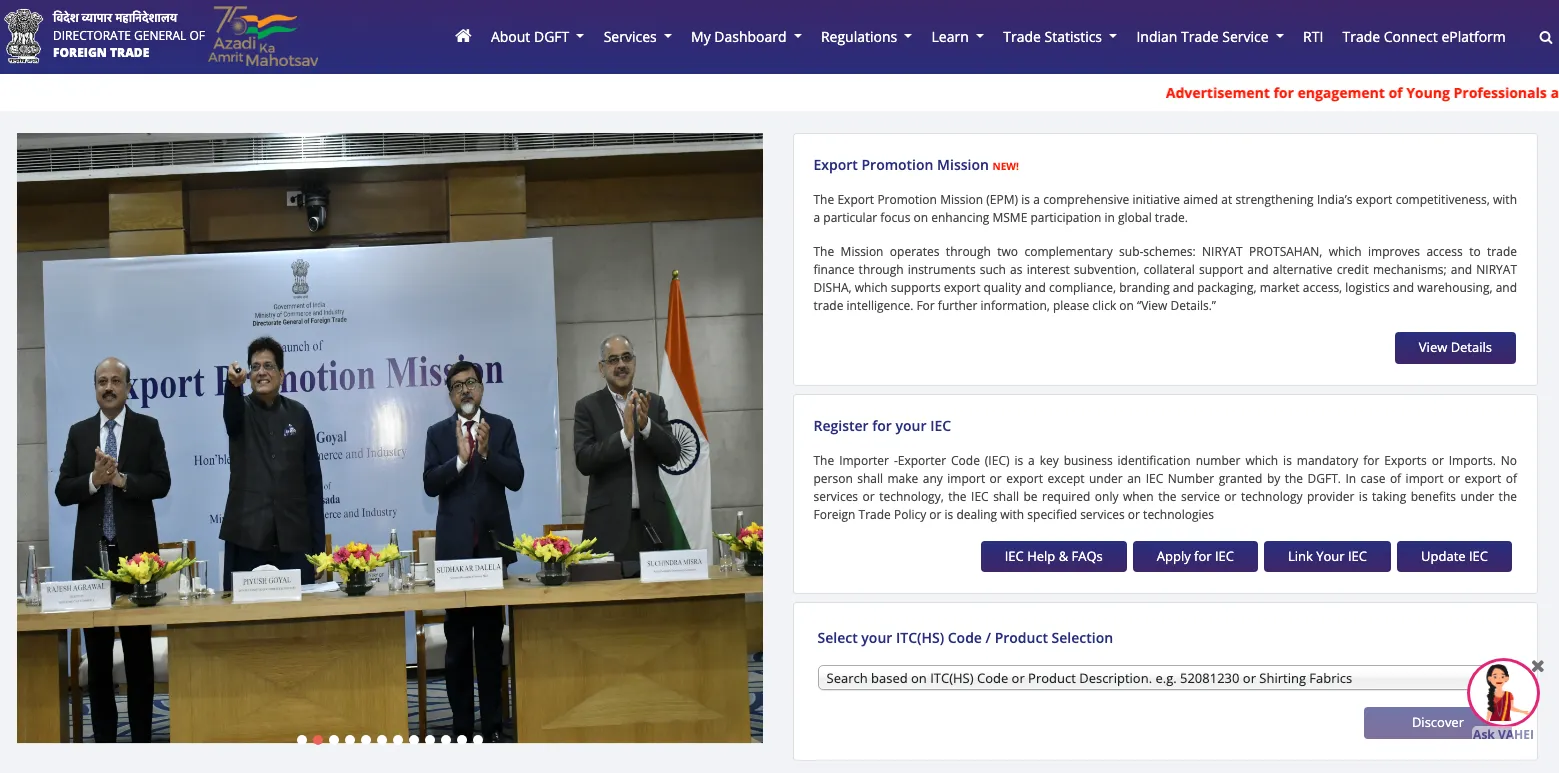
If your application is complete and correct, your IEC is issued within 1–2 working days as a digitally signed PDF certificate sent to your registered email.
Three critical points about IEC:
- Annual update is mandatory: Every year between April 1 and June 30, you must log in to the DGFT portal and confirm your IEC details (even if nothing has changed). Miss two consecutive annual updates and your IEC is automatically deactivated — which stops all your exports cold.
- One IEC per PAN: Only one IEC is issued per PAN number. If you run multiple businesses under the same PAN, they all operate under the same IEC.
- Lifetime validity: No expiry, no annual renewal fee — just the annual confirmation update.
Step 5: Register with an Export Promotion Council (EPC)
Every product category in India has a dedicated Export Promotion Council. Your EPC registration gives you an RCMC (Registration cum Membership Certificate) — which is required to claim most export incentives under the Foreign Trade Policy.
Without RCMC, you cannot claim RoDTEP benefits, apply for Advance Authorisation, get EPCG scheme benefits, or access most government export promotion support. Get your RCMC early — before your first export shipment.
Major EPCs by sector:
- FIEO (Federation of Indian Export Organisations) — Multi-product, general merchandise
- AEPC — Garments and apparel
- APEDA — Agricultural and processed food products
- EEPC India — Engineering goods
- Pharmexcil — Pharmaceuticals
- GJEPC — Gems and jewellery
- Spices Board — Spices
If you are a multi-product exporter or your product does not have a dedicated EPC, register with FIEO. Annual membership fees range from ₹10,000–50,000 depending on the council and your export turnover category.
Step 6: Open an EEFC Account
An EEFC (Exchange Earners' Foreign Currency) account is a current account in foreign currency maintained with your Indian bank. It allows you to hold the USD or EUR you receive from export payments without immediately converting to INR — giving you flexibility to convert when the exchange rate is favorable, or use the foreign currency to pay import suppliers directly.
Ask your bank to open an EEFC account alongside your regular current account. Most major Indian banks offer this. Under current RBI rules, you can retain 100% of your foreign exchange earnings in your EEFC account — there is no mandatory conversion requirement.
Step 7: Find Your First International Buyers
This is where most first-time exporters get stuck the longest. Finding genuine international buyers takes strategy and persistence, but it is absolutely doable in 2026 with the right approach.
B2B Marketplaces
Start with Alibaba — it is still the world's most effective B2B platform for international sourcing, and buyers from 200+ countries actively search it daily. Create a Gold Supplier account (approximately ₹1–2 lakh per year) with a complete, verified profile. Upload high-quality product photos, detailed specifications, certifications, and a realistic MOQ. Respond to every inquiry within 2 hours during business hours — Alibaba's algorithm penalises slow responders with lower search ranking.
Also create profiles on IndiaMART Global, TradeIndia, and GlobalSources. These generate domestic and international inquiries respectively.
LinkedIn Outreach
LinkedIn is underused by Indian exporters and overused by everyone else globally — which means there is genuine opportunity if you do it right. Search for importers, distributors, and procurement managers in your target countries. Connect with a specific, value-focused message — not a generic "I am an exporter" pitch. Mention their company, their product range, and what specifically you can offer them. Send your product specification and a price indication in the follow-up, not the connection request.
Export Promotion Councils
Once you have your RCMC, your EPC regularly shares buyer inquiries with members. FIEO, APEDA, AEPC, and other major councils receive hundreds of buyer inquiries from foreign trade commissions and Indian embassies. These are pre-qualified leads — significantly more valuable than cold marketplace inquiries.
Indian Embassies and Trade Commissions Abroad
The Commercial Wing of Indian Embassies in major countries maintains databases of local importers and distributors. Email them with your company profile, product details, and the type of buyer you are looking for. Many commercial attachés are genuinely helpful and will make introductions or add you to their supplier database.
Trade Fairs
If your budget allows, attending or exhibiting at an international trade fair is one of the highest-conversion channels for export lead generation. Direct face-to-face meetings build trust faster than months of email exchanges. Apply through your EPC for MAI scheme funding — the government reimburses 75–100% of eligible costs for MSME exporters at approved fairs.
Step 8: Price Your Export Product Correctly
Export pricing is fundamentally different from domestic pricing because of the additional cost layers involved. Many new exporters make the mistake of converting their domestic price to USD and sending it as a quote — then wonder why they lose money on the order.
Build your export price from the ground up:
- Ex-Factory Cost: Raw materials + labour + manufacturing overheads + target profit
- Export Packaging: Export-grade cartons, inner packing, moisture protection — typically higher cost than domestic packaging
- Inland Freight: Cost of moving goods from factory to port or ICD
- CHA and Port Charges: Documentation fee, terminal handling charges (THC), container stuffing — allocate ₹8,000–20,000 per shipment depending on volume
- This gives you your FOB Price
- Bank Charges: 0.3–0.5% of invoice value for foreign exchange processing
- Less Export Incentives: Deduct RoDTEP rate % of FOB + Duty Drawback rate % of FOB — these are real income that reduce your net cost
- Add Forex Buffer: Price at a rate ₹2–3 below the current USD/INR rate to protect against adverse rate movements
Your final quoted price should cover all costs, deliver your target margin, and still be competitive in the buyer's market. Use Eximigo's Landed Cost Calculator to model the buyer's total landed cost including their import duty and freight — this helps you understand where your price sits in their total cost picture.
Step 9: Master Export Documentation
Every export shipment requires a specific set of documents. Missing or incorrect documents can delay your shipment, block your GST refund, reject your incentive claims, or cause the buyer's customs to hold the goods at their port. Documentation is not optional bureaucracy — it is the legal infrastructure of international trade.
The core documents for a standard export shipment are:
Commercial Invoice
The main billing document. Must include your GSTIN, IEC, the buyer's details, product description with HS code, quantity, unit price, total FOB/CIF value in the agreed currency, Incoterms, payment terms, and the GST declaration (LUT ARN or IGST amount). This is a GST tax invoice — it must comply with GST rules under Rule 46 of CGST Rules.
Packing List
A package-by-package breakdown of the shipment contents — number of packages, dimensions, net weight, gross weight, marks and numbers. Must match the Commercial Invoice exactly. Customs and the freight forwarder both require this.
Shipping Bill
The primary customs clearance document for exports from India. Filed electronically on ICEGATE by your CHA. Contains all the shipment details — HS code, FOB value in INR, buyer and seller details, port of loading, vessel name, and your incentive selections (RoDTEP, Drawback). Your CHA handles this — you provide them the invoice, packing list, and any product-specific documents they need.
Bill of Lading (Sea) / Airway Bill (Air)
The transport document issued by the shipping line or airline. For sea freight — the Bill of Lading is both a receipt of goods and a document of title. The buyer needs the original B/L to take delivery at the destination port. For air freight — the Airway Bill is non-negotiable and delivery is made to the named consignee by identity proof.
Certificate of Origin
Certifies that the goods were produced or manufactured in India. Required by most importing countries for customs classification. If you are shipping to a country with which India has an FTA (UAE under CEPA, Australia under ECTA, ASEAN under India-ASEAN FTA), use the specific preferential COO for that agreement — it allows your buyer to claim lower or zero import duty.
Product-Specific Documents
Depending on what you are exporting, additional documents may be required:
- Agricultural goods: Phytosanitary certificate from Plant Quarantine, APEDA certificate
- Food products: FSSAI Export Health Certificate
- Spices: Spices Board certificate
- Pharmaceuticals: WHO-GMP certificate, Free Sale Certificate, CDSCO export NOC
- Chemicals: MSDS/SDS, REACH compliance (for EU)
Download Eximigo's complete export documents checklist: Complete Export Documents Checklist — Free PDF
Step 10: Choose Your Shipping Mode and Work with a CHA
As a first-time exporter, you should not attempt to handle shipping and customs clearance yourself. Appoint a reliable CHA (Customs House Agent) near your nearest export port. They will handle Shipping Bill filing, customs examination coordination, port documentation, and liaison with the shipping line on your behalf.
To find a CHA: check the CBIC CHA licence directory on cbic.gov.in, ask for references from other exporters in your industry, and always verify their CHA licence number before engaging them.
Sea Freight vs Air Freight
For most standard commercial exports of non-perishable goods, sea freight is the default choice — it is significantly cheaper than air, handles bulk volumes, and is the accepted standard for most product categories.
Use air freight only when: goods are perishable (fresh produce, flowers, pharmaceutical samples), the order is high-value and urgent, or your product has a high value-to-weight ratio where the faster transit justifies the higher cost (electronics, jewellery, pharmaceutical formulations).
Current approximate sea freight rates from India (2026):
- India to Middle East: USD 400–800 per 20ft container
- India to USA: USD 2,000–3,500 per 20ft container
- India to Europe (via Cape): USD 2,500–4,000 per 20ft container
- India to Southeast Asia: USD 300–600 per 20ft container
Step 11: Claim Your Export Incentives
After your goods are shipped and EGM is filed by the shipping line, you are entitled to claim your export incentives. These are real cash and scrip income that significantly improve your export economics.
RoDTEP (Remission of Duties and Taxes on Exported Products)
RoDTEP reimburses embedded state and local taxes (VAT on fuel, mandi tax, electricity duty) that are not refunded under any other mechanism. Rates are 0.3–4.3% of FOB value depending on your HS code. Credited as duty credit scrips on ICEGATE — usable against import duty or sellable on BSE/NSE.
To claim: instruct your CHA to select RoDTEP on your Shipping Bill at time of filing. The scrips are auto-generated after EGM filing — no separate application needed.
Duty Drawback
Refund of customs duty paid on imported inputs used in export production. Available as All Industry Rate (AIR) — a pre-fixed percentage of FOB value published annually in the Drawback Schedule. Credited as cash directly to your bank account.
Claim window: 3 months from export date. Do not miss this deadline.
GST Refund
If you exported under LUT (the recommended route), you accumulate ITC on your inputs which is refundable via Form RFD-01 on the GST portal. File the refund application promptly — do not let ITC accumulate for months without claiming.
Common Mistakes First-Time Exporters Make
Having been through this process and having spoken with dozens of new exporters, I want to call out the mistakes I see most frequently — because most of them are entirely avoidable.
Not filing LUT before the first export. Every year, new exporters export their first shipment without filing LUT — because they didn't know they needed to, or forgot. Result: Shipping Bill shows IGST Paid but no IGST was actually paid — creating a mismatch that blocks refunds for months. File LUT on April 1st every year without exception.
Wrong HS code. Exporters use a vague or approximate HS code because they are not sure of the correct one. This results in wrong RoDTEP and Drawback rates, potential customs classification disputes, and incorrect import duty assessment in the buyer's country. Spend 20 minutes getting this right before your first shipment.
Skipping buyer verification. Accepting a large first order from an unknown buyer on DA (deferred payment) terms without any verification. This is how exporters lose crores. For your first order with any new buyer, insist on advance payment or LC — always.
Under-pricing by not accounting for incentives. Calculating your export price without deducting the RoDTEP and Drawback income you will receive after shipment. These incentives can be 2–5% of FOB value — ignoring them means you either under-price (losing margin) or over-price (losing the order).
Missing the IEC annual update. Forgetting to do the April–June annual update on DGFT portal. Two missed years = automatic IEC deactivation = all exports stop. Put a calendar reminder on April 1st every year.
How Long Does It Take to Start Exporting?
Based on my experience and that of exporters I have mentored, here is a realistic timeline from deciding to start to your first shipment:
- Days 1–7: Business structure finalised, current bank account opened (or in process)
- Days 3–10: GST registration applied — GSTIN received within 7 days typically
- Days 5–7: IEC applied — received within 1–2 working days
- Day 8–10: LUT filed on GST portal (takes 10 minutes)
- Days 10–25: EPC membership and RCMC application submitted — certificate in 15–30 days
- Weeks 3–8: Buyer outreach begins — Alibaba listing, EPC buyer inquiries, LinkedIn outreach
- Weeks 6–16: First genuine buyer inquiry, samples sent, price negotiation
- Weeks 8–20: First purchase order received
- Weeks 10–24: First shipment dispatched
Realistically, most motivated first-time exporters with a clear product and some buyer outreach effort complete their first shipment within 3–6 months of seriously starting the process. The wide range reflects the significant variance in how quickly buyers come through — some exporters get their first order in 6 weeks, others take 6 months. Persistence is the key variable.
Your Export Setup Checklist
- ✅ Product decided and HS code identified
- ✅ Export restrictions checked — product is freely exportable or has required licence
- ✅ Business entity registered (Proprietorship / Pvt Ltd / LLP)
- ✅ Current bank account opened in business name
- ✅ GST Registration obtained — GSTIN received
- ✅ LUT filed on GST portal for current financial year
- ✅ IEC Code applied and received from DGFT
- ✅ AD Code registered with customs at your nearest export port
- ✅ EEFC account opened for foreign currency receipts
- ✅ EPC membership applied — RCMC in process or received
- ✅ Alibaba/B2B platform profile created
- ✅ Company profile and product catalogue prepared
- ✅ CHA identified near your nearest export port
- ✅ Export costing sheet prepared for your product
- ✅ Buyer outreach actively underway
Frequently Asked Questions
Can I start an export business as an individual without a registered company?
Yes. You can export as a sole proprietor without formally registering a company. You still need GST registration, an IEC code, and a current bank account in your business name. Sole proprietorship is the simplest and fastest way to start. Consider converting to Pvt Ltd once your exports are consistently above ₹50 lakh/year.
How much money do I need to start an export business in India?
The registrations themselves are inexpensive — GST is free, IEC costs ₹500, EPC membership ₹10,000–50,000. The real capital requirement depends on your product. The minimum working capital is whatever you need to manufacture/procure the first order before receiving payment. For most MSMEs, ₹2–10 lakh is enough to start with a small first order, especially if you negotiate advance payment terms.
Do I need a warehouse or factory to export?
No. Many Indian exporters are merchant exporters — they source products from manufacturers and export in their own name without owning a factory or warehouse. This is completely legal and common. You add value through buyer relationships, quality control, and logistics management rather than manufacturing.
What is the minimum export order value?
There is no legal minimum. However, very small orders (below USD 500–1,000) may not be economically viable once you factor in fixed export costs — documentation, CHA charges, port handling. For small orders, consider courier export (DHL/FedEx) which eliminates most port-related fixed costs.
Is export income tax-free in India?
Export income itself is not tax-free — it is part of your normal business income and subject to income tax. However, profits from export turnover may qualify for certain deductions. Consult your CA for specifics based on your business structure and export volume. Export proceeds received in foreign currency do not attract GST — exports are zero-rated under GST.
Conclusion
Starting an export business in India in 2026 is genuinely achievable — more so than at any time in the past. The registrations are digital and fast, the incentive schemes are generous, the logistics infrastructure has improved significantly, and global demand for Indian goods across dozens of categories is at an all-time high.
The path from "I want to export" to "first shipment dispatched" is not complicated — it is a sequence of steps, each of which is manageable on its own. Get your registrations in order, price your product correctly, reach out to buyers systematically, and work with a reliable CHA to handle the shipping end. That is the entire playbook.
The hardest part is not the documentation or the shipping logistics. It is persistence — the willingness to keep sending buyer outreach messages, keep refining your product offering, and keep learning from every inquiry and every shipment. That persistence compounds into a genuine, sustainable export business over time.
Your first export shipment is closer than you think. Start today.