Most export success stories feature companies with dedicated export teams, large production facilities, and budgets that small traders cannot relate to. I wanted to share a different kind of story.
I came across Ramesh’s story while researching how small traders in India were breaking into export markets. What struck me was how simple his starting point was — and how methodically he moved forward from there. No shortcuts, no connections, no large capital. Just a product he already knew, a process he learned step by step, and the patience to see it through.
By the end of his first year, Ramesh had completed two export shipments. This article walks through exactly how he did it.
Who is Ramesh? The Starting Point
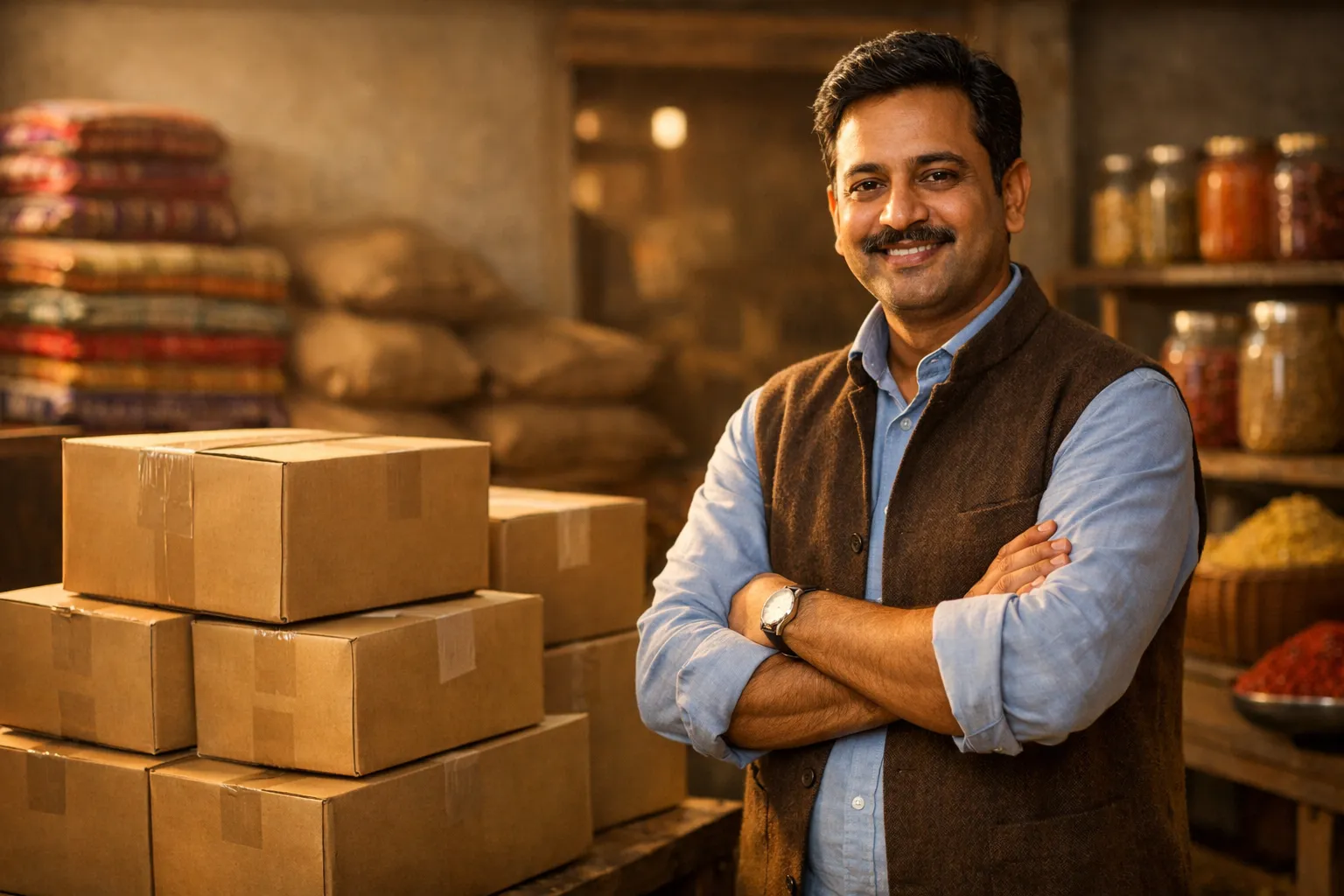
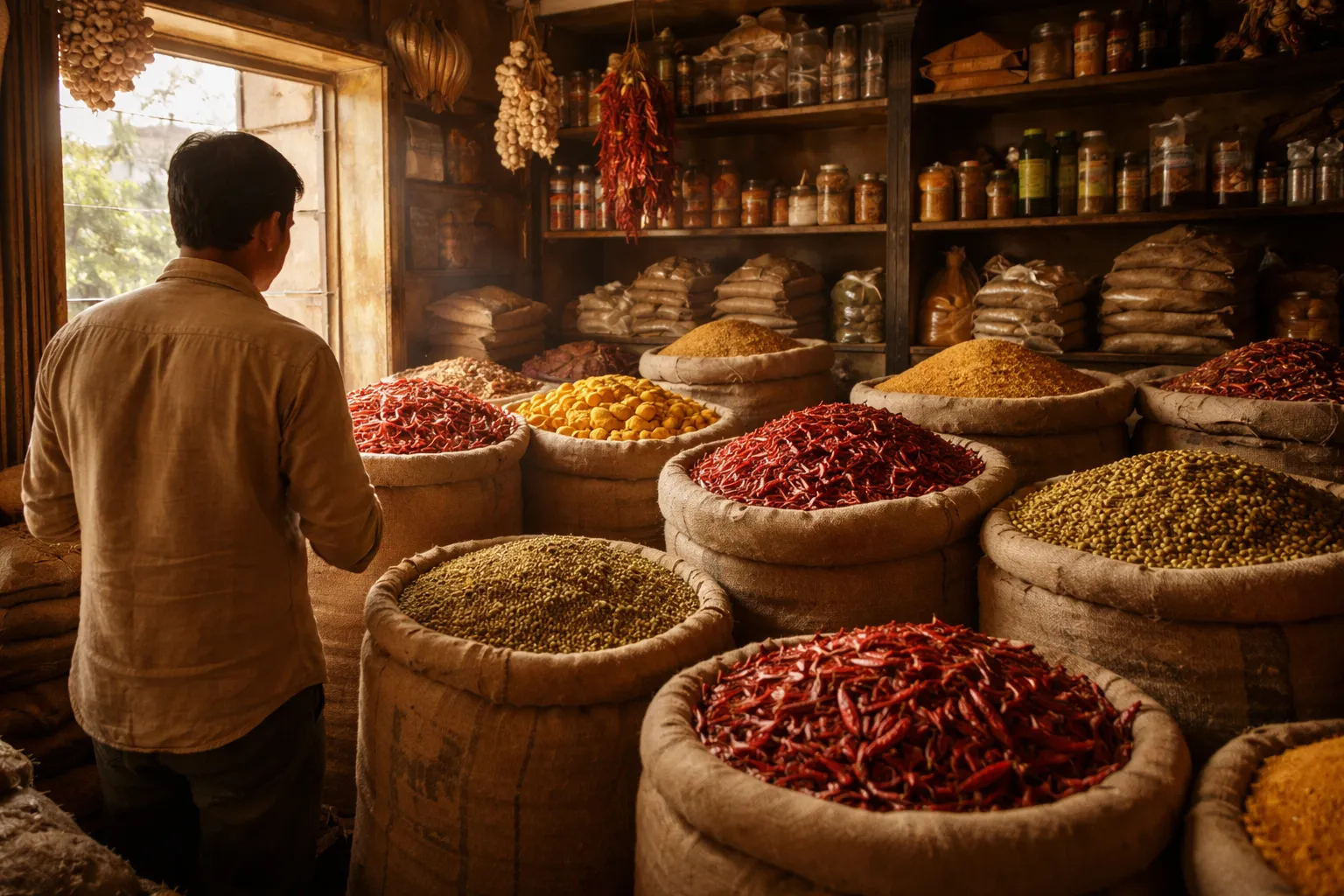
Ramesh runs a small spice trading shop in Guntur, Andhra Pradesh — one of India’s most significant spice trading hubs. He has been sourcing red chillies, turmeric, and coriander from local farmers for over eight years, selling to wholesale buyers and small retailers in the domestic market.
The business sustains itself — but growth had plateaued. Domestic prices were competitive, margins were thin, and the market was crowded with traders doing the same thing at similar prices.
The idea of export came from a conversation with a friend who was exporting rice. The friend mentioned almost offhandedly that chilli prices in international markets were significantly higher than what Ramesh was getting domestically. That single observation was enough to make Ramesh curious.
His situation at the starting point: no export experience, no knowledge of customs or freight, no foreign buyer contacts, and approximately ₹50,000 he was willing to set aside to explore whether export was actually possible for a business like his.
The First Question — Is My Product Exportable?
Before spending a rupee on registrations or platforms, Ramesh did something that most beginners skip: he validated whether international demand actually existed for his product.
He used ITC Trade Map — trademap.org — to check which countries were importing Indian red chillies and in what volumes. The results were clear: the USA, UAE, UK, and Malaysia were all significant importers, and India was already a major supplier to each of those markets. Demand was proven. He was not trying to create a market — he was trying to enter one that already existed.
He then checked DGFT’s export policy for his product category to confirm there were no export restrictions, bans, or licensing requirements on red chillies. There were none for his grade and form.
He identified the correct HS Code — Chapter 09, specifically 09042190 for dried red chillies — and noted that FSSAI registration and Spices Board of India registration were both mandatory for spice exports from India.
The lesson I draw from this step is straightforward: product validation before registration is not just good practice — it is how you avoid spending money on a direction that might not work.
Getting the Registrations Done
Ramesh already had a sole proprietorship registered in his shop name and an active GST number from his domestic trading activity. That eliminated two registrations from his list immediately.
IEC Code: He applied himself on the DGFT portal — dgft.gov.in — paid the ₹500 government fee, and received his IEC Code within two working days. He followed the steps carefully and did not need an agent for this one.
You can read our detailed guide on: “How to Get IEC Code in India: Step-by-Step Guide“
LUT Filing: Since he already had GST, he filed his Letter of Undertaking on the GST portal at the start of the financial year — free of charge — which meant he could export without paying IGST upfront on his shipments.
FSSAI Licence: Ramesh applied for a State FSSAI food business licence, which is required for the export of food products including spices. The process involved submitting business details, the premises address, and the product category. Cost was approximately ₹2,000 to ₹5,000 including documentation help from a local consultant.
Spices Board Registration: This is specific to spice exporters and is mandatory. The Spices Board of India — under the Ministry of Commerce — requires all spice exporters to register before their first shipment. Ramesh visited the regional Spices Board office and completed the registration. The Spices Board also provided him with a list of registered international importers — something he had not expected and which proved useful later.
AD Code: He visited his bank branch, requested the AD Code Letter, and had his CHA register it on ICEGATE before the first shipment.
Total registration cost across all steps: approximately ₹15,000 to ₹20,000 — some of which included agent fees for FSSAI and logistical help. Timeline from starting to completing all registrations: approximately three to four weeks.
Finding the First Buyer
With registrations in place, Ramesh turned to finding a buyer. He took a multi-track approach rather than waiting on a single method.
He created a free listing on IndiaMART with product photos, grade specifications, moisture content, available quantity, and an FOB price. He spent time on the listing — clear photos, accurate product description, and a professional presentation — rather than putting up a placeholder and hoping for responses.
He also put together a basic product catalogue — a three-page PDF covering his red chilli grades, packaging options, certifications, and pricing. Nothing elaborate. Legible, accurate, and professional.
Through the Spices Board, he obtained a directory of registered importers across several markets. He used this to identify spice importers in UAE and UK and sent fifteen to twenty cold emails over two weeks — short, specific, with his catalogue attached and his Spices Board registration number mentioned.
After six weeks, he received his first serious inquiry — from a spice importer in Dubai who had found his IndiaMART listing. The buyer asked detailed questions about moisture content, stemless grade percentage, and packaging. Ramesh answered every question specifically. The buyer then asked for a sample before committing to an order.
You can read our detailed guide on: “How to Find Foreign Buyers for Your Export Business in India”
Sending the Sample and Waiting
The sample stage is where many inquiries die — either because the exporter sends a poor quality sample, packages it carelessly, or sends nothing at all and asks the buyer to just trust the photos.
Ramesh approached this differently. He prepared a 500g sample of his best grade red chilli — stemless, machine-cleaned, vacuum-packed in a food-grade pouch, properly labelled with product name, grade, net weight, and his company details. He sent it via international courier to Dubai — cost approximately ₹3,500.
With the sample, he included a covering letter, a copy of his FSSAI certificate, and his Spices Board registration copy. The buyer could verify his credentials before the shipment arrived.
Ten days later, the buyer responded positively on quality — but asked for a moisture content certificate. This was a fair request — moisture content directly affects shelf life and quality in destination markets.
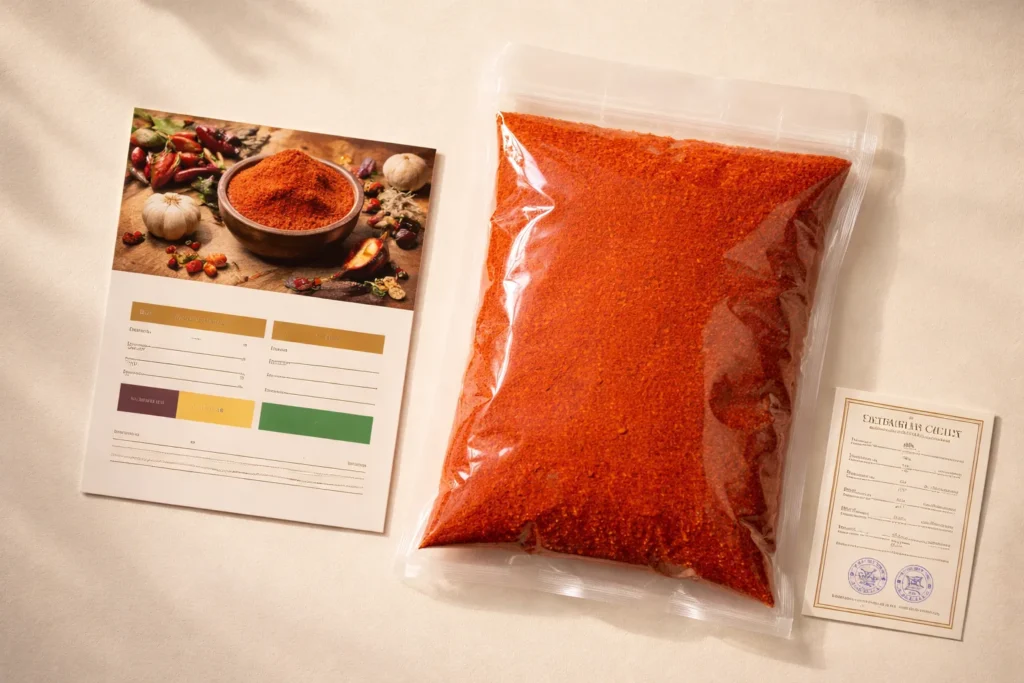
Ramesh got the sample tested at a NABL-accredited laboratory near Guntur. Cost was ₹1,200. He received the report within three working days and sent it to the buyer.
The buyer confirmed he wanted to place a trial order.
The First Order — Details and Challenges
The first order was modest by any measure — 500 kg of red chilli (stemless, machine cleaned) to Dubai, UAE.
Order value: approximately USD 1,200. Payment terms: 100% advance via T/T — Ramesh insisted on this and the buyer agreed after a short back and forth. The buyer was comfortable partly because the amount was small and partly because Ramesh had already built credibility through the sample process. Incoterm: FOB Nhava Sheva (Mumbai port).
The challenges that came up — and they always do on a first shipment:
Finding a freight forwarder willing to handle a small LCL (Less than Container Load) shipment without excessive charges took more calls than Ramesh expected. He eventually found one through a reference from his CHA contact.
Getting the Phytosanitary Certificate — required for agricultural products — from the Plant Quarantine Department involved a brief inspection and a few days of processing time. This was a step he had not fully anticipated and which added a week to his preparation timeline.
The AD Code registration at the Nhava Sheva port had a one-day processing delay — which briefly held up the Shipping Bill filing. His CHA resolved it quickly, but it was a reminder of why registrations need to be completed well before the shipment date.
You can read our detailed guide on: “What is Advance Payment in Export? When Safe, When Risky”
The Shipment — What Happened
Ramesh engaged a CHA based in Mumbai to handle the customs clearance — coordinating with him remotely from Guntur throughout the process.
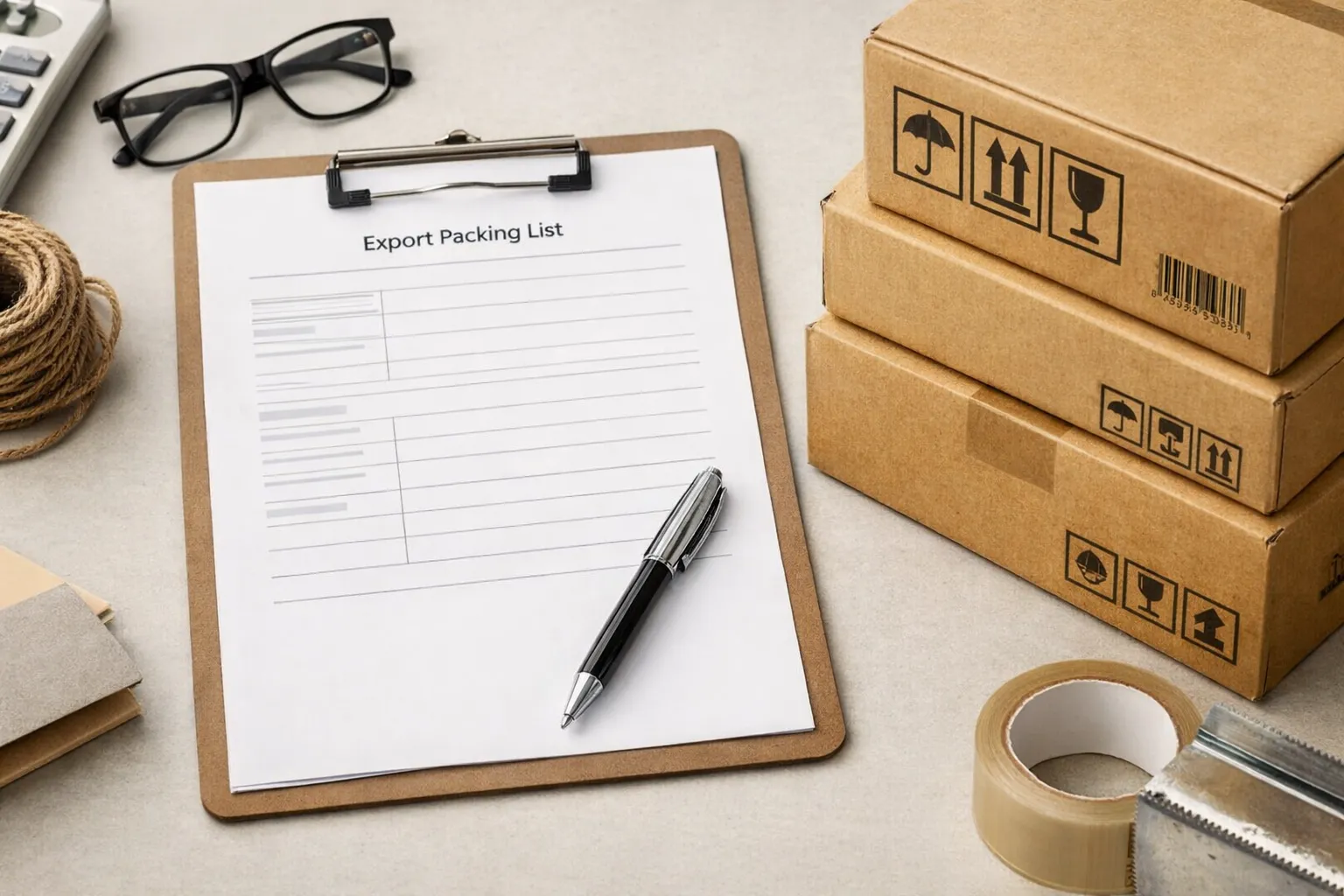
The goods were loaded onto a truck in Guntur and transported to Mumbai — two days of road transit. The CHA received the goods at the Container Freight Station, verified the packing list and commercial invoice, and filed the Shipping Bill on ICEGATE.
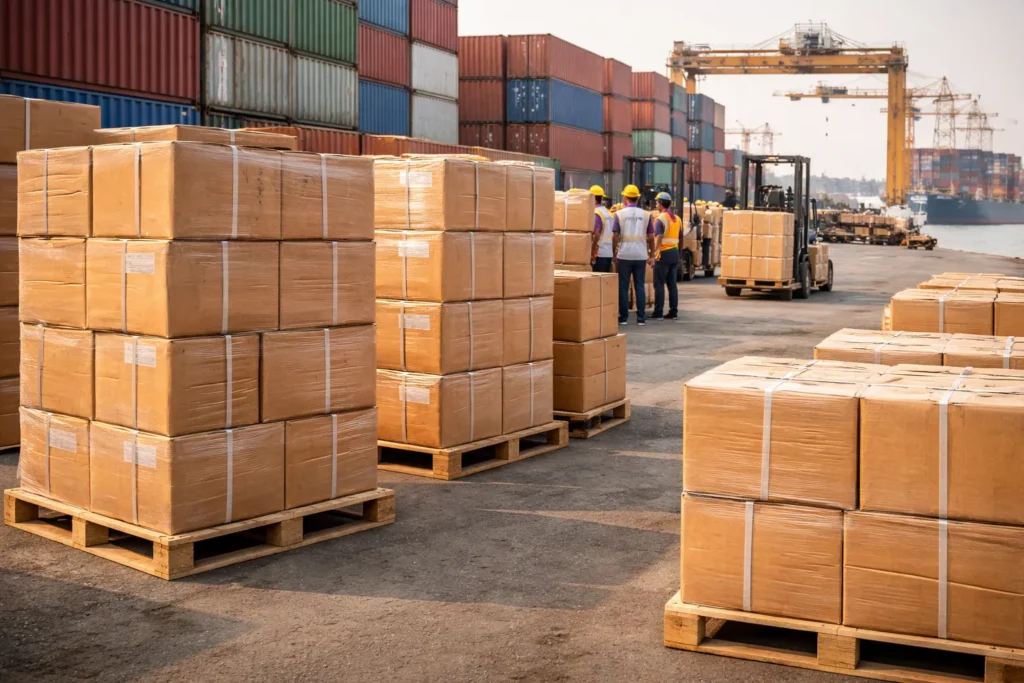
Customs inspection was carried out — a standard examination for a first-time exporter’s first shipment. The goods cleared without issues. They were loaded onto the vessel and a Bill of Lading was issued by the shipping line.
Ramesh sent the complete document set to the buyer — scanned copies by email first, originals by courier — commercial invoice, packing list, Bill of Lading, Phytosanitary Certificate, FSSAI certificate, and the moisture content lab report.
The buyer received the goods in Dubai within twelve days of the vessel departure. Quality matched the sample. No complaints. The advance payment had already been received before shipment, so there was no payment follow-up needed.
First shipment: complete.
You can read our detailed guide on: “How Export Actually Works — The Full Process in Plain Language“
The Numbers — First Shipment Financials
| Item | Approximate Cost |
|---|---|
| Product cost (500 kg red chilli) | ₹35,000 |
| Packaging and labelling | ₹3,000 |
| Lab testing and certificates | ₹2,500 |
| Freight — LCL to Dubai | ₹8,000 |
| CHA charges | ₹5,000 |
| Sample courier cost | ₹3,500 |
| Miscellaneous | ₹2,000 |
| Total Cost | ₹59,000 |
| Revenue (USD 1,200 at ₹83/USD) | ₹99,600 |
| Gross Profit on First Shipment | ₹40,600 |
A few honest notes on these numbers. The gross profit figure does not account for the registration costs of ₹15,000 to ₹20,000 that Ramesh had already spent — those are setup costs spread across all future shipments, not just the first one. It also does not account for his time, the sample cost that preceded the order, or the overhead of running his regular shop business during this period.
What the numbers do show is that the margin on even a small first export shipment can be meaningful — roughly 40% gross margin on a 500 kg trial order. That alone was enough for Ramesh to know the direction was worth pursuing seriously.
What Ramesh Did After the First Shipment
The Dubai buyer came back within six weeks with a second order — 2,000 kg, four times the volume of the first.
For the second order, Ramesh negotiated the payment terms to 50% advance and 50% before BL release — a structure he was comfortable with given that one successful transaction had already established a baseline of trust.
He used the proceeds from the first two shipments to get APEDA registration — which opened up a broader range of agricultural and processed food export options beyond just spices.
He applied for RoDTEP benefits on his HS Code — an incentive he had been eligible for from the first shipment but had not yet claimed — and started the process of recovering that entitlement.
He also began reaching out to buyers in UK and Malaysia using the same approach that had worked for Dubai — cold email with catalogue, supported by his growing list of credentials and now an actual export track record to reference.
Key Lessons From Ramesh’s Story
Satyajit’s perspective on what actually matters in this story:
Start with what you already have access to. Ramesh did not need a new product, a new factory, or a new business. He used the product he already sourced, the supplier relationships he already had, and the quality knowledge he had built over eight years. Export was an additional channel for what already existed.
Validate demand before spending. The ITC Trade Map check took one afternoon and cost nothing. It confirmed that international buyers were already purchasing his product category at significantly better prices. That validation made every subsequent step feel purposeful rather than speculative.
Spices Board and FSSAI are non-negotiable. These two registrations are mandatory for spice exports from India — not optional, not something to sort out later. Getting them done in the first month of his export journey meant they were never a bottleneck.
Sample quality determines the first order. Ramesh’s sample was vacuum-packed, properly labelled, and accompanied by his certifications. When the buyer asked for a moisture certificate, he got it done in three days. That responsiveness and professionalism converted a speculative inquiry into a confirmed order.
100% advance for the first order is worth insisting on. He lost at least two potential buyers during outreach who refused advance terms. He does not regret it. The one who agreed paid in full before shipment and turned into a repeat buyer. The ones who refused were unwilling to commit even a small amount to test a new supplier — which tells its own story.
The first shipment teaches more than any guide can. The AD Code delay, the Phytosanitary Certificate timeline, the freight forwarder search — none of these were covered in what Ramesh had read before starting. He learned them by doing. That is still how it works.
Conclusion
Ramesh’s story is not exceptional. It is repeatable — by anyone with access to a quality product, the patience to complete the process correctly, and the discipline to stay consistent through the months before the first order arrives.
What made the difference was not capital, connections, or luck. It was product validation before spending, professional sample presentation, insistence on payment security, and methodical follow-through at every step.
The first shipment was not Ramesh’s finish line. It was his proof of concept — for himself as much as for his buyer.
Key Takeaways
- A small spice trader with approximately ₹50,000 in starting capital can realistically complete their first export shipment within four to six months of beginning the process seriously.
- Spices Board registration and FSSAI licence are both mandatory for spice exports from India — these must be completed before the first shipment, not after.
- Sending a professional sample with supporting certificates — FSSAI, Spices Board registration, and lab reports — significantly increases the conversion rate from inquiry to confirmed order.
- Insisting on 100% advance payment for the first order protects against payment risk with unknown buyers — some buyers will decline, but those who agree are demonstrating genuine intent.
- The first export shipment is a learning experience — the goal is to execute it correctly and build a relationship that leads to a second and third order, not to maximise profit on shipment one.
Frequently Asked Questions
Q1: What registrations are mandatory to export spices from India?
Four registrations are mandatory for any spice exporter in India — and all four must be in place before the first shipment.
IEC Code — Import Export Code from DGFT — is the foundational export registration required for all exporters regardless of product category. Without it, no Shipping Bill can be filed.
GST Registration with LUT filing — required for exporting under the zero-rated GST route without paying IGST upfront. If you already have GST for domestic trading, you only need to file the LUT additionally.
FSSAI Licence — spices are food products and fall under FSSAI’s regulatory scope. A State or Central FSSAI licence is required depending on your business scale and whether you process or only trade the spices.
Spices Board Registration — the Spices Board of India requires all spice exporters to register before exporting. This registration also gives access to buyer databases, trade leads, and quality development support from the Board.
Additional registrations like AD Code and Phytosanitary Certificate arrangements are also part of the setup — but the four above are the core mandatory ones specific to spice export.
Q2: How much does it cost to send an export sample to a foreign buyer?
The cost of sending a sample internationally depends on the weight, destination, and courier service used.
For a small spice sample — 250g to 500g — international courier charges to Middle Eastern countries like UAE typically range from ₹2,500 to ₹4,000. For Europe or North America, the range is ₹3,500 to ₹6,000 depending on the courier and service level.
In addition to courier charges, factor in the cost of proper packaging — food-grade pouches, vacuum sealing, and outer courier packaging — which adds ₹200 to ₹500 for a small sample. If lab testing is requested by the buyer, add ₹800 to ₹1,500 for a standard moisture content or quality test at a NABL-accredited laboratory.
Total sample cost for a small spice shipment to the Middle East: approximately ₹3,500 to ₹5,500 including packaging and basic testing. Treat this as a customer acquisition cost — a well-executed sample that converts to a first order is one of the best returns on investment in early-stage exporting.
Q3: Can a small spice trader export directly without going through an export house?
Yes — completely. There is no legal requirement to route your exports through an export house or trading company. A sole proprietor or small business with an IEC Code, GST registration, FSSAI licence, and Spices Board registration can export directly to international buyers.
Export houses — also called merchant exporters or export trading companies — exist for traders who prefer to sell to a domestic intermediary who then handles the export process. They simplify things by removing the need for the original seller to deal with customs, freight, and foreign buyers directly. But they also take a margin, and the original seller loses visibility into the international price their product is fetching.
Exporting directly means more complexity — you handle the CHA, freight forwarder, documentation, and buyer communication yourself — but you capture the full export margin. For a trader with quality product and the patience to learn the process, direct export is the more commercially rewarding path. Ramesh’s story is an example of exactly that.