How to Find International Buyers for Your Export Product: 10 Proven Methods That Actually Work
Satyajit Srichandan
22 min read
Introduction
The question I get asked most often by new exporters is not about documentation, not about GST, not about freight — it is this: "How do I actually find buyers?"
Everything else in export — the registrations, the compliance, the shipping logistics — is learnable and procedural. But finding buyers requires a combination of strategy, persistence, and the kind of judgment that comes only from actually doing it. I have been through the process of building a buyer base from scratch, from the first hesitant email sent into the void to the point where inbound inquiries started arriving consistently. The methods that worked are not secret — but they require genuine effort, patience, and the discipline to do them systematically rather than sporadically.
This guide covers ten methods for finding international buyers, ordered roughly from the highest volume to the most relationship-intensive. Not all ten will apply to every exporter or every product. But most exporters who build a sustainable international buyer base use at least four or five of these methods in combination — because buyer acquisition through a single channel is fragile, and diversification across methods compounds your reach.
Before the methods: one framing point that will save you months of wasted effort. The goal of buyer outreach is not to send the most messages. It is to reach the right people — importers who are already buying your product type, who have the capacity and track record to place commercial orders, and who have a reason to consider switching or diversifying their source. Quality of targeting consistently outperforms volume of outreach. Keep that principle in mind as you implement each method.
Method 1: B2B Marketplaces — Alibaba, IndiaMART Global, and Trade India
B2B marketplaces are the most obvious starting point and, for many product categories, genuinely the most effective channel for reaching international buyers at scale. They are not a shortcut — a well-performing B2B marketplace presence requires sustained investment of time and money — but they are the closest thing the export world has to an inbound marketing machine once set up correctly.
Alibaba
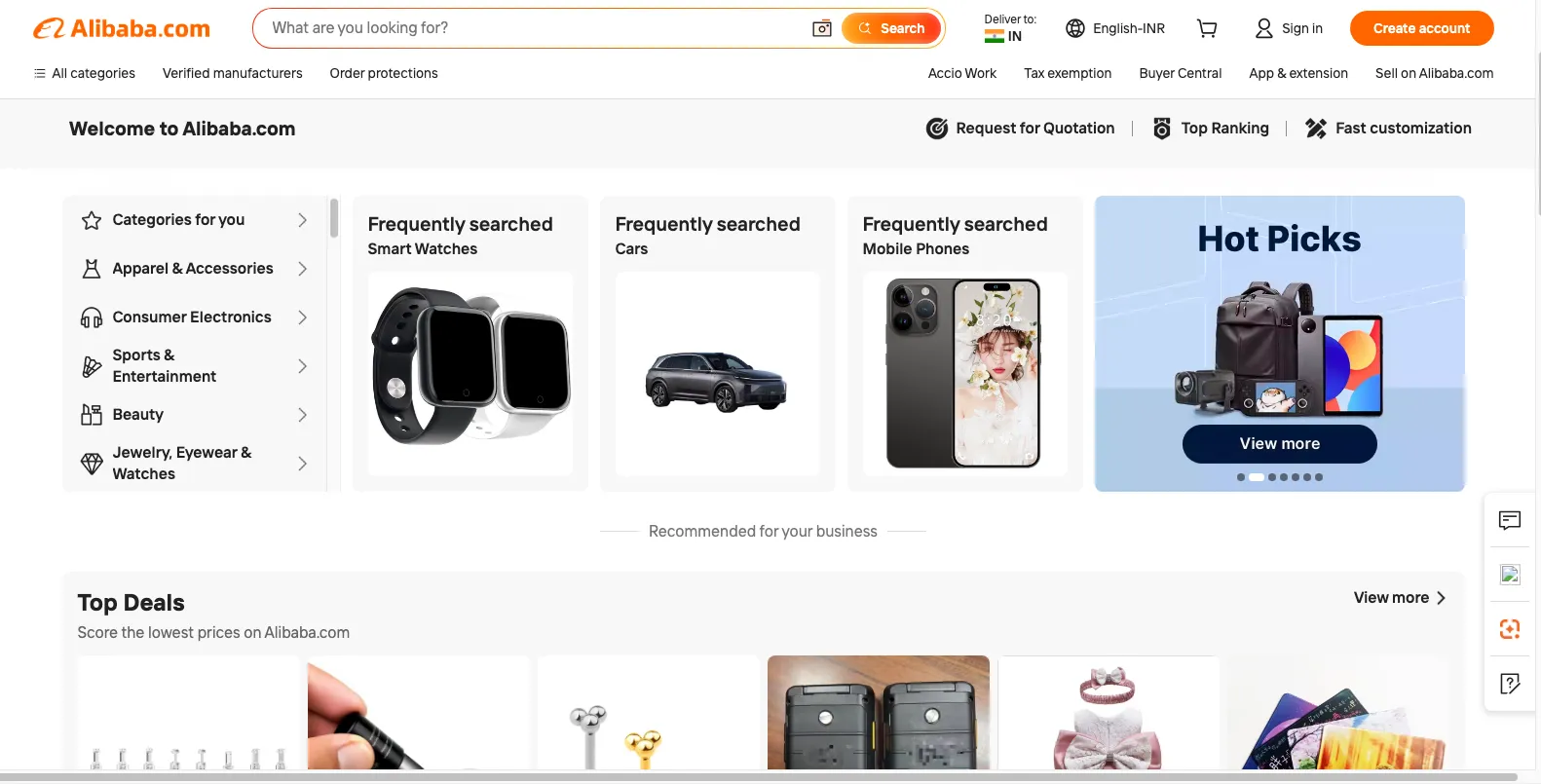
Alibaba.com — the world's largest B2B marketplace, with 40 million+ registered buyers from 200+ countries
Alibaba remains the dominant global B2B platform with over 40 million registered buyers from 200+ countries. For Indian exporters targeting international buyers in the US, Europe, Middle East, Southeast Asia, and Latin America, Alibaba is often the single highest-volume source of genuine inquiries.
Gold Supplier membership costs: Approximately USD 1,500–3,000 per year depending on your category and subscription level. This is a real investment, and it pays off only if you use the platform actively — uploading complete product listings, responding to inquiries within 2 hours, maintaining high response rate metrics, and collecting Trade Assurance orders to build your review score.
Complete product specifications — dimensions, weight, materials, certifications, MOQ, lead time
Honest pricing range (not absurdly low "contact for price" — buyers filter by price)
Verified certifications displayed prominently — ISO, HACCP, CE, organic, whatever is relevant to your product
A strong company profile with facility photos, production capacity, and years in business
Video content — product demonstration videos significantly increase inquiry rates
Response discipline: Alibaba's algorithm ranks suppliers partly on response rate and response time. Buyers shortlist suppliers with response rates above 90% and response times under 4 hours. If you cannot monitor inquiries regularly, assign someone on your team to do it. An unanswered inquiry on Alibaba is a buyer going to your competitor.
IndiaMART Global and TradeIndia
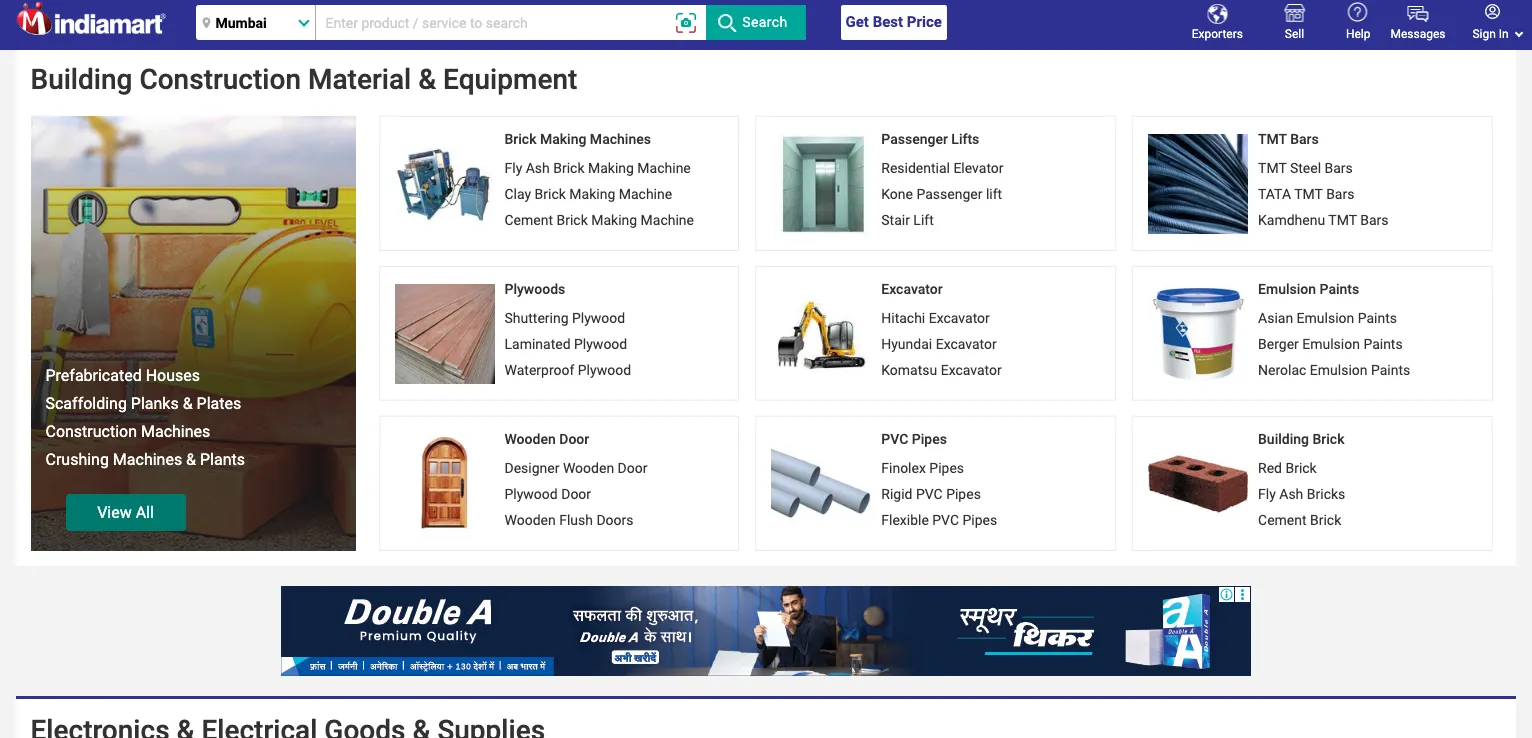
IndiaMART Global — a cost-effective starting point for Indian exporters targeting international buyers in specific categories
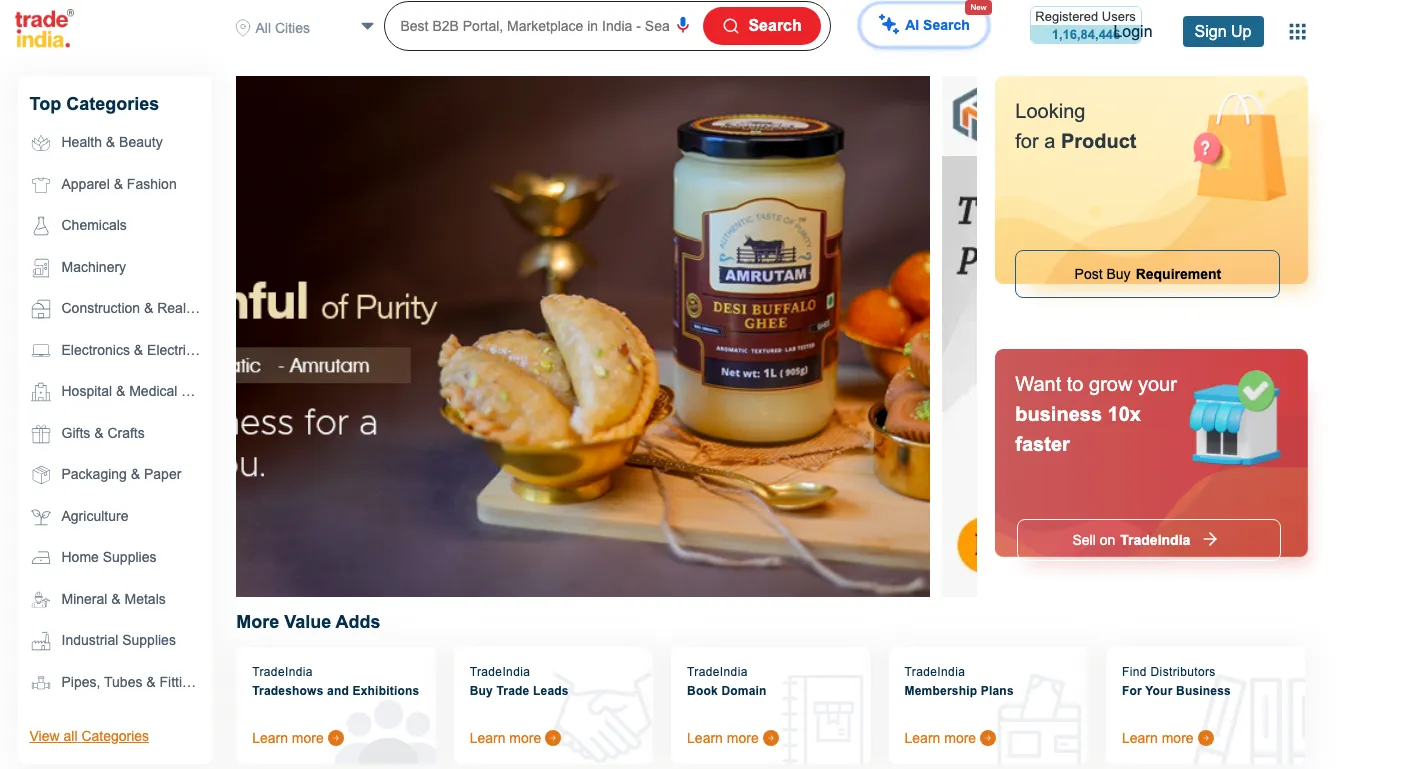
These platforms generate a mix of domestic and international inquiries. IndiaMART's international buyer traffic is smaller than Alibaba's, but the platform is significantly cheaper and the inquiries can be more targetted for specific Indian goods categories. Worth maintaining as a secondary presence, particularly if your budget does not accommodate Alibaba Gold Supplier at the start.
TradeIndia.com — a secondary B2B platform worth maintaining alongside IndiaMART for additional international inquiry coverage
Global Sources
Particularly strong for electronics, machinery, and consumer goods categories. Well regarded by professional buyers in Hong Kong, Taiwan, and Southeast Asia. Worth evaluating if your product falls into these categories.
Method 2: LinkedIn — The Most Underused Buyer Acquisition Channel
If there is one channel that Indian exporters systematically underinvest in, it is LinkedIn. Most export-focused outreach on LinkedIn from India is generic, untargeted, and immediately ignored. Done correctly — with specificity, genuine value, and persistence — LinkedIn outreach to professional importers and procurement managers is one of the highest-conversion buyer acquisition methods available.
Finding the Right Contacts
Use LinkedIn's search function with specific keywords:
"Import Manager" + your product category + country
"Procurement Director" + company type + country
"Sourcing Manager" + industry + country
Search the company names of importers you have identified from import data (Method 4 below) to find specific individuals
LinkedIn Sales Navigator (paid, approximately USD 80/month) gives significantly more search filters and contact data. For serious export marketers, it is worth the investment — it pays for itself with one good lead.
The Connection Request and First Message
Your connection request note (300 characters maximum) should be specific, not generic. Bad: "I am an exporter from India and want to connect." Good: "Hi [Name], I saw [Company] imports [product category] from Asia. We are a [your city] manufacturer of [specific product] with [key credential]. Would value connecting."
After connection acceptance, your follow-up message (sent within 24 hours) should:
Reference something specific about their company or current sourcing
State your single most relevant credential for them (a certification they would care about, a comparable buyer you already supply, your production capacity)
Make one specific ask — not "can I get an order?" but "may I send you our product specification and price range for your review?"
Be under 150 words
Follow-up discipline: Most LinkedIn outreach fails not because the first message was bad but because there was no follow-up. Send a second message 5–7 days after the first if there is no response. Then a third 10 days after that. After three unanswered messages, move on. This three-message sequence is professional, not pushy, and significantly improves your response rate.
Content as a Buyer Magnet
Posting relevant content on LinkedIn — product knowledge articles, market insights, industry updates — builds your visibility with procurement professionals in your sector. A post about "how Indian turmeric quality standards have changed in 2026" reaching procurement managers at European spice importers is genuinely valuable to them. Over time, this content strategy generates inbound connection requests from buyers who found you through content rather than cold outreach.
Method 3: Government Export Promotion Channels
The Indian government — through the Ministry of Commerce, Export Promotion Councils (EPCs), and Indian Embassies abroad — maintains a significant infrastructure for connecting Indian exporters with foreign buyers. Most new exporters massively underutilise these resources.
Export Promotion Council (EPC) Buyer Inquiries
Your EPC receives buyer inquiries from Indian embassies abroad, foreign trade commissions, and buyers who approach the EPC directly. These are pre-qualified leads — real buyers with real import requirements, looking for Indian suppliers. As an RCMC holder with your EPC, you have access to these leads.
How to access: check your EPC's member portal, subscribe to their email newsletters, and attend EPC events. FIEO, AEPC, APEDA, PHARMEXCIL, EEPC, and other major EPCs circulate buyer inquiries regularly. Respond to relevant ones promptly — these leads are available to all members and the first credible responder often wins.
Indian Embassy Commercial Wings
The Commercial Wing of Indian Embassies in every major country maintains a database of local importers and distributors, participates in local trade events, and actively promotes Indian exports in their host country. Email the Commercial Attaché at the Indian Embassy in your target country with:
The type of buyers you are looking for (importers? distributors? retailers?)
A request to be added to their supplier database and for any current buyer inquiries relevant to your category
The quality of response varies by embassy and by attaché — some are proactive and helpful, others are not. But the effort costs you only an email, and the best ones can introduce you to serious local buyers with genuine import interest.
ITPO (India Trade Promotion Organisation) Events
ITPO organises India's official participation at major international trade fairs and runs the India Pavilion at events like Hannover Messe, Arab Health, SIAL, and others. Exhibiting under the India Pavilion at a fraction of individual stall costs is often better than standalone exhibition at these fairs. Apply through ITPO or your relevant EPC for India Pavilion participation.
Method 4: Import Data Tools — Finding Buyers Who Are Already Buying
This is the method that most Indian exporters have never heard of, but that professional export salespeople consider one of the most powerful buyer identification tools available.
The US Customs and Border Protection (CBP) makes import data publicly available — records of every commercial shipment that enters the United States, including the importer name, the foreign exporter name, the product description, the HS code, the shipment value, and the frequency and volume of imports. This data is aggregated and made searchable by commercial data providers.
ImportYeti (importyeti.com): Free tier available. Search by product category or HS code to see US companies currently importing your product type, which countries they are sourcing from, and how frequently. If you can see that an American food ingredients company imports Indian turmeric from three specific Indian suppliers on a monthly basis, you know: (1) they are a genuine buyer who knows how to work with Indian suppliers, (2) they need this product regularly, (3) they may be open to adding a backup or alternative supplier. This is infinitely more targeted than cold outreach to randomly found importers.
Panjiva / S&P Global (paid): More comprehensive than ImportYeti, covering more countries and providing cleaner data. Subscription costs USD 200–400/month. For serious export marketers in large categories, the investment in Panjiva quickly pays off through higher-quality leads.
Zauba Corp (India): The Indian equivalent — import and export data from Indian customs. Useful for understanding which Indian companies are importing products you could substitute domestically, and for understanding your competitors' export volumes and buyer relationships.
How to use import data effectively:
Search for your product's HS code on ImportYeti
Filter for US importers currently sourcing from China, Vietnam, or other competing countries
Identify 20–30 companies with consistent import history (regular buyers, not one-time samplers)
Find the specific procurement contacts at those companies on LinkedIn
Craft outreach messages referencing their existing import activity: "I noticed [Company] imports [product] from Southeast Asia — we are an Indian manufacturer of the same category and would like to share our specification and pricing for comparison"
This targeted approach has a significantly higher response rate than generic mass outreach because you are approaching buyers who have already demonstrated they buy this product, not buyers you are hoping might be interested.
Method 5
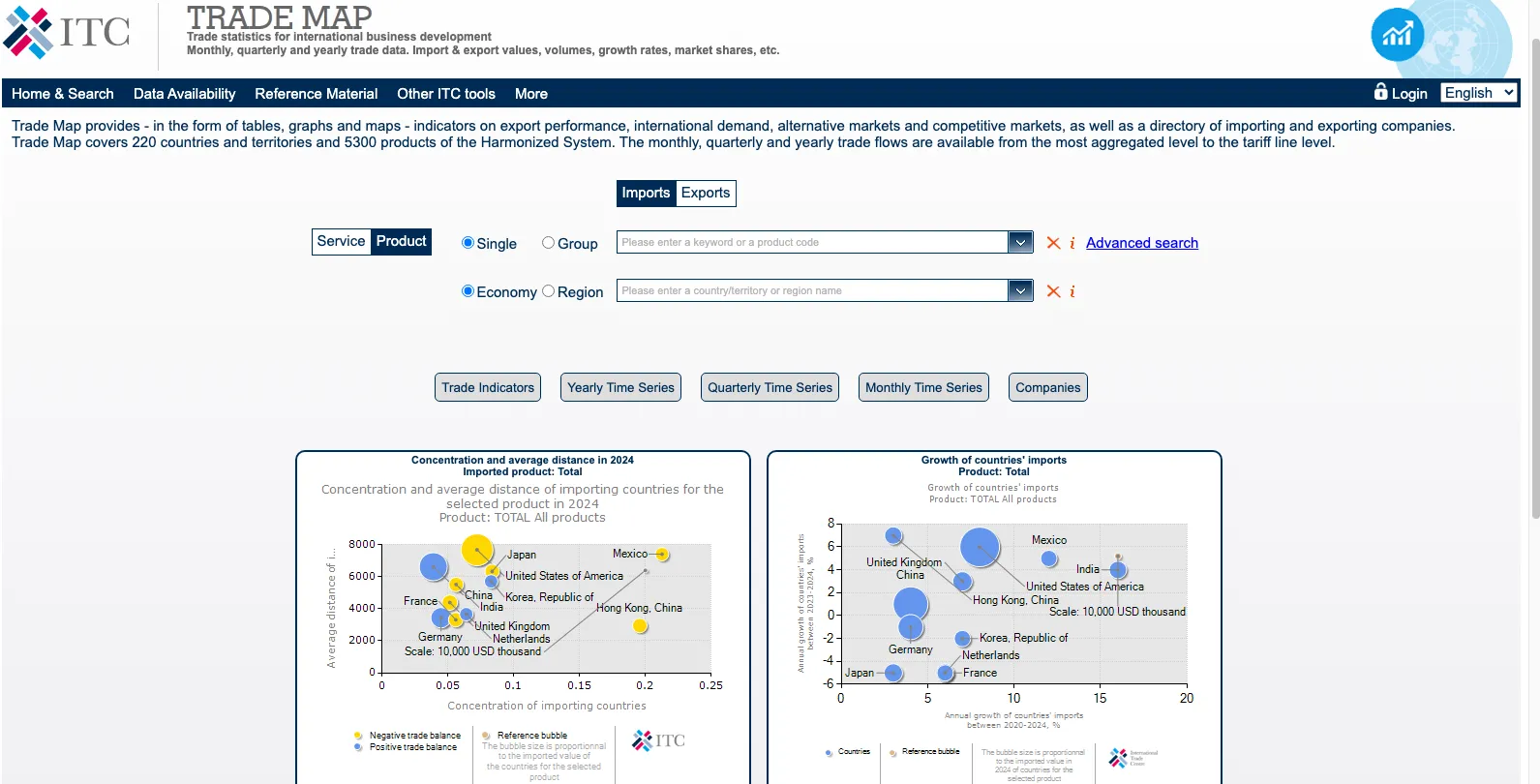
ITC Trade Map (trademap.org) — a free tool that shows which countries import your product, at what volumes, and the key supplying countries competing with you: International Trade Fairs — Where Deals Are Made in Person
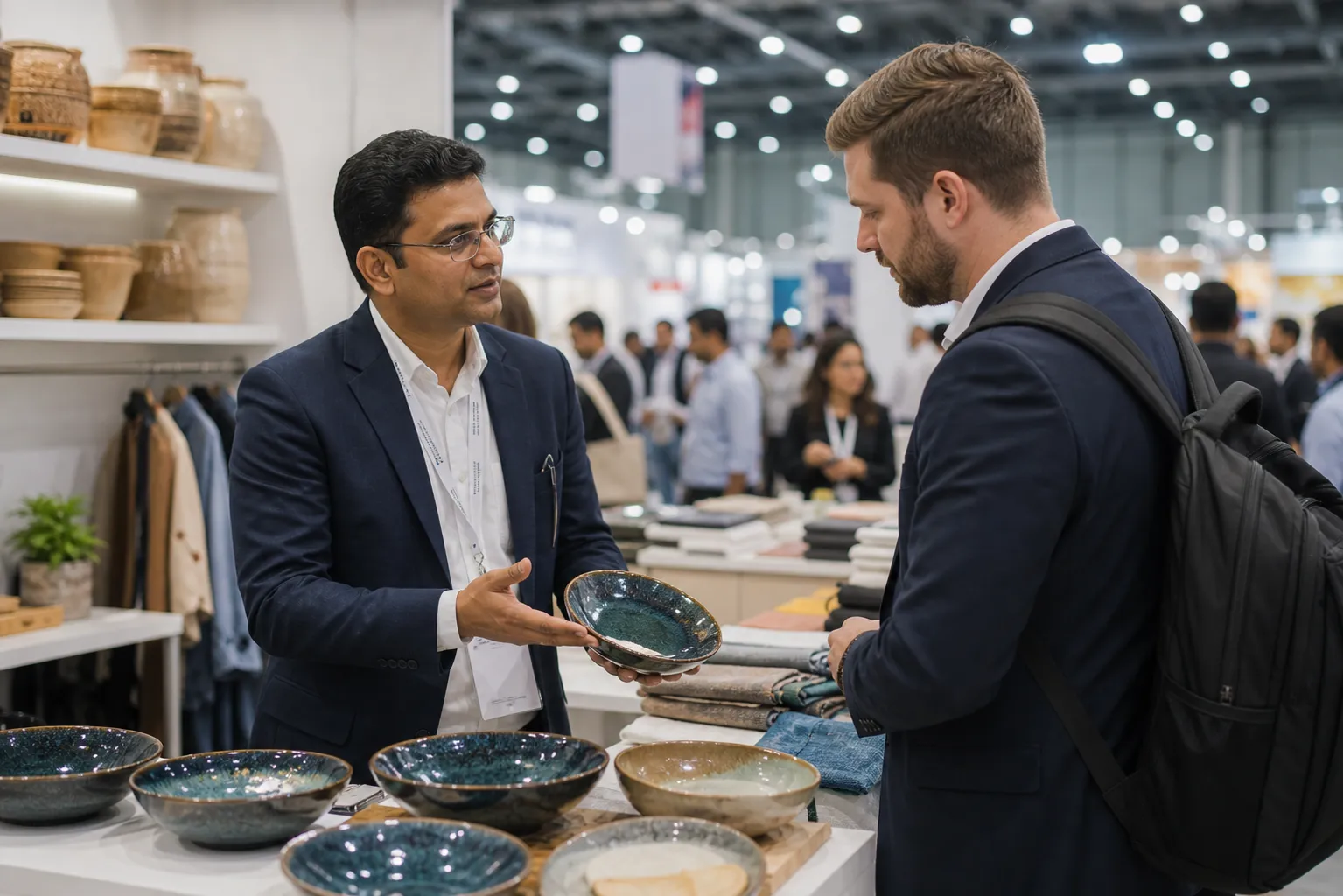
Nothing converts a prospect into a buyer faster than a face-to-face meeting at a well-attended trade fair. The combination of physical product samples, personal interaction, and the concentrated presence of serious buyers creates a deal-making environment that no digital channel can replicate.
The top trade fairs relevant to Indian exporters by sector:
Hannover Messe: Industrial machinery and engineering — Hannover
MEDICA / Arab Health: Medical devices and pharma — Düsseldorf, Dubai
Texworld / ITMA: Textiles — Paris, different cities
Canton Fair: Multi-category — Guangzhou (India pavilion attendance is strong)
MAGIC / Première Vision: Fashion and apparel — Las Vegas, Paris
GITEX / CES: Technology — Dubai, Las Vegas
ProMat / MODEX: Industrial and logistics — Chicago
How to attend cost-effectively through government support: Apply to your EPC or FIEO for MAI (Market Access Initiative) scheme participation. The government reimburses 75–100% of eligible costs (stall rental, travel, accommodation) for MSME exporters attending government-approved fairs. The application must be made 2–3 months before the fair. This can reduce your effective cost of trade fair participation to 20–30% of the full price.
Making the most of a trade fair:
Do not sit in your stall waiting for people to come to you — walk the fair, visit relevant buyer booths, introduce yourself
Bring enough samples to leave with every serious buyer — samples they can evaluate after the fair are far more effective than brochures
Collect business cards, but more importantly take notes on each conversation — what they buy, from where, what they are looking for, their specific concerns
Follow up within 48 hours of the fair ending — while the conversation is still fresh
Method 6: Reverse Buyer-Seller Meets (BSMs)
Buyer-Seller Meets are government and EPC-organised events where foreign buyers are specifically brought to India (or Indian exporters travel to the buyer's country) to meet pre-qualified Indian suppliers in structured one-on-one sessions. Unlike trade fairs where you compete for attention with hundreds of other exhibitors, BSMs give you guaranteed face time with buyers who have already expressed interest in sourcing from India.
These are among the highest-quality leads available to Indian exporters — the buyer has made an effort to participate in the BSM specifically to find Indian suppliers. Inquire with your EPC about upcoming BSMs. APEDA regularly organises BSMs for agricultural exporters. AEPC organises them for garment exporters. FIEO and CII organise multi-category BSMs in major markets.
Preparation for a BSM is critical. Unlike a trade fair where you have hours to make an impression, a BSM typically gives you 15–30 minutes with each buyer. Have your pitch, your samples, your pricing, and your capability documentation ready in a tight, professional presentation. Practice it. Know your product's competitive positioning against the buyer's current suppliers.
Method 7: Direct Email and Cold Outreach Campaigns
Cold email, done correctly, remains one of the most scalable buyer acquisition methods. Done incorrectly, it generates spam complaints and zero responses. The difference is entirely in the quality of targeting and the quality of the message.
Building Your Target List
Sources for international importer contacts:
Import data tools (Method 4) — the best source for verified, actively buying companies
Trade directories — Kompass, Yellow Pages for specific countries
Your target country's trade associations — most associations publish member directories
Exhibitor lists from trade fairs you could not attend — trade fair websites publish exhibitor catalogues which are essentially directories of industry players
LinkedIn search as described in Method 2
Email Message Framework
Your cold outreach email should follow this structure:
Subject line: Specific and value-oriented. "Turmeric supplier from India — WHO-GMP certified, 50MT/month capacity" is far better than "Export inquiry" or "Business proposal."
Opening sentence: Personalised reference to their business. "I noticed [Company] distributes Indian spices across the Benelux region." Do not start with "Dear Sir/Madam" or "I am writing to introduce my company."
Value proposition (2–3 sentences): What you offer that is specific and potentially relevant to them. Focus on one or two things, not everything. "We manufacture organic turmeric powder (curcumin 3.5% min) with USDA NOP and EU organic certification, currently supplying three European food ingredient distributors. Our capacity is 40 MT per month year-round."
The ask (one sentence): Small, easy to say yes to. "Would it be helpful if I sent you our current specification sheet and pricing for comparison with your current supplier?"
Sign-off: Your name, title, company, phone/WhatsApp, LinkedIn profile link.
Total length: Under 150 words. Long emails are not read. Short, specific, credible emails get responses.
Follow-Up Sequence
Send Email 1 on Day 1. If no response by Day 6, send Email 2 — a brief one-line follow-up referencing the first email and adding one new piece of information ("I also wanted to mention we have stocks available for immediate shipment"). If no response by Day 14, send Email 3 — either a final piece of value ("I am sharing our product test report in case it is useful for your quality team") or a graceful exit ("Happy to reconnect when your sourcing review comes around — I will keep your contact on file"). Then mark this contact for follow-up in 3–6 months and move on.
Method 8: Your Country's Indian Diaspora Business Networks
This is a channel that is completely unique to Indian exporters and genuinely underexplored. The Indian diaspora — Indians and people of Indian origin living in the USA, UK, Canada, Australia, UAE, and across Southeast Africa and Southeast Asia — constitutes one of the most business-active immigrant communities in the world. Many diaspora Indian businesspeople own or manage import companies, distribution businesses, and retail chains that actively source Indian goods.
How to access this network:
GOPIO (Global Organisation of People of Indian Origin): Chapters in 50+ countries — events, business networking, member directories
IndUS Entrepreneurs (TiE): South Asian entrepreneur network with chapters in the USA, UK, and major Indian cities — strong presence in technology and food sectors
Federation of Indian Chambers of Commerce Abroad: FICCI and CII have international chapters that facilitate Indian-diaspora business connections
Local Indian Merchants Associations: In Singapore, Dubai, London, Toronto, Melbourne — these associations serve as hubs for Indian-origin business community, many of whom are in import/distribution
A diaspora Indian importer is often easier to approach than a non-Indian buyer — there is cultural familiarity, potentially shared language, and a natural affinity toward Indian products. These relationships can start warm and build to commercial quickly.
Method 9: Indian Yellow Pages Equivalent for Target Countries — National Trade Directories
Every country has national trade directories or chamber of commerce databases that list importers, distributors, and retailers by product category. These are less targeted than import data tools but are free or low-cost and can surface companies you would not find through other methods.
Useful directories by market:
USA: ThomasNet (thomasnet.com) for industrial/manufacturing buyers; ReferenceUSA via library access
Germany / EU: Wer liefert was (wlw.de); Kompass.com (covers most of Europe)
UAE / GCC: Dubai Chamber of Commerce member directory; Gulf Business Opportunities portal
UK: Kompass UK; Kellysearch
Australia: Australian Business Register; Kompass Australia
Search by product category and import/wholesale classification. Compile a list of relevant companies, then verify their actual import activity using tools like ImportYeti before investing time in outreach.
Method 10: Your Existing Network and Referrals
The most consistent finding from exporters who have built strong international buyer bases over time: their best buyers came from referrals — from satisfied buyers who mentioned them to other buyers, from logistics partners who connected them with other clients, from trade fair conversations that led to introductions.
This does not happen automatically. You have to ask. With every buyer relationship you establish, build the habit of occasionally asking: "We are expanding our export market — do you know of any other companies in your market or neighbouring markets who import this type of product and might benefit from our supply?"
Beyond direct buyers:
Your freight forwarder or CHA serves many exporters in your industry — they know which overseas importers are actively looking for new Indian suppliers
Your export bank's relationship manager often has connections with importers in markets where their bank has correspondent relationships
FIEO and your EPC maintain databases of buyer inquiries and can introduce you to buyers who match your product
Trade journalists and industry publication editors in your sector know every significant player — a brief, credible introduction can lead to editorial coverage that generates inbound buyer inquiries
Combining Methods: Building a Multi-Channel Buyer Acquisition System
No single method generates enough buyer volume to build a sustainable international business on its own. The exporters I have seen grow consistently over three to five years use a portfolio approach — typically:
One strong B2B marketplace presence (Alibaba or Global Sources) for inbound volume
LinkedIn outreach as the primary targeted cold acquisition channel
Import data for building a precision target list
One or two trade fair appearances per year for face-to-face relationship building
EPC channels for government-supported lead flow
The compounding effect: a buyer who finds you on Alibaba and then sees you are active on LinkedIn and then meets you at a trade fair is significantly more likely to place a commercial order than one who found you through only one channel. Multiple touchpoints build the credibility and familiarity that converts inquiries into orders.
What to Do When You Get an Inquiry
Finding buyers is only half the work. Converting an inquiry into an order requires its own discipline:
Respond within 2 hours during business hours. The global average response time to export inquiries is 24–48 hours. A response within 2 hours signals professionalism and seriousness. It also catches the buyer while your competitor's email is still unread.
Answer the specific question asked, not your standard pitch. If the buyer asks for pricing on a specific quantity — give the pricing. Do not lead with a company profile. Do not redirect them to your catalogue. Answer what they asked, then offer additional information.
Verify the buyer before investing significant effort. Use the buyer verification methods from our guide on buyer verification — company registry check, LinkedIn verification, ImportYeti history — before investing time in detailed quotations, sample preparation, or contract drafting.
Follow up consistently. Most inquiries do not convert to orders on the first exchange. A buyer who inquired in January and went quiet may become a buyer in May when their current supplier fails a quality check. Maintain a follow-up calendar and check in with non-converting inquiries every 60–90 days with a single line: "Hope all is well — we have [new certification / new product / improved lead time] since we last spoke. Happy to share if useful."
Frequently Asked Questions
How long does it typically take to get the first international order?
For an exporter actively using three or more of the methods above, the typical timeline from starting buyer outreach to first confirmed order is 2–6 months. This range is wide because it depends heavily on your product category (pharmaceutical buyers take longer to qualify a new supplier than agricultural commodity buyers), your target market, and the strength of your value proposition. Exporters who set up Alibaba and wait passively often wait 6–12 months with poor results. Exporters who combine Alibaba with active LinkedIn outreach and import data targeting routinely get first orders within 3 months.
Should I work through an export agent or find buyers directly?
Export agents (commission-based intermediaries who represent you in a specific market) can accelerate your entry into markets where you have no relationships. The trade-off: you pay a commission (typically 3–7% of invoice value) and have less direct relationship with the end buyer. For your first exports into an unfamiliar market, working through a credible local agent while simultaneously building direct relationships is a reasonable hybrid approach. As your direct relationships develop, you can reduce agent dependency in that market.
I sent 500 emails and got 3 responses. Is email outreach dead?
A 0.6% response rate from cold email is below average but not unusual for untargeted mass outreach. The issue is almost always targeting, not the channel. Were these 500 emails sent to verified, active importers of your specific product? Were they personalised to each recipient's company? Did they reference the recipient's actual sourcing activity? Generic mass email to poorly targeted lists gets exactly those results. Targeted, personalised outreach to verified active buyers of your product should generate 5–15% response rates. Rebuild your list using import data tools and your response rate will change dramatically.
What is the best market to target for a first-time exporter?
For most Indian exporters entering export for the first time, the Middle East — particularly UAE — is the most accessible market to start with. Reasons: geographic proximity (5–10 day sea freight), large Indian diaspora that creates cultural familiarity, the India-UAE CEPA that gives zero duty access, high-volume food and consumer goods demand, and a business culture that moves relatively quickly from inquiry to order. The EU and USA are ultimately larger markets but have higher regulatory compliance demands for many product categories. Start with Middle East, build confidence and cash flow, then expand to more demanding markets.
Do I need a local distributor in every target country?
Not necessarily, but distributors significantly reduce your market entry friction in complex or relationship-dependent markets. A distributor handles local regulatory compliance, warehousing, last-mile delivery, and customer relationships in their market — you focus on production and export. The trade-off: you share margin with the distributor. For markets where direct-to-buyer sales are practical (large B2B buyers who import directly), go direct. For markets where you need local stocking and distribution reach (retail-level product placements, wide distribution in smaller markets), a distributor arrangement makes sense.
Conclusion
Finding international buyers is both a science and an art. The science is in the targeting — using import data to identify verified, active buyers, building systematic outreach sequences, tracking responses, and measuring conversion rates. The art is in the relationship — reading a buyer's specific concerns, positioning your product's strengths against their current supplier's weaknesses, and building the trust that turns a first trial order into a recurring supply relationship.
Start with two or three methods from this guide — Alibaba for inbound volume, LinkedIn for targeted outreach, and import data for precision targeting are a strong foundation trio. Add trade fair participation when budget allows. Keep your EPC channels active. Build referral habits into every buyer relationship you establish.
The single most important variable is persistence. Export buyer development is a long game. The exporters who give up after three months of modest results miss the point — most of the best buyer relationships I have were established after six months of consistent contact with someone who initially did not respond, then responded with "not right now," and then became a recurring buyer when their circumstances changed. Stay in the pipeline, stay visible, and keep delivering quality. The orders come.
Exporter and global trade professional sharing practical knowledge about international trade, export documentation, logistics, and market opportunities.
Stay Ahead in Global Trade
Get the latest export guides, trade news, and market opportunities delivered to your inbox.